

Ch. 7 - Transcendental Functions
Hass - Thomas' Calculus 15th Edition
Hass15th EditionThomas' CalculusISBN: 9780137616077당신이 사용하는 게 아니라요?교과서 변경
7장, 문제 7.2.8

In Exercises 7–38, find the derivative of y with respect to x, t, or θ, as appropriate.
8. y = ln kx, k constant

검증된 단계별 안내
1
Identify the function given: \(y = \ln(kx)\), where \(k\) is a constant and \(x\) is the variable with respect to which we differentiate.
Recall the derivative rule for the natural logarithm function: if \(y = \ln(u)\), then \(\frac{dy}{dx} = \frac{1}{u} \cdot \frac{du}{dx}\).
Set $u = kx$. Since \(k\) is a constant, find the derivative of \(u\) with respect to \(x\): \(\frac{du}{dx} = k\).
Apply the chain rule: \(\frac{dy}{dx} = \frac{1}{kx} \cdot k\).
Simplify the expression to write the derivative in its simplest form.

비슷한 문제에 대한 검증된 영상 답변:

이 영상 해법은 위 문제에 도움이 된다고 튜터들이 추천한 것입니다.
영상 길이:
1m

주요 개념

질문에 올바르게 답하기 위해 반드시 이해해야 하는 핵심 개념들은 다음과 같습니다.

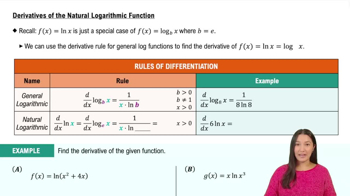
Derivative of the Natural Logarithm Function

The derivative of the natural logarithm function ln(u) with respect to its variable is 1/u times the derivative of u. This rule is essential for differentiating expressions involving ln, such as ln(kx), where the chain rule applies.
추천 영상:
05:18
Derivative of the Natural Logarithmic Function

Constant Multiple Rule

When differentiating a function multiplied by a constant, the constant can be factored out and remains unchanged. For example, in ln(kx), k is a constant multiplier inside the logarithm, affecting the differentiation through the chain rule but not changing the derivative directly.
추천 영상:
04:02
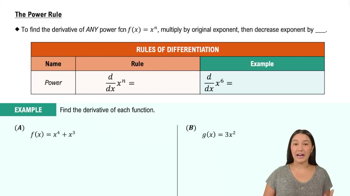
The Power Rule

Chain Rule

The chain rule is used to differentiate composite functions. For y = ln(kx), the outer function is ln(u) and the inner function is u = kx. The derivative is found by multiplying the derivative of the outer function evaluated at the inner function by the derivative of the inner function.
추천 영상:
05:02
Intro to the Chain Rule