Ch. 7 - Transcendental Functions
Hass - Thomas' Calculus 15th Edition
Hass15th EditionThomas' CalculusISBN: 9780137616077당신이 사용하는 게 아니라요?교과서 변경
7장, 문제 7.5.63

Indeterminate Powers and Products
Find the limits in Exercises 53–68.
63. lim (x → ∞) ((x + 2)/(x - 1))^x

검증된 단계별 안내
1
Identify the limit expression: \(\lim_{x \to \infty} \left( \frac{x + 2}{x - 1} \right)^x\).
Rewrite the base inside the parentheses to express it in a form that approaches 1 as \(x\) approaches infinity. For example, write \(\frac{x + 2}{x - 1} = \frac{x - 1 + 3}{x - 1} = 1 + \frac{3}{x - 1}\).
Recognize that the limit has the indeterminate form \(1^\infty\), which suggests using the exponential and logarithm transformation: rewrite the limit as \(\lim_{x \to \infty} e^{x \ln \left(1 + \frac{3}{x - 1} \right)}\).
Focus on evaluating the exponent limit: \(\lim_{x \to \infty} x \ln \left(1 + \frac{3}{x - 1} \right)\). Use the fact that \(\ln(1 + y) \approx y\) for small \(y\) to simplify the expression inside the limit.
Calculate the simplified limit of the exponent, then substitute back into the exponential function to find the overall limit.

비슷한 문제에 대한 검증된 영상 답변:

이 영상 해법은 위 문제에 도움이 된다고 튜터들이 추천한 것입니다.
영상 길이:
5m
도움이 되었나요?

주요 개념

질문에 올바르게 답하기 위해 반드시 이해해야 하는 핵심 개념들은 다음과 같습니다.

Limits at Infinity

Limits at infinity describe the behavior of a function as the input variable grows without bound. Understanding how expressions behave as x approaches infinity helps determine the end behavior of functions, which is essential for evaluating limits like ((x + 2)/(x - 1))^x as x → ∞.
추천 영상:
03:07
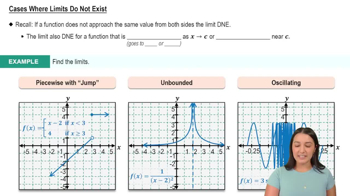
Cases Where Limits Do Not Exist

Indeterminate Forms

Indeterminate forms occur when a limit expression does not directly yield a clear value, such as 1^∞, 0/0, or ∞/∞. Recognizing these forms is crucial because they require special techniques, like logarithms or L'Hôpital's Rule, to resolve the limit properly.
추천 영상:
가이드 코스
6:20
Circles in General Form

Exponential Limits and Logarithmic Transformation

When limits involve expressions raised to variable powers, rewriting the expression using logarithms can simplify evaluation. By setting y = f(x)^g(x), taking the natural log, and then applying limit laws, one can find the limit of y by exponentiating the limit of the logarithm.
추천 영상:
가이드 코스
5:25
Intro to Transformations