Ch. 7 - Transcendental Functions
Hass - Thomas' Calculus 15th Edition
Hass15th EditionThomas' CalculusISBN: 9780137616077당신이 사용하는 게 아니라요?교과서 변경
7장, 문제 7.6.108

L’Hôpital’s Rule
Find the limits in Exercises 103–110.
108. lim(x→∞)(e^x arctan(e^x))/(e^(2x)+x)

검증된 단계별 안내
1
Identify the limit expression: \(\lim_{x \to \infty} \frac{e^{x} \arctan(e^{x})}{e^{2x} + x}\).
Check the behavior of numerator and denominator as \(x \to \infty\): \(e^{x} \to \infty\), \(\arctan(e^{x}) \to \frac{\pi}{2}\), so numerator behaves like \(\infty \cdot \frac{\pi}{2} = \infty\). Denominator \(e^{2x} + x \to \infty\). So the limit is of the form \(\frac{\infty}{\infty}\), which is an indeterminate form suitable for L’Hôpital’s Rule.
Apply L’Hôpital’s Rule by differentiating numerator and denominator separately with respect to \(x\):
Numerator derivative: Use product rule on \(e^{x} \arctan(e^{x})\):
\[\frac{d}{dx} \left(e^{x} \arctan(e^{x})\right) = e^{x} \arctan(e^{x}) + e^{x} \cdot \frac{1}{1 + (e^{x})^{2}} \cdot e^{x} = e^{x} \arctan(e^{x}) + \frac{e^{2x}}{1 + e^{2x}}.\]
Denominator derivative: \(\frac{d}{dx} (e^{2x} + x) = 2 e^{2x} + 1\).

비슷한 문제에 대한 검증된 영상 답변:

이 영상 해법은 위 문제에 도움이 된다고 튜터들이 추천한 것입니다.
영상 길이:
5m
도움이 되었나요?

주요 개념

질문에 올바르게 답하기 위해 반드시 이해해야 하는 핵심 개념들은 다음과 같습니다.

L’Hôpital’s Rule

L’Hôpital’s Rule is a method for evaluating limits that result in indeterminate forms like 0/0 or ∞/∞. It states that the limit of a ratio of functions can be found by taking the limit of the ratio of their derivatives, provided certain conditions are met. This rule simplifies complex limits involving exponential, logarithmic, or trigonometric functions.
추천 영상:
5:50
Power Rules

Behavior of Exponential and Inverse Trigonometric Functions at Infinity

Understanding how functions like e^x and arctan(e^x) behave as x approaches infinity is crucial. Exponential functions grow rapidly without bound, while arctan approaches a finite horizontal asymptote (π/2). Recognizing these behaviors helps in simplifying and evaluating limits involving these functions.
추천 영상:
06:35
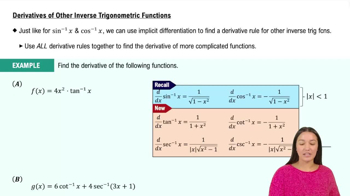
Derivatives of Other Inverse Trigonometric Functions

Dominant Terms in Limits

When evaluating limits as x approaches infinity, identifying the dominant terms in the numerator and denominator is essential. Terms with the highest growth rates determine the limit's behavior. Comparing exponential growth rates and polynomial terms helps simplify the expression before applying limit laws or L’Hôpital’s Rule.
추천 영상:
05:50
One-Sided Limits