Ch. 7 - Transcendental Functions
Hass - Thomas' Calculus 15th Edition
Hass15th EditionThomas' CalculusISBN: 9780137616077당신이 사용하는 게 아니라요?교과서 변경
7장, 문제 7.7.65

Since the hyperbolic functions can be expressed in terms of exponential functions, it is possible to express the inverse hyperbolic functions in terms of logarithms, as shown in the following table.
sinh⁻¹x = ln(x + √(x² + 1)), -∞ < x < ∞
cosh⁻¹x = ln(x + √(x² - 1)), x ≥ 1
tanh⁻¹x = (1/2)ln((1+x)/(1-x)), |x| < 1
sech⁻¹x = ln((1+√(1-x²))/x), 0 < x ≤ 1
csch⁻¹x = ln(1/x + √(1+x²)/|x|), x ≠ 1
coth⁻¹x = (1/2)ln((x+1)/(x-1)), |x| > 1
Use these formulas to express the numbers in Exercises 61–66 in terms of natural logarithms.


65. sech⁻¹(3/5)

검증된 단계별 안내
1
Identify the formula for the inverse hyperbolic secant function: \(\text{sech}^{-1} x = \ln \left( \frac{1 + \sqrt{1 - x^2}}{x} \right)\), where \(0 < x \leq 1\).
Substitute the given value \(x = \frac{3}{5}\) into the formula: \(\text{sech}^{-1} \left( \frac{3}{5} \right) = \ln \left( \frac{1 + \sqrt{1 - \left( \frac{3}{5} \right)^2}}{\frac{3}{5}} \right)\).
Simplify the expression inside the square root: calculate \(1 - \left( \frac{3}{5} \right)^2 = 1 - \frac{9}{25}\).
Take the square root of the simplified expression: \(\sqrt{1 - \left( \frac{3}{5} \right)^2} = \sqrt{\frac{16}{25}}\).
Rewrite the entire expression inside the logarithm and simplify the fraction to get the final logarithmic form without evaluating the numerical value.

비슷한 문제에 대한 검증된 영상 답변:

이 영상 해법은 위 문제에 도움이 된다고 튜터들이 추천한 것입니다.
영상 길이:
2m
도움이 되었나요?

주요 개념

질문에 올바르게 답하기 위해 반드시 이해해야 하는 핵심 개념들은 다음과 같습니다.

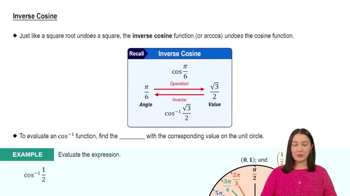
Inverse Hyperbolic Functions

Inverse hyperbolic functions undo the hyperbolic functions, similar to how inverse trigonometric functions relate to trigonometric functions. They are defined for specific domains and can be expressed using logarithmic formulas, which allow evaluation without relying on geometric interpretations.
추천 영상:
4:49
Inverse Cosine

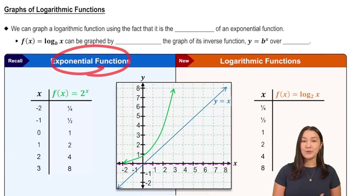
Logarithmic Expressions of Inverse Hyperbolic Functions

Each inverse hyperbolic function can be rewritten as a natural logarithm involving algebraic expressions with square roots. This transformation leverages the exponential definitions of hyperbolic functions, enabling easier computation and simplification in calculus problems.
추천 영상:
5:26
Graphs of Logarithmic Functions

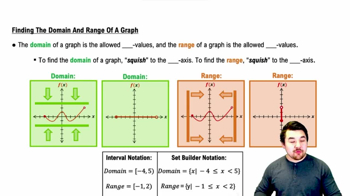
Domain Restrictions and Validity

The domain of each inverse hyperbolic function is crucial to ensure the expressions inside the logarithms and square roots are valid (e.g., non-negative under the root). Understanding these restrictions prevents errors when substituting values and ensures the expressions are mathematically sound.
추천 영상:
가이드 코스
5:10
Finding the Domain and Range of a Graph