Ch. 7 - Transcendental Functions
Hass - Thomas' Calculus 15th Edition
Hass15th EditionThomas' CalculusISBN: 9780137616077당신이 사용하는 게 아니라요?교과서 변경
7장, 문제 7.5.24

Use l’Hôpital’s rule to find the limits in Exercises 7–52.
24. lim (x → π/2) (ln(csc x)) / (x - (π/2))²

검증된 단계별 안내
1
First, identify the form of the limit as \(x\) approaches \(\frac{\pi}{2}\). Evaluate the numerator and denominator separately at \(x = \frac{\pi}{2}\) to check if it results in an indeterminate form like \(\frac{0}{0}\) or \(\frac{\infty}{\infty}\).
Rewrite the limit expression: \(\lim_{x \to \frac{\pi}{2}} \frac{\ln(\csc x)}{\left(x - \frac{\pi}{2}\right)^2}\). Note that \(\csc x = \frac{1}{\sin x}\), so \(\ln(\csc x) = \ln\left(\frac{1}{\sin x}\right) = -\ln(\sin x)\).
Since the denominator is squared, the limit is of the form \(\frac{0}{0}\) after substitution, so l’Hôpital’s Rule applies. Differentiate the numerator and denominator with respect to \(x\):
Calculate the derivative of the numerator: \(\frac{d}{dx} \left( \ln(\csc x) \right) = \frac{d}{dx} \left( -\ln(\sin x) \right) = -\frac{\cos x}{\sin x} = -\cot x\).
Calculate the derivative of the denominator: \(\frac{d}{dx} \left( x - \frac{\pi}{2} \right)^2 = 2 \left( x - \frac{\pi}{2} \right)\). Then, rewrite the limit as \(\lim_{x \to \frac{\pi}{2}} \frac{-\cot x}{2 \left( x - \frac{\pi}{2} \right)}\). If this still results in an indeterminate form, apply l’Hôpital’s Rule again by differentiating numerator and denominator once more.

비슷한 문제에 대한 검증된 영상 답변:

이 영상 해법은 위 문제에 도움이 된다고 튜터들이 추천한 것입니다.
영상 길이:
2m

주요 개념

질문에 올바르게 답하기 위해 반드시 이해해야 하는 핵심 개념들은 다음과 같습니다.

l’Hôpital’s Rule

l’Hôpital’s Rule is a method for evaluating limits that result in indeterminate forms like 0/0 or ∞/∞. It states that the limit of a ratio of functions can be found by taking the limit of the ratio of their derivatives, provided certain conditions are met. This rule simplifies complex limit problems by transforming them into easier derivative calculations.
추천 영상:
5:50
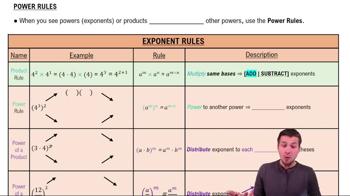
Power Rules

Behavior of Trigonometric Functions Near Specific Points

Understanding how trigonometric functions like cosecant (csc x) behave near points such as x = π/2 is crucial. Since csc x = 1/sin x, and sin(π/2) = 1, csc x is well-defined near π/2. Analyzing the limit involves knowing the continuity and differentiability of these functions around the point of interest.
추천 영상:
가이드 코스
6:04
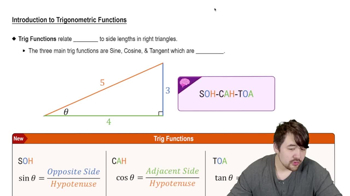
Introduction to Trigonometric Functions

Logarithmic Functions and Their Limits

The natural logarithm function, ln(x), is continuous and differentiable for x > 0. When combined with trigonometric functions inside the logarithm, it is important to ensure the argument remains positive near the limit point. Understanding how ln(csc x) behaves near π/2 helps in applying l’Hôpital’s Rule correctly.
추천 영상:
5:26
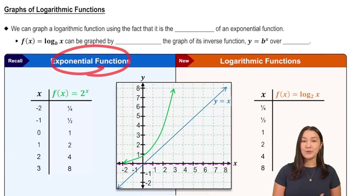
Graphs of Logarithmic Functions