Ch. 7 - Transcendental Functions
Hass - Thomas' Calculus 15th Edition
Hass15th EditionThomas' CalculusISBN: 9780137616077당신이 사용하는 게 아니라요?교과서 변경
7장, 문제 7.6.5a

Use reference triangles in an appropriate quadrant to find the angles in Exercises 1–8.
5. a. arccos(1/2)

검증된 단계별 안내
1
Recall that the function arccos(x) gives the angle \( \theta \) whose cosine is \( x \), and its principal value range is \( 0 \leq \theta \leq \pi \) (or 0 to 180 degrees).
Identify the value inside the arccos function: here it is \( \frac{1}{2} \). We want to find \( \theta \) such that \( \cos(\theta) = \frac{1}{2} \).
Use a reference triangle to determine the angle with cosine \( \frac{1}{2} \). Recall that in a right triangle, cosine is adjacent over hypotenuse, so the adjacent side is half the hypotenuse.
From common special angles, recognize that \( \cos(\frac{\pi}{3}) = \frac{1}{2} \). Since arccos returns values in the first and second quadrants, the angle is either \( \frac{\pi}{3} \) or \( \pi - \frac{\pi}{3} = \frac{2\pi}{3} \).
Conclude that the principal value of \( \arccos(\frac{1}{2}) \) is \( \frac{\pi}{3} \), and if considering the full range of cosine, the other angle in the second quadrant is \( \frac{2\pi}{3} \).

비슷한 문제에 대한 검증된 영상 답변:

이 영상 해법은 위 문제에 도움이 된다고 튜터들이 추천한 것입니다.
영상 길이:
1m
도움이 되었나요?

주요 개념

질문에 올바르게 답하기 위해 반드시 이해해야 하는 핵심 개념들은 다음과 같습니다.

Inverse Trigonometric Functions

Inverse trigonometric functions, like arccos, return the angle whose trigonometric ratio matches a given value. For arccos(1/2), it finds the angle whose cosine is 1/2, typically within the principal range of 0 to π radians (0° to 180°). Understanding their ranges is essential to identify correct angle values.
추천 영상:
06:35
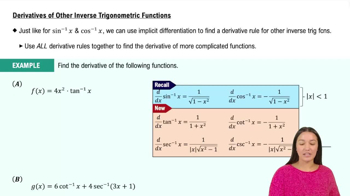
Derivatives of Other Inverse Trigonometric Functions

Reference Triangles

Reference triangles are right triangles used to relate trigonometric ratios to angles in different quadrants. By using the known side ratios, you can find the acute reference angle and then determine the actual angle based on the quadrant specified, ensuring correct angle measurement.
추천 영상:
가이드 코스
6:04
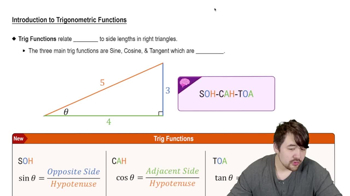
Introduction to Trigonometric Functions

Quadrants and Angle Sign Conventions

The coordinate plane is divided into four quadrants, each with specific signs for sine, cosine, and tangent. Knowing which quadrant an angle lies in helps determine the correct angle value from the reference angle, especially since cosine is positive in the first and fourth quadrants.
추천 영상:
5:30
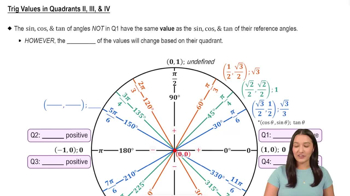
Trig Values in Quadrants II, III, & IV