Ch. 7 - Transcendental Functions
Hass - Thomas' Calculus 15th Edition
Hass15th EditionThomas' CalculusISBN: 9780137616077당신이 사용하는 게 아니라요?교과서 변경
7장, 문제 7.7.37a

Verify the integration formulas in Exercises 37–40.
37. a. ∫sech(x)dx = tan⁻¹(sinh x) + C

검증된 단계별 안내
1
Recall the definition of the hyperbolic secant function: \(\text{sech}(x) = \frac{1}{\cosh(x)}\) and the hyperbolic sine function: \(\sinh(x)\).
Set up the integral: \(\int \text{sech}(x) \, dx = \int \frac{1}{\cosh(x)} \, dx\).
Use the substitution method by letting \(u = \sinh(x)\), then compute the derivative \(\frac{du}{dx} = \cosh(x)\), which implies \(dx = \frac{du}{\cosh(x)}\).
Rewrite the integral in terms of \(u\): substituting \(dx\) and \(\text{sech}(x)\), the integral becomes \(\int \frac{1}{\cosh(x)} \cdot \frac{du}{\cosh(x)} = \int \frac{1}{\cosh^2(x)} du\).
Recognize that \(\frac{1}{\cosh^2(x)} = \text{sech}^2(x)\) and recall that \(\frac{d}{dx} \tanh(x) = \text{sech}^2(x)\), so the integral simplifies to \(\int \text{sech}(x) \, dx = \tan^{-1}(\sinh(x)) + C\) after back-substitution and using the inverse tangent relationship.

비슷한 문제에 대한 검증된 영상 답변:

이 영상 해법은 위 문제에 도움이 된다고 튜터들이 추천한 것입니다.
영상 길이:
7m
도움이 되었나요?

주요 개념

질문에 올바르게 답하기 위해 반드시 이해해야 하는 핵심 개념들은 다음과 같습니다.

Hyperbolic Functions

Hyperbolic functions like sinh(x) and sech(x) are analogs of trigonometric functions but based on exponential functions. Understanding their definitions and properties, such as sech(x) = 1/cosh(x), is essential for manipulating and integrating expressions involving them.
추천 영상:
가이드 코스
5:50
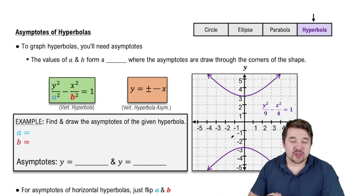
Asymptotes of Hyperbolas

Integration Techniques for Hyperbolic Functions

Integrating hyperbolic functions often involves substitution or recognizing derivatives of related functions. For example, knowing that the derivative of tan⁻¹(sinh x) relates to sech(x) helps verify the integral formula by differentiation.
추천 영상:
가이드 코스
5:50
Asymptotes of Hyperbolas

Inverse Trigonometric Functions and Their Derivatives

Inverse trigonometric functions like tan⁻¹(u) have specific derivative formulas, such as d/dx [tan⁻¹(u)] = u' / (1 + u²). Applying this to u = sinh x allows verification of the integral by differentiating the proposed antiderivative.
추천 영상:
06:35
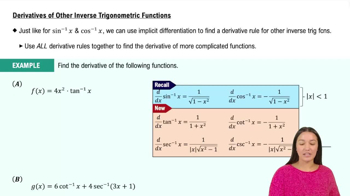
Derivatives of Other Inverse Trigonometric Functions