

Ch. 8 - Techniques of Integration
Hass - Thomas' Calculus 15th Edition
Hass15th EditionThomas' CalculusISBN: 9780137616077당신이 사용하는 게 아니라요?교과서 변경
8장, 문제 8.AAE.7

Evaluate the limits in Exercise 7 and 8.
lim (x → ∞) ∫₋ˣ^ˣ sin t dt

검증된 단계별 안내
1
Recognize that the problem asks for the limit as \(x\) approaches infinity of the integral \(\int_{-x}^{x} \sin t \, dt\).
Recall the Fundamental Theorem of Calculus, which tells us how to evaluate definite integrals using antiderivatives.
Find the antiderivative of \(\sin t\), which is \(-\cos t\).
Evaluate the definite integral \(\int_{-x}^{x} \sin t \, dt\) by computing \([-\cos t]_{-x}^{x} = -\cos x - (-\cos(-x))\).
Use the fact that cosine is an even function, so \(\cos(-x) = \cos x\), and simplify the expression before taking the limit as \(x \to \infty\).

비슷한 문제에 대한 검증된 영상 답변:

이 영상 해법은 위 문제에 도움이 된다고 튜터들이 추천한 것입니다.
영상 길이:
2m
도움이 되었나요?

주요 개념

질문에 올바르게 답하기 위해 반드시 이해해야 하는 핵심 개념들은 다음과 같습니다.

Definite Integral and its Geometric Interpretation

A definite integral represents the net area under a curve between two limits. In this problem, the integral of sin(t) from -x to x measures the accumulated area under the sine curve over a symmetric interval, which is essential for understanding how the integral behaves as x approaches infinity.
추천 영상:
05:43
Definition of the Definite Integral

Limit of a Function as x Approaches Infinity

The limit as x approaches infinity examines the behavior of a function or expression when x grows without bound. Here, evaluating lim (x → ∞) ∫₋ˣ^ˣ sin t dt requires understanding how the integral changes as the interval expands indefinitely.
추천 영상:
06:11
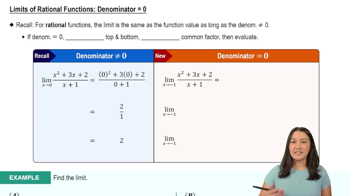
Limits of Rational Functions: Denominator = 0

Properties of the Sine Function and its Integral

The sine function is periodic and oscillates between -1 and 1. Its integral over symmetric intervals often cancels out due to its odd symmetry, which is crucial for evaluating the limit of the integral from -x to x as x tends to infinity.
추천 영상:
06:21
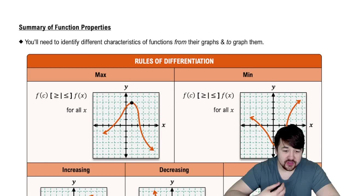
Properties of Functions