Ch. 8 - Techniques of Integration
Hass - Thomas' Calculus 15th Edition
Hass15th EditionThomas' CalculusISBN: 9780137616077당신이 사용하는 게 아니라요?교과서 변경
8장, 문제 8.2.57b

Finding area
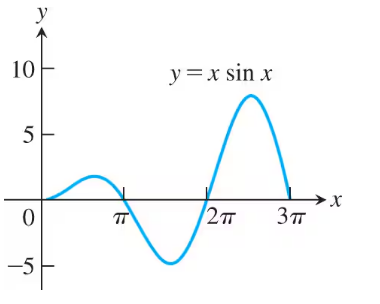
Find the area of the region enclosed by the curve y = x sin(x) and the x-axis (see the accompanying figure) for:
b. π ≤ x ≤ 2π.
Graph of y = x sin(x) from 0 to 3π showing curve crossing x-axis at π and 2π with labeled axes.

검증된 단계별 안내
1
Identify the region whose area is to be found: the curve is given by \(y = x \sin x\) and the interval is \(\pi \leq x \leq 2\pi\). From the graph, note that the curve lies below the x-axis in this interval, so the function values are negative.
Set up the integral for the area between the curve and the x-axis. Since the curve is below the x-axis, the area is given by the integral of the negative of the function: \(\text{Area} = \int_{\pi}^{2\pi} -x \sin x \, dx\).
Use integration by parts to evaluate the integral \(\int x \sin x \, dx\). Let \(u = x\) and \(dv = \sin x \, dx\), then $du = dx$ and \(v = -\cos x\). Applying integration by parts formula: \(\int u \, dv = uv - \int v \, du\).
Substitute back into the definite integral and evaluate the resulting expression at the limits \(x = \pi\) and \(x = 2\pi\).
Take the absolute value of the result if necessary to ensure the area is positive, as area cannot be negative.

비슷한 문제에 대한 검증된 영상 답변:

이 영상 해법은 위 문제에 도움이 된다고 튜터들이 추천한 것입니다.
영상 길이:
7m

주요 개념

질문에 올바르게 답하기 위해 반드시 이해해야 하는 핵심 개념들은 다음과 같습니다.

Definite Integral for Area Calculation

The definite integral of a function over an interval gives the net area between the curve and the x-axis. When the function dips below the x-axis, the integral yields a negative value, so the absolute value or splitting the integral at zeros is necessary to find the total enclosed area.
추천 영상:
가이드 코스
05:43
Definition of the Definite Integral

Behavior of the Function y = x sin(x)

The function y = x sin(x) oscillates with increasing amplitude as x increases. It crosses the x-axis at multiples of π, creating regions above and below the axis. Understanding where the function is positive or negative helps determine how to set up the integral for area.
추천 영상:
03:39
Integrals of Natural Exponential Functions (e^x)

Splitting the Integral at Zeros of the Function

To find the area between the curve and the x-axis over an interval where the function changes sign, split the integral at points where y = 0. Calculate the integral over each subinterval and take the absolute value of each to sum the total area.
추천 영상:
05:11
Integrals of General Exponential Functions
관련 실천
교과서 질문

Lifetime of a tire Assume the random variable L in Example 2f is normally distributed with mean μ = 22,000 miles and σ = 4,000 miles.

a. In a batch of 4000 tires, how many can be expected to last for at least 18,000 miles?

20
views

교과서 질문

In Exercises 11–22, estimate the minimum number of subintervals needed to approximate the integrals with an error of magnitude less than 10^-4 by (b) Simpson’s Rule. (The integrals in Exercises 11–18 are the integrals from Exercises 1–8.)

∫ from 0 to 2 of sin(x + 1) dx

25
views
교과서 질문

90. Consider the infinite region in the first quadrant bounded by the graphs of

y = 1 / √x, y = 0, x = 0, and x = 1.

b. Find the volume of the solid formed by revolving the region (i) about the x-axis

31
views
교과서 질문

Finding volume: Find the volume of the solid generated by revolving the region in the first quadrant bounded by the coordinate axes and the curve y = cos(x), 0 ≤ x ≤ π/2, about

b. The line x = π/2.

60
views
교과서 질문

In Exercises 11–22, estimate the minimum number of subintervals needed to approximate the integrals with an error of magnitude less than 10^-4 by (b) Simpson’s Rule. (The integrals in Exercises 11–18 are the integrals from Exercises 1–8.)

∫ from 0 to 3 of 1/√(x + 1) dx

25
views
교과서 질문

In Exercises 11–22, estimate the minimum number of subintervals needed to approximate the integrals with an error of magnitude less than 10^-4 by (b) Simpson’s Rule. (The integrals in Exercises 11–18 are the integrals from Exercises 1–8.)

∫ from -1 to 1 of (x² + 1) dx

29
views