Ch. 8 - Techniques of Integration
Hass - Thomas' Calculus 15th Edition
Hass15th EditionThomas' CalculusISBN: 9780137616077당신이 사용하는 게 아니라요?교과서 변경
8장, 문제 8.2.59

Finding volume: Find the volume of the solid generated by revolving the region in the first quadrant bounded by the coordinate axes, the curve y = e^x, and the line x = ln(2) about the line x = ln(2).

검증된 단계별 안내
1
Identify the region to be revolved: it is bounded by the coordinate axes (x=0 and y=0), the curve \(y = e^{x}\), and the vertical line \(x = \ln(2)\), all in the first quadrant.
Since the solid is generated by revolving the region about the vertical line \(x = \ln(2)\), consider using the method of cylindrical shells, which is well-suited for rotation around vertical lines.
Set up the volume integral using the shell method. For a typical shell at position \(x\) (where \(0 \leq x \leq \ln(2)\)), the radius of the shell is the horizontal distance from \(x\) to the axis of rotation: \(r = \ln(2) - x\).
The height of the shell is given by the function value at \(x\), which is \(h = e^{x}\). The thickness of the shell is \(dx\).
Write the volume integral as \(V = \int_{0}^{\ln(2)} 2\pi \times (\text{radius}) \times (\text{height}) \, dx = \int_{0}^{\ln(2)} 2\pi (\ln(2) - x) e^{x} \, dx\). This integral can then be evaluated to find the volume.

비슷한 문제에 대한 검증된 영상 답변:

이 영상 해법은 위 문제에 도움이 된다고 튜터들이 추천한 것입니다.
영상 길이:
12m
도움이 되었나요?

주요 개념

질문에 올바르게 답하기 위해 반드시 이해해야 하는 핵심 개념들은 다음과 같습니다.

Volume of Solids of Revolution

This concept involves finding the volume of a 3D solid formed by rotating a 2D region around a given axis. Common methods include the disk/washer and shell methods, which use integration to sum infinitesimal volumes. Understanding the shape and axis of rotation is crucial to choosing the appropriate method.
추천 영상:
04:48
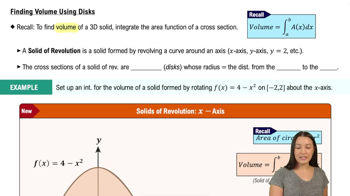
Finding Volume Using Disks

Shell Method

The shell method calculates volume by integrating cylindrical shells formed by revolving vertical or horizontal slices around an axis. Each shell's volume is approximated by circumference × height × thickness. This method is especially useful when the axis of rotation is parallel to the slices and simplifies integration.
추천 영상:
07:33
Euler's Method

Natural Logarithm and Exponential Functions

The problem involves the curve y = e^x and the line x = ln(2). Understanding the properties of exponential and logarithmic functions, including their inverses and domains, helps in setting integration limits and expressing the region accurately for volume calculation.
추천 영상:
05:18
Derivative of the Natural Logarithmic Function