
Ch. 8 - Techniques of Integration
Hass - Thomas' Calculus 15th Edition
Hass15th EditionThomas' CalculusISBN: 9780137616077당신이 사용하는 게 아니라요?교과서 변경
8장, 문제 8.2.60a

Finding volume: Find the volume of the solid generated by revolving the region in the first quadrant bounded by the coordinate axes, the curve y = e^(-x), and the line x = 1.
a. About the y-axis.

검증된 단계별 안내
1
Identify the region to be revolved: it is bounded by the x-axis (y=0), y-axis (x=0), the curve \(y = e^{-x}\), and the vertical line \(x = 1\) in the first quadrant.
Since the solid is generated by revolving the region about the y-axis, consider using the method of cylindrical shells. The formula for the volume using shells is \(V = \int_a^b 2\pi \cdot (\text{radius}) \cdot (\text{height}) \, dx\).
Determine the radius and height of a typical shell: the radius is the distance from the y-axis, which is \(x\), and the height is the value of the function \(y = e^{-x}\).
Set up the integral for the volume: \(V = \int_0^1 2\pi x e^{-x} \, dx\).
Evaluate the integral using integration by parts or an appropriate method to find the volume (do not compute the final value here).

비슷한 문제에 대한 검증된 영상 답변:

이 영상 해법은 위 문제에 도움이 된다고 튜터들이 추천한 것입니다.
영상 길이:
10m
도움이 되었나요?

주요 개념

질문에 올바르게 답하기 위해 반드시 이해해야 하는 핵심 개념들은 다음과 같습니다.

Volume of Solids of Revolution

This concept involves finding the volume of a 3D solid formed by rotating a 2D region around an axis. The volume can be computed using integral methods such as the disk/washer or shell method, depending on the axis of rotation and the shape of the region.
추천 영상:
04:48
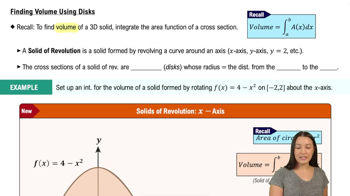
Finding Volume Using Disks

Shell Method

The shell method calculates volume by integrating cylindrical shells formed by revolving vertical slices around a vertical axis. It is especially useful when rotating around the y-axis and when the function is given in terms of x, simplifying the integral setup.
추천 영상:
07:33
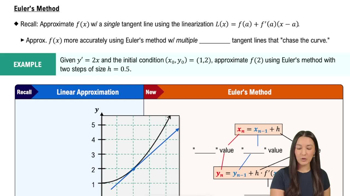
Euler's Method

Exponential Functions and Their Properties

Understanding the behavior of the function y = e^(-x) is crucial, as it defines the boundary of the region. Knowing its decay and how to integrate expressions involving e^(-x) helps in setting up and evaluating the integral for volume.
추천 영상:
가이드 코스
06:21
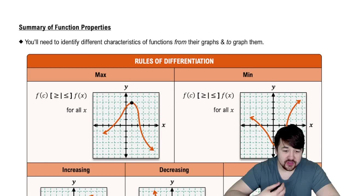
Properties of Functions
관련 실천
교과서 질문

In Exercises 11–22, estimate the minimum number of subintervals needed to approximate the integrals with an error of magnitude less than 10^-4 by (a) the Trapezoidal Rule (The integrals in Exercises 11–18 are the integrals from Exercises 1–8.)

∫ from 2 to 4 of 1/(s - 1)² ds

30
views
교과서 질문

In Exercises 11–22, estimate the minimum number of subintervals needed to approximate the integrals with an error of magnitude less than 10^-4 by (a) the Trapezoidal Rule (The integrals in Exercises 11–18 are the integrals from Exercises 1–8.)

∫ from 1 to 3 of (2x - 1) dx

27
views
교과서 질문

In Exercises 11–22, estimate the minimum number of subintervals needed to approximate the integrals with an error of magnitude less than 10^-4 by (a) the Trapezoidal Rule (The integrals in Exercises 11–18 are the integrals from Exercises 1–8.)

∫ from -1 to 1 of (t³ + 1) dt

30
views
교과서 질문

In Exercises 11–22, estimate the minimum number of subintervals needed to approximate the integrals with an error of magnitude less than 10^-4 by (a) the Trapezoidal Rule (The integrals in Exercises 11–18 are the integrals from Exercises 1–8.)

∫ from -2 to 0 of (x² - 1) dx

30
views
교과서 질문

Finding area

Find the area of the region enclosed by the curve y = x cos(x) and the x-axis (see the accompanying figure) for:

a. π/2 ≤ x ≤ 3π/2.

58
views
교과서 질문

Finding volume: Find the volume of the solid generated by revolving the region bounded by the x-axis and the curve y = x sin(x), 0 ≤ x ≤ π, about

a. The y-axis.

(See Exercise 57 for a graph.)

52
views