Ch. 8 - Techniques of Integration
Hass - Thomas' Calculus 15th Edition
Hass15th EditionThomas' CalculusISBN: 9780137616077당신이 사용하는 게 아니라요?교과서 변경
8장, 문제 8.8.54

In Exercises 35–68, use integration, the Direct Comparison Test, or the Limit Comparison Test to test the integrals for convergence. If more than one method applies, use whatever method you prefer.
∫ from 0 to ∞ of (dθ / (1 + e^θ))

검증된 단계별 안내
1
Identify the integral to be tested for convergence: \(\displaystyle \int_0^{\infty} \frac{d\theta}{1 + e^{\theta}}\).
Examine the behavior of the integrand \(f(\theta) = \frac{1}{1 + e^{\theta}}\) as \(\theta \to \infty\) and as \(\theta \to 0\) to understand the nature of the integral over the interval \([0, \infty)\).
For large \(\theta\), note that \(e^{\theta}\) grows very quickly, so \(f(\theta)\) behaves like \(\frac{1}{e^{\theta}} = e^{-\theta}\). This suggests comparing the integrand to \(g(\theta) = e^{-\theta}\), a function with a known convergent integral over \([0, \infty)\).
Apply the Direct Comparison Test by checking if \(0 \leq f(\theta) \leq g(\theta)\) for sufficiently large \(\theta\). Since \(\frac{1}{1 + e^{\theta}} < \frac{1}{e^{\theta}}\) for \(\theta > 0\), the integral of \(f(\theta)\) is bounded above by the integral of \(g(\theta)\), which converges.
Conclude that since \(\int_0^{\infty} e^{-\theta} d\theta\) converges and \(f(\theta)\) is less than or equal to \(g(\theta)\) for large \(\theta\), by the Direct Comparison Test, the original integral \(\int_0^{\infty} \frac{d\theta}{1 + e^{\theta}}\) also converges.

비슷한 문제에 대한 검증된 영상 답변:

이 영상 해법은 위 문제에 도움이 된다고 튜터들이 추천한 것입니다.
영상 길이:
5m
도움이 되었나요?

주요 개념

질문에 올바르게 답하기 위해 반드시 이해해야 하는 핵심 개념들은 다음과 같습니다.

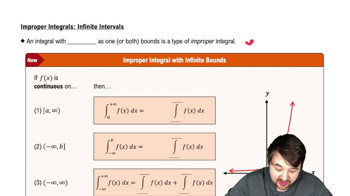
Improper Integrals

Improper integrals involve integration over an infinite interval or integrands with infinite discontinuities. To evaluate convergence, we consider limits of definite integrals as the bounds approach infinity or points of discontinuity. Understanding this helps determine if the integral converges to a finite value or diverges.
추천 영상:
11:11
Improper Integrals: Infinite Intervals

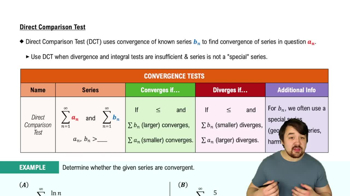
Direct Comparison Test

The Direct Comparison Test compares the given integral's integrand to a simpler function whose convergence behavior is known. If the integrand is less than or equal to a convergent function, the integral converges; if it is greater than or equal to a divergent function, it diverges. This test requires finding appropriate bounding functions.
추천 영상:
09:25
Direct Comparison Test

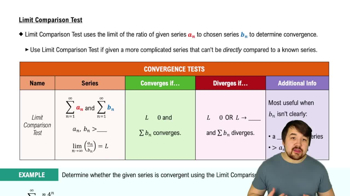
Limit Comparison Test

The Limit Comparison Test uses the limit of the ratio of two functions as the variable approaches infinity. If the limit is a positive finite number, both integrals either converge or diverge together. This test is useful when direct comparison is difficult but the integrand behaves similarly to a known function at infinity.
추천 영상:
07:45
Limit Comparison Test