Ch. 8 - Techniques of Integration
Hass - Thomas' Calculus 15th Edition
Hass15th EditionThomas' CalculusISBN: 9780137616077당신이 사용하는 게 아니라요?교과서 변경
8장, 문제 8.8.24

The integrals in Exercises 1–34 converge. Evaluate the integrals without using tables.
∫₋∞^∞ 2x e^(−x²) dx

검증된 단계별 안내
1
Recognize that the integral is an improper integral over the entire real line, from \(-\infty\) to \(\infty\), of the function \(2x e^{-x^{2}}\).
Note that the integrand \(2x e^{-x^{2}}\) is an odd function because \(2(-x) e^{-(-x)^{2}} = -2x e^{-x^{2}}\), which is the negative of the original function.
Recall that the integral of any odd function over symmetric limits \([-a, a]\) is zero, provided the integral converges.
Since the limits are \(-\infty\) to \(\infty\), which are symmetric about zero, and the function is odd and integrable, the integral evaluates to zero.
Therefore, without performing any integration by parts or substitution, conclude that the value of the integral is zero due to the symmetry of the integrand.

비슷한 문제에 대한 검증된 영상 답변:

이 영상 해법은 위 문제에 도움이 된다고 튜터들이 추천한 것입니다.
영상 길이:
7m
도움이 되었나요?

주요 개념

질문에 올바르게 답하기 위해 반드시 이해해야 하는 핵심 개념들은 다음과 같습니다.

Improper Integrals

Improper integrals involve integration over infinite limits or integrands with infinite discontinuities. To evaluate them, one typically takes limits of definite integrals as the bounds approach infinity. Understanding convergence is crucial to ensure the integral has a finite value.
추천 영상:
11:11
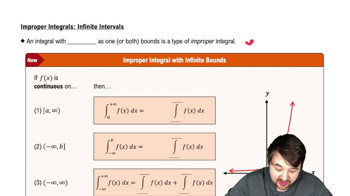
Improper Integrals: Infinite Intervals

Properties of Even and Odd Functions

Even functions satisfy f(−x) = f(x), and odd functions satisfy f(−x) = −f(x). When integrating over symmetric limits (−a to a), the integral of an odd function is zero, while the integral of an even function is twice the integral from 0 to a. Recognizing function symmetry simplifies evaluation.
추천 영상:
06:21
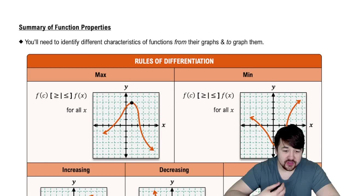
Properties of Functions

Integration of Exponential Functions with Quadratic Exponents

Integrals involving e^(−x²) are common in calculus and probability. While the integral of e^(−x²) has no elementary antiderivative, multiplying by x or other polynomials can allow evaluation using substitution or recognizing derivative forms. This helps in solving integrals like ∫ x e^(−x²) dx.
추천 영상:
05:11
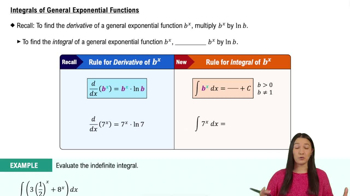
Integrals of General Exponential Functions