Ch. 8 - Techniques of Integration
Hass - Thomas' Calculus 15th Edition
Hass15th EditionThomas' CalculusISBN: 9780137616077당신이 사용하는 게 아니라요?교과서 변경
8장, 문제 8.8.26

The integrals in Exercises 1–34 converge. Evaluate the integrals without using tables.
∫₀¹ (−ln(x)) dx

검증된 단계별 안내
1
Recognize that the integral is \( \int_0^1 (-\ln(x)) \, dx \). Since the integrand is \( -\ln(x) \), rewrite the integral as \( - \int_0^1 \ln(x) \, dx \) to simplify the process.
Recall that the integral of \( \ln(x) \) can be found using integration by parts. Set \( u = \ln(x) \) and \( dv = dx \). Then, compute \( du = \frac{1}{x} dx \) and \( v = x \).
Apply the integration by parts formula: \( \int u \, dv = uv - \int v \, du \). Substitute the values to get \( \int \ln(x) \, dx = x \ln(x) - \int x \cdot \frac{1}{x} \, dx = x \ln(x) - \int 1 \, dx \).
Simplify the integral to \( x \ln(x) - x + C \). Now, evaluate the definite integral \( \int_0^1 \ln(x) \, dx = [x \ln(x) - x]_0^1 \).
Evaluate the limits carefully: at \( x=1 \), \( 1 \cdot \ln(1) - 1 = 0 - 1 = -1 \); at \( x=0 \), use the limit \( \lim_{x \to 0^+} x \ln(x) = 0 \), so the expression at 0 is \( 0 - 0 = 0 \). Therefore, \( \int_0^1 \ln(x) \, dx = -1 \). Finally, multiply by \( -1 \) to get the value of the original integral.

비슷한 문제에 대한 검증된 영상 답변:

이 영상 해법은 위 문제에 도움이 된다고 튜터들이 추천한 것입니다.
영상 길이:
5m
도움이 되었나요?

주요 개념

질문에 올바르게 답하기 위해 반드시 이해해야 하는 핵심 개념들은 다음과 같습니다.

Improper Integrals and Convergence

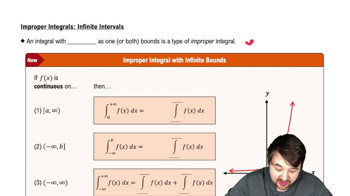
An integral is improper if the interval is infinite or the integrand is unbounded. Here, the integrand involves ln(x), which is unbounded near 0, so we consider the limit as x approaches 0 to check convergence before evaluating.
추천 영상:
11:11
Improper Integrals: Infinite Intervals

Integration by Parts

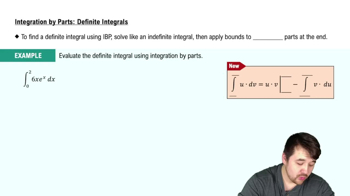
Integration by parts is a technique based on the product rule for differentiation. It transforms the integral of a product of functions into simpler integrals, often used when integrating functions like ln(x) or products involving logarithms.
추천 영상:
06:18
Integration by Parts for Definite Integrals

Properties of the Natural Logarithm Function

The natural logarithm ln(x) is defined for x > 0 and approaches negative infinity as x approaches 0 from the right. Understanding its behavior near zero is crucial for evaluating integrals involving ln(x), especially when combined with limits.
추천 영상:
06:21
Properties of Functions