
Ch. 8 - Techniques of Integration
Hass - Thomas' Calculus 15th Edition
Hass15th EditionThomas' CalculusISBN: 9780137616077당신이 사용하는 게 아니라요?교과서 변경
8장, 문제 8.1.54f

Using different substitutions
Show that the integral
∫((x² - 1)(x + 1))^(-2/3) dx
can be evaluated with any of the following substitutions.
f. u = arccos x
What is the value of the integral?

검증된 단계별 안내
1
Start with the integral \( \int ((x^{2} - 1)(x + 1))^{-\frac{2}{3}} \, dx \). First, simplify the expression inside the integral. Notice that \( x^{2} - 1 = (x - 1)(x + 1) \), so the integrand becomes \( ((x - 1)(x + 1)(x + 1))^{-\frac{2}{3}} = ((x - 1)(x + 1)^{2})^{-\frac{2}{3}} \).
Rewrite the integrand as \( (x - 1)^{-\frac{2}{3}} (x + 1)^{-\frac{4}{3}} \) by distributing the exponent \( -\frac{2}{3} \) to each factor.
Use the substitution \( u = \arccos x \). Then, \( x = \cos u \) and \( dx = -\sin u \, du \). This substitution is useful because it relates \( x \) to trigonometric functions, which can simplify expressions involving \( x^{2} - 1 \).
Express the factors \( x - 1 \) and \( x + 1 \) in terms of \( u \): \( x - 1 = \cos u - 1 \) and \( x + 1 = \cos u + 1 \). Also, note that \( \sin^{2} u = 1 - \cos^{2} u \), which can help simplify the expression further.
Rewrite the integral entirely in terms of \( u \) and \( du \), substituting \( x \), \( dx \), and the factors \( x - 1 \), \( x + 1 \). Then simplify the resulting integral, which should be easier to evaluate using standard trigonometric integral techniques.

비슷한 문제에 대한 검증된 영상 답변:

이 영상 해법은 위 문제에 도움이 된다고 튜터들이 추천한 것입니다.
영상 길이:
3m
도움이 되었나요?

주요 개념

질문에 올바르게 답하기 위해 반드시 이해해야 하는 핵심 개념들은 다음과 같습니다.

Trigonometric Substitution

Trigonometric substitution is a technique used to simplify integrals involving algebraic expressions by substituting a trigonometric function for a variable. For example, substituting u = arccos(x) transforms expressions involving x into trigonometric forms, often making the integral easier to evaluate by leveraging trigonometric identities.
추천 영상:
가이드 코스
6:04
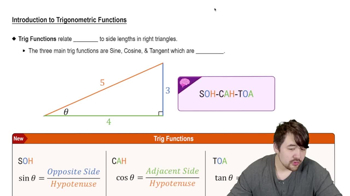
Introduction to Trigonometric Functions

Integration of Powers of Functions

Integrating expressions raised to fractional powers, such as ((x² - 1)(x + 1))^(-2/3), requires understanding how to manipulate and simplify the integrand. This often involves rewriting the expression in a more manageable form or using substitution to convert it into a standard integral form.
추천 영상:
07:32
Representing Functions as Power Series

Inverse Trigonometric Functions and Their Derivatives

Inverse trigonometric functions like arccos(x) have specific derivatives that are essential when performing substitution in integrals. Knowing that d/dx[arccos(x)] = -1/√(1 - x²) helps in changing variables and adjusting the differential dx accordingly during integration.
추천 영상:
06:35
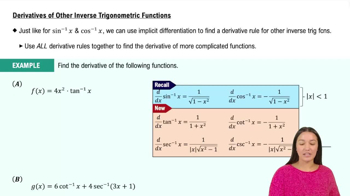
Derivatives of Other Inverse Trigonometric Functions
관련 실천
교과서 질문

The instructions for the integrals in Exercises 1–10 have three parts, one for the Midpoint Rule, one for the Trapezoidal Rule, and one for Simpson’s Rule.

II. Using the Trapezoidal Rule

b. Evaluate the integral directly and find |ET|.

∫ from 0 to 2 of (t³ + t) dt

18
views
교과서 질문

The instructions for the integrals in Exercises 1–10 have three parts, one for the Midpoint Rule, one for the Trapezoidal Rule, and one for Simpson’s Rule.

III. Using Simpson's Rule

a. Estimate the integral with n = 4 steps and find an upper bound for |ES|.

∫ from 1 to 3 of (2x - 1) dx

21
views
교과서 질문

The instructions for the integrals in Exercises 1–10 have three parts, one for the Midpoint Rule, one for the Trapezoidal Rule, and one for Simpson’s Rule.

III. Using Simpson's Rule

a. Estimate the integral with n = 4 steps and find an upper bound for |ES|.

∫ from 0 to π of sin(t) dt

20
views
교과서 질문

Using different substitutions

Show that the integral

∫((x² - 1)(x + 1))^(-2/3) dx

can be evaluated with any of the following substitutions.

e. u = tan^(-1) ((x - 1)/2)

What is the value of the integral?

7
views
교과서 질문

The instructions for the integrals in Exercises 1–10 have three parts, one for the Midpoint Rule, one for the Trapezoidal Rule, and one for Simpson’s Rule.

III. Using Simpson's Rule

a. Estimate the integral with n = 4 steps and find an upper bound for |ES|.

∫ from 1 to 2 of x dx

20
views
교과서 질문

The instructions for the integrals in Exercises 1–10 have three parts, one for the Midpoint Rule, one for the Trapezoidal Rule, and one for Simpson’s Rule.

II. Using the Trapezoidal Rule

b. Evaluate the integral directly and find |ET|.

∫ from 1 to 3 of (2x - 1) dx

23
views