Ch. 9 - First-Order Differential Equations
Hass - Thomas' Calculus 15th Edition
Hass15th EditionThomas' CalculusISBN: 9780137616077당신이 사용하는 게 아니라요?교과서 변경
9장, 문제 9.2.14

First-Order Linear Equations
Solve the differential equations in Exercises 1–14.


tan θ dr/dθ + r = sin²θ, 0 < θ < π/2

검증된 단계별 안내
1
Rewrite the given differential equation in the standard linear form. The original equation is \(\tan \theta \frac{dr}{d\theta} + r = \sin^{2} \theta\). Divide both sides by \(\tan \theta\) to isolate \(\frac{dr}{d\theta}\), resulting in \(\frac{dr}{d\theta} + \frac{r}{\tan \theta} = \frac{\sin^{2} \theta}{\tan \theta}\).
Identify the integrating factor (IF) for the linear differential equation \(\frac{dr}{d\theta} + P(\theta) r = Q(\theta)\), where \(P(\theta) = \frac{1}{\tan \theta}\). The integrating factor is given by \(\mu(\theta) = e^{\int P(\theta) d\theta}\).
Calculate the integral \(\int \frac{1}{\tan \theta} d\theta\). Recall that \(\frac{1}{\tan \theta} = \cot \theta\), so the integral becomes \(\int \cot \theta d\theta\). Use the known integral formula for \(\cot \theta\).
Multiply the entire differential equation by the integrating factor \(\mu(\theta)\) to write the left side as the derivative of the product \(\mu(\theta) r\). This transforms the equation into \(\frac{d}{d\theta} [\mu(\theta) r] = \mu(\theta) Q(\theta)\).
Integrate both sides with respect to \(\theta\) to find \(\mu(\theta) r = \int \mu(\theta) Q(\theta) d\theta + C\). Finally, solve for \(r(\theta)\) by dividing both sides by \(\mu(\theta)\).

비슷한 문제에 대한 검증된 영상 답변:

이 영상 해법은 위 문제에 도움이 된다고 튜터들이 추천한 것입니다.
영상 길이:
2m
도움이 되었나요?

주요 개념

질문에 올바르게 답하기 위해 반드시 이해해야 하는 핵심 개념들은 다음과 같습니다.

First-Order Linear Differential Equations

These are differential equations of the form dy/dx + P(x)y = Q(x), where the highest derivative is first order and the equation is linear in the unknown function and its derivative. Solving them typically involves finding an integrating factor to simplify the equation into an exact derivative.
추천 영상:
07:39
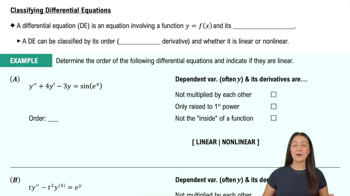
Classifying Differential Equations

Integrating Factor Method

An integrating factor is a function, usually denoted μ(x), used to multiply a linear differential equation to make the left side an exact derivative. It is found by μ(x) = e^(∫P(x)dx), enabling straightforward integration and solution of the equation.
추천 영상:
07:33
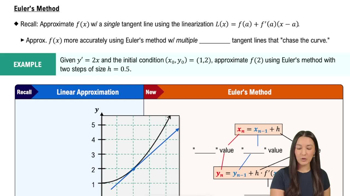
Euler's Method

Trigonometric Functions and Their Properties

Understanding the behavior and identities of trigonometric functions like tan(θ) and sin²(θ) is essential. These functions often appear in differential equations involving angular variables, and their properties help simplify and integrate terms effectively.
추천 영상:
06:21
Properties of Functions
관련 실천
교과서 질문

Use Euler’s method with dx = 0.2 to estimate y(2) if y′ = y/x and y(1) = 2. What is the exact value of y(2)?

31
views

교과서 질문

In Exercises 39–42, use Euler’s method with the specified step size to estimate the value of the solution at the given point x*. Find the value of the exact solution at x*.


y′ = √x/y, y > 0, y(0) = 1, dx = 0.1, x* = 1

38
views
교과서 질문

Carbon monoxide pollution An executive conference room of a corporation contains 4500 ft³ of air initially free of carbon monoxide. Starting at time t = 0, cigarette smoke containing 4% carbon monoxide is blown into the room at the rate of 0.3 ft³/min. A ceiling fan keeps the air in the room well circulated and the air leaves the room at the same rate of 0.3 ft³/min. Find the time when the concentration of carbon monoxide in the room reaches 0.01%.

29
views
교과서 질문

In Exercises 39–42, use Euler’s method with the specified step size to estimate the value of the solution at the given point x*. Find the value of the exact solution at x*.


y' = 2xexp(x²) , y(0) = 2, dx = 0.1, x* = 1

22
views
교과서 질문

Is either of the following equations correct? Give reasons for your answers.


a. (1/cosx) ∫ cos x dx = tan x + C

b. (1/cosx) ∫ cos x dx = tan x + C / cos x

25
views
교과서 질문

In Exercises 39–42, use Euler’s method with the specified step size to estimate the value of the solution at the given point x*. Find the value of the exact solution at x*.


y' = 1 + y², y(0) = 0, dx = 0.1, x* = 1

19
views