
Ch. 9 - First-Order Differential Equations
Hass - Thomas' Calculus 15th Edition
Hass15th EditionThomas' CalculusISBN: 9780137616077당신이 사용하는 게 아니라요?교과서 변경
9장, 문제 9.1.12

Integral Equations
In Exercises 7–12, write an equivalent first-order differential equation
and initial condition for y.


y = ln x + ∫ₓᵉ √ (t² + (y(t))²) dt

검증된 단계별 안내
1
Start with the given integral equation: \(y = \ln x + \int_{x}^{e} \sqrt{t^{2} + (y(t))^{2}} \, dt\).
Recognize that the integral has a variable lower limit \(x\) and a constant upper limit \(e\). To differentiate both sides with respect to \(x\), apply the Leibniz rule for differentiation under the integral sign.
Differentiate the right side with respect to \(x\): the derivative of \(\ln x\) is \(\frac{1}{x}\), and by the Leibniz rule, the derivative of the integral \(\int_{x}^{e} f(t) \, dt\) with respect to \(x\) is \(-f(x)\) because the lower limit is \(x\).
Set up the differential equation by differentiating both sides: \(\frac{dy}{dx} = \frac{1}{x} - \sqrt{x^{2} + (y)^{2}}\).
Use the original equation to find the initial condition by substituting \(x = e\): \(y(e) = \ln e + \int_{e}^{e} \sqrt{t^{2} + (y(t))^{2}} \, dt\), which simplifies to \(y(e) = 1\) since the integral from \(e\) to \(e\) is zero.

비슷한 문제에 대한 검증된 영상 답변:

이 영상 해법은 위 문제에 도움이 된다고 튜터들이 추천한 것입니다.
영상 길이:
2m
도움이 되었나요?

주요 개념

질문에 올바르게 답하기 위해 반드시 이해해야 하는 핵심 개념들은 다음과 같습니다.

Integral Equations and Their Relation to Differential Equations

An integral equation expresses a function in terms of an integral involving the function itself. Converting such an equation into a differential equation involves differentiating both sides to eliminate the integral, allowing the use of differential equation techniques to find solutions.
추천 영상:
07:39
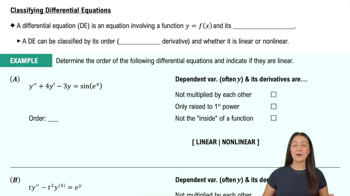
Classifying Differential Equations

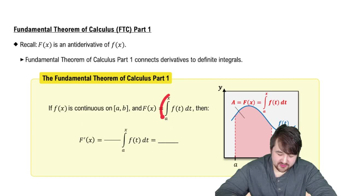
Fundamental Theorem of Calculus

This theorem connects differentiation and integration, stating that differentiation can undo integration. When differentiating an integral with a variable limit, the derivative equals the integrand evaluated at that limit, which is essential for transforming the given integral equation into a differential equation.
추천 영상:
06:11
Fundamental Theorem of Calculus Part 1

Initial Conditions in Differential Equations

Initial conditions specify the value of the unknown function at a particular point, ensuring a unique solution to a differential equation. In this problem, identifying the initial condition from the integral equation or given values is crucial for solving the resulting first-order differential equation.
추천 영상:
04:00
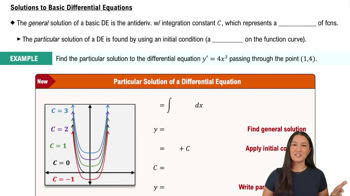
Solutions to Basic Differential Equations