Ch. 9 - First-Order Differential Equations
Hass - Thomas' Calculus 15th Edition
Hass15th EditionThomas' CalculusISBN: 9780137616077당신이 사용하는 게 아니라요?교과서 변경
9장, 문제 9.2.22a

Solve the following initial value problem for u as a function of t:


du/dt + (k/m) u = 0 (k and m positive constants), u(0) = u₀


a. as a first-order linear equation.

검증된 단계별 안내
1
Recognize that the given differential equation is a first-order linear ordinary differential equation of the form \(\frac{du}{dt} + \frac{k}{m} u = 0\), where \(k\) and \(m\) are positive constants.
Identify the integrating factor \(\mu(t)\), which is given by \(\mu(t) = e^{\int P(t) \, dt}\), where \(P(t)\) is the coefficient of \(u\) in the equation. Here, \(P(t) = \frac{k}{m}\), so calculate \(\mu(t) = e^{\int \frac{k}{m} \, dt} = e^{\frac{k}{m} t}\).
Multiply both sides of the differential equation by the integrating factor \(\mu(t)\) to obtain \(e^{\frac{k}{m} t} \frac{du}{dt} + e^{\frac{k}{m} t} \frac{k}{m} u = 0\). This simplifies to \(\frac{d}{dt} \left( e^{\frac{k}{m} t} u \right) = 0\) because the left side is the derivative of the product \(e^{\frac{k}{m} t} u\).
Integrate both sides with respect to \(t\) to get \(e^{\frac{k}{m} t} u = C\), where \(C\) is the constant of integration.
Solve for \(u(t)\) by dividing both sides by \(e^{\frac{k}{m} t}\), yielding \(u(t) = C e^{-\frac{k}{m} t}\). Then, apply the initial condition \(u(0) = u_0\) to find \(C = u_0\), so the solution is \(u(t) = u_0 e^{-\frac{k}{m} t}\).

비슷한 문제에 대한 검증된 영상 답변:

이 영상 해법은 위 문제에 도움이 된다고 튜터들이 추천한 것입니다.
영상 길이:
4m
도움이 되었나요?

주요 개념

질문에 올바르게 답하기 위해 반드시 이해해야 하는 핵심 개념들은 다음과 같습니다.

First-Order Linear Differential Equations

A first-order linear differential equation has the form du/dt + P(t)u = Q(t). It can be solved using an integrating factor, which simplifies the equation into an exact derivative, allowing integration to find the solution. Recognizing this form is essential for solving the given problem.
추천 영상:
07:39
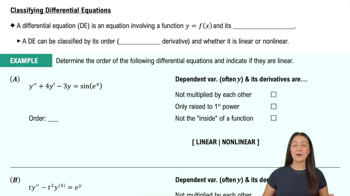
Classifying Differential Equations

Integrating Factor Method

The integrating factor is a function, typically e^(∫P(t)dt), used to multiply both sides of a linear differential equation. This transforms the left side into the derivative of a product, enabling straightforward integration. Applying this method helps solve the equation du/dt + (k/m)u = 0.
추천 영상:
07:33
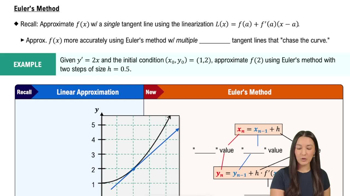
Euler's Method

Initial Value Problems

An initial value problem specifies the value of the unknown function at a particular point, here u(0) = u₀. This condition allows determination of the constant of integration after solving the differential equation, ensuring a unique solution that fits the given initial state.
추천 영상:
05:03
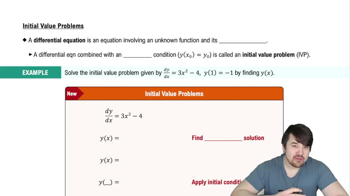
Initial Value Problems