Ch. 9 - First-Order Differential Equations
Hass - Thomas' Calculus 15th Edition
Hass15th EditionThomas' CalculusISBN: 9780137616077당신이 사용하는 게 아니라요?교과서 변경
9장, 문제 9.1.23

Use Euler’s method with dx = 0.5 to estimate y(5) if y′ = y²/√x and y(1) = −1. What is the exact value of y(5)?

검증된 단계별 안내
1
Identify the differential equation and initial condition: \(\frac{dy}{dx} = \frac{y^2}{\sqrt{x}}\) with \(y(1) = -1\).
Set the step size \(\Delta x = 0.5\) and determine the points at which to approximate \(y\): starting from \(x=1\), the points are \$1, 1.5, 2, 2.5, 3, 3.5, 4, 4.5, 5$.
Apply Euler's method iteratively using the formula \(y_{n+1} = y_n + \Delta x \cdot f(x_n, y_n)\), where \(f(x,y) = \frac{y^2}{\sqrt{x}}\). For each step, calculate the slope \(f(x_n, y_n)\) and update \(y\) accordingly.
Continue this process until you reach \(x=5\), which will give you the Euler's method estimate for \(y(5)\).
To find the exact value of \(y(5)\), solve the differential equation analytically by separating variables and integrating both sides, then apply the initial condition to find the constant of integration and evaluate \(y\) at \(x=5\).

비슷한 문제에 대한 검증된 영상 답변:

이 영상 해법은 위 문제에 도움이 된다고 튜터들이 추천한 것입니다.
영상 길이:
12m
도움이 되었나요?

주요 개념

질문에 올바르게 답하기 위해 반드시 이해해야 하는 핵심 개념들은 다음과 같습니다.

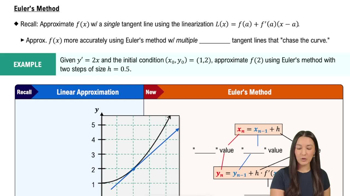
Euler's Method

Euler's method is a numerical technique to approximate solutions of first-order differential equations. It uses a step size (dx) to incrementally estimate the value of the function by applying the slope (derivative) at the current point. This method is especially useful when an exact solution is difficult to find.
추천 영상:
07:33
Euler's Method

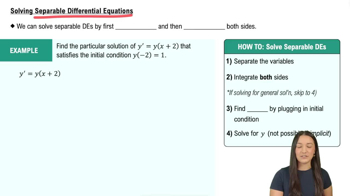
Solving First-Order Differential Equations

A first-order differential equation relates a function and its derivative. To find the exact solution, one often separates variables or uses an integrating factor. Understanding how to manipulate and solve these equations is essential to find the exact value of y(5) in this problem.
추천 영상:
06:06
Solving Separable Differential Equations

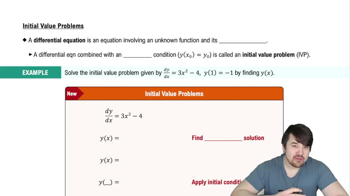
Initial Value Problems (IVP)

An initial value problem specifies the value of the function at a starting point, here y(1) = -1. This condition allows for a unique solution to the differential equation and is crucial for both numerical methods like Euler's and for finding the exact solution.
추천 영상:
가이드 코스
05:03
Initial Value Problems