Skip to main content
Cell Biology
나의 코스
배우기
시험 준비
AI 튜터
학습 가이드
플래시카드
탐험해 보세요
앱을 사용해 보세요
나의 코스
배우기
시험 준비
AI 튜터
학습 가이드
플래시카드
탐험해 보세요
앱을 사용해 보세요
뒤로
Cilia and Flagella definitions
카드를 뒤집기 위해 탭할 수 있습니다.
Cilia
카드를 뒤집기 위해 탭할 수 있습니다.
👆
Cilia
Short, hair-like organelles found in groups on the plasma membrane, beating back and forth to move cells or surrounding fluid.
진행 상황 추적
컨트롤 버튼이 '내비게이션' 모드로 변경되었습니다.
1/15
관련 플래시카드
관련 실천
추천 영상
Cilia and Flagella quiz #1
Cilia and Flagella
12 용어
Cilia and Flagella
15. Cytoskeleton and Cell Movement
7 문제점
주제
Microtubules and Cell Division
15. Cytoskeleton and Cell Movement
7 문제점
주제
15. Cytoskeleton and Cell Movement - Part 1 of 2
5 주제
14 문제점
장
15. Cytoskeleton and Cell Movement - Part 2 of 2
5 주제
13 문제점
장
VideoThumbView.guidedCourse
03:36
Sliding Microtubule Model
490
views
4
rank
2
comments
VideoThumbView.guidedCourse
06:18
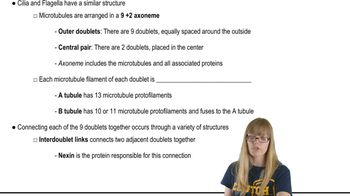
Structure
634
views
5
rank
2
comments
이 집합의 용어 (15)
하이드의 정의
Cilia
Short, hair-like organelles found in groups on the plasma membrane, beating back and forth to move cells or surrounding fluid.
Flagella
Long, usually singular organelles with a wave-like spinning motion, propelling cells such as sperm through their environment.
Microtubules
Cylindrical protein structures forming the core scaffold of cilia and flagella, arranged in specific patterns for movement.
9+2 Arrangement
Structural pattern with nine outer microtubule doublets and a central pair, characteristic of cilia and flagella axonemes.
Axoneme
Central shaft of cilia and flagella, composed of microtubules and associated proteins, enabling movement.
Basal Body
Microtubule-based structure at the base of cilia and flagella, organizing their assembly and anchoring them to the cell.
Outer Doublets
Nine pairs of microtubules forming the outer ring in the axoneme, essential for structural integrity and movement.
Central Pair
Two single microtubules located at the center of the axoneme, surrounded by the nine outer doublets.
A Tubule
Complete microtubule within each outer doublet, containing 13 protofilaments and serving as the main scaffold.
B Tubule
Incomplete microtubule fused to the A tubule in each doublet, containing 10 or 11 protofilaments.
Nexin
Protein linking adjacent outer doublets, preventing excessive sliding and enabling bending during movement.
Dynein
Motor protein attached to microtubules, using ATP to generate force for bending and movement of cilia and flagella.
Sliding Microtubule Model
Mechanism explaining how dynein-driven sliding of microtubules, constrained by nexin, results in bending and movement.
Intraflagellar Transport
Process moving molecules along the length of flagella, distinct from the bending mechanism responsible for movement.
Interdoublet Links
Structures connecting adjacent outer doublets, crucial for coordinated movement and structural stability.
 뒤로뒤로
뒤로뒤로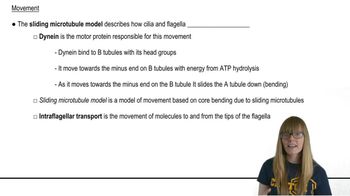
 03:36
03:36