Skip to main content
Cell Biology
나의 코스
배우기
시험 준비
AI 튜터
학습 가이드
플래시카드
탐험해 보세요
앱을 사용해 보세요
나의 코스
배우기
시험 준비
AI 튜터
학습 가이드
플래시카드
탐험해 보세요
앱을 사용해 보세요
뒤로
Genomic Comparison quiz
카드를 뒤집기 위해 탭할 수 있습니다.
What does comparing genomic sequences between organisms help us understand?
카드를 뒤집기 위해 탭할 수 있습니다.
👆
What does comparing genomic sequences between organisms help us understand?
It provides insight into evolutionary changes and the history of life on Earth.
진행 상황 추적
컨트롤 버튼이 '내비게이션' 모드로 변경되었습니다.
1/15
관련 플래시카드
관련 실천
추천 영상
Genomic Comparison definitions
Genomic Comparison
13 용어
Genomic Comparison
4. DNA, Chromosomes, and Genomes
7 문제점
주제
Human Genetic Variation
4. DNA, Chromosomes, and Genomes
5 문제점
주제
4. DNA, Chromosomes, and Genomes - Part 1 of 2
5 주제
14 문제점
장
4. DNA, Chromosomes, and Genomes - Part 2 of 2
5 주제
13 문제점
장
VideoThumbView.guidedCourse
06:15
Genomic Comparison
254
views
이 집합의 용어 (15)
하이드의 정의
What does comparing genomic sequences between organisms help us understand?
It provides insight into evolutionary changes and the history of life on Earth.
How do genomic sequences of two species differ?
They differ by the length of time the species have separately evolved from a common ancestor.
What is purifying selection in genomic comparison?
Purifying selection is when mutations in critical genes cause death, preventing those mutations from accumulating.
Why are conserved sequences similar across distantly related organisms?
Because mutations in these critical genes are eliminated, so their sequences remain similar across species.
What percentage of genes are typically conserved across species?
About 5% of genes are conserved across distantly related organisms.
What is synteny in the context of genomics?
Synteny refers to the conservation of the order of genes on chromosomes across different organisms.
Why is gene order important in synteny?
Because the order of genes is critical for their function and is conserved across species.
Does a larger genomic size mean an organism is more complex or has more genes?
No, genomic size does not directly correlate with organism complexity or gene count.
What information does genomic size provide when comparing organisms?
It reflects the rates of DNA addition or loss but not the complexity or number of genes.
What is a phylogenetic tree and how is it constructed?
A phylogenetic tree is constructed using DNA sequences to trace relationships between organisms.
Which changes occur more rapidly: introns or conserved genes?
Changes in introns occur more rapidly than in conserved genes with critical functions.
Why do introns mutate more freely than conserved genes?
Because introns are non-coding regions and are not essential for life, so mutations are tolerated.
How does genome size vary among bacteria, algae, mammals, and flowering plants?
Bacteria and algae generally have smaller genomes, while flowering plants can have much larger genomes than mammals.
Are flowering plants necessarily more complex than humans because they have larger genomes?
No, flowering plants can have larger genomes but are not necessarily more complex than humans.
What misconception about genomic size is debunked by genomic comparisons?
The misconception that larger genomes mean more genes or greater organism complexity is debunked.
 뒤로뒤로
뒤로뒤로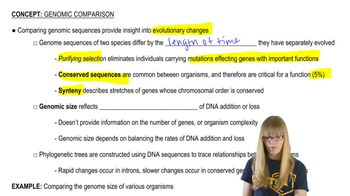
 06:15
06:15