Skip to main content
Cell Biology
나의 코스
배우기
시험 준비
AI 튜터
학습 가이드
플래시카드
탐험해 보세요
앱을 사용해 보세요
나의 코스
배우기
시험 준비
AI 튜터
학습 가이드
플래시카드
탐험해 보세요
앱을 사용해 보세요
뒤로
Gibbs Free Energy and Equilibrium definitions
카드를 뒤집기 위해 탭할 수 있습니다.
Gibbs Free Energy
카드를 뒤집기 위해 탭할 수 있습니다.
👆
Gibbs Free Energy
A thermodynamic quantity used to predict if a reaction can occur without external input, reflecting both enthalpy and entropy changes.
진행 상황 추적
컨트롤 버튼이 '내비게이션' 모드로 변경되었습니다.
1/14
관련 플래시카드
관련 실천
추천 영상
Gibbs Free Energy and Equilibrium quiz
Gibbs Free Energy and Equilibrium
15 용어
Gibbs Free Energy and Equilibrium
3. Energy
6 문제점
주제
Activated Carriers
3. Energy
6 문제점
주제
3. Energy - Part 1 of 2
4 주제
9 문제점
장
3. Energy - Part 2 of 2
3 주제
8 문제점
장
VideoThumbView.guidedCourse
08:57
Gibbs Free Energy
746
views
19
rank
1
comments
VideoThumbView.guidedCourse
04:43
Equilibrium
553
views
6
rank
1
comments
이 집합의 용어 (14)
하이드의 정의
Gibbs Free Energy
A thermodynamic quantity used to predict if a reaction can occur without external input, reflecting both enthalpy and entropy changes.
Spontaneous Reaction
A process that proceeds on its own, increasing disorder and requiring no outside energy to occur.
Entropy
A measure of disorder or randomness, with higher values indicating more disordered systems.
Delta G
A value representing the change in free energy during a reaction, indicating favorability and direction.
Standard Free Energy Change
A reference value for spontaneity, calculated under set temperature and pressure, allowing comparison between reactions.
Exergonic Reaction
A process that releases energy, resulting in products with lower free energy than reactants and a negative free energy change.
Endergonic Reaction
A process that absorbs energy, producing products with higher free energy than reactants and a positive free energy change.
Equilibrium
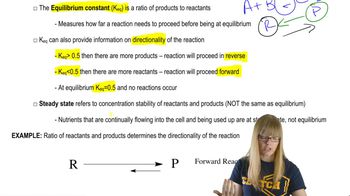
A state where forward and reverse reactions occur at equal rates, causing no net change in reactant or product concentrations.
Equilibrium Constant
A ratio reflecting the relative amounts of products and reactants at equilibrium, used to predict reaction direction.
Directionality
The tendency of a reaction to proceed toward either products or reactants, influenced by the equilibrium constant.
Steady State
A condition where concentrations of reactants and products remain stable over time, despite ongoing input or output.
Thermodynamic Favorability
A characteristic of processes that can occur without external energy, often associated with increased disorder and energy release.
Reactant
A starting substance in a chemical process, whose transformation leads to product formation.
Product
A substance formed as a result of a chemical process, present after the transformation of reactants.
 뒤로뒤로
뒤로뒤로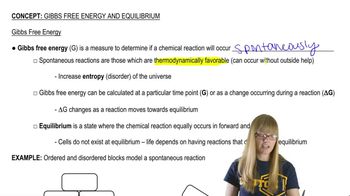
 08:57
08:57