Skip to main content
Cell Biology
나의 코스
배우기
시험 준비
AI 튜터
학습 가이드
플래시카드
탐험해 보세요
앱을 사용해 보세요
나의 코스
배우기
시험 준비
AI 튜터
학습 가이드
플래시카드
탐험해 보세요
앱을 사용해 보세요
뒤로
Light Independent Reactions quiz
카드를 뒤집기 위해 탭할 수 있습니다.
What is the main purpose of the Calvin cycle in plants?
카드를 뒤집기 위해 탭할 수 있습니다.
👆
What is the main purpose of the Calvin cycle in plants?
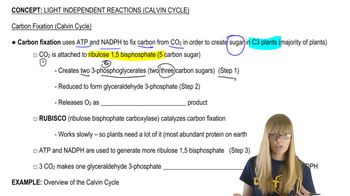
The Calvin cycle uses ATP and NADPH from light-dependent reactions to fix carbon from CO2 into sugars.
진행 상황 추적
컨트롤 버튼이 '내비게이션' 모드로 변경되었습니다.
1/15
관련 플래시카드
관련 실천
추천 영상
Light Independent Reactions definitions
Light Independent Reactions
15 용어
Light Independent Reactions
12. Photosynthesis
7 문제점
주제
Light Dependent Reactions
12. Photosynthesis
7 문제점
주제
12. Photosynthesis
4 주제
12 문제점
장
VideoThumbView.guidedCourse
07:37
C4 and CAM Plants
417
views
1
comments
VideoThumbView.guidedCourse
03:56
Calvin Cycle
488
views
이 집합의 용어 (15)
하이드의 정의
What is the main purpose of the Calvin cycle in plants?
The Calvin cycle uses ATP and NADPH from light-dependent reactions to fix carbon from CO2 into sugars.
Which enzyme catalyzes the attachment of CO2 to ribulose-1,5-bisphosphate in the Calvin cycle?
RuBisCO catalyzes the attachment of CO2 to ribulose-1,5-bisphosphate.
Why is RuBisCO considered the most abundant protein on Earth?
Because RuBisCO is slow and inefficient, plants need large amounts of it to fix enough carbon, making it the most abundant protein.
What is the first stable product formed when CO2 is fixed in the Calvin cycle?
The first stable product is a three-carbon sugar called phosphoglycerate.
How many ATP and NADPH molecules are consumed to produce one sugar molecule in the Calvin cycle?
Nine ATP and six NADPH molecules are consumed to produce one sugar molecule.
What is photorespiration and why is it considered wasteful for plants?
Photorespiration occurs when RuBisCO binds O2 instead of CO2, leading to a waste of energy and resources for the plant.
Why do plants close their stomata in hot environments, and what problem does this cause?
Plants close their stomata to conserve water, but this limits CO2 intake and increases O2, leading to photorespiration.
How do C4 plants avoid photorespiration?
C4 plants separate carbon fixation into mesophyll and bundle sheath cells, concentrating CO2 around RuBisCO and reducing photorespiration.
What molecule is CO2 initially fixed into in C4 plants before entering the Calvin cycle?
CO2 is initially fixed into malate in C4 plants.
Where is RuBisCO located in C4 plants, and why is this important?
RuBisCO is located in the bundle sheath cells, which helps prevent oxygen buildup and increases efficiency.
How do CAM plants adapt to hot, arid environments to fix carbon efficiently?
CAM plants open their stomata at night to fix CO2 into malate, storing it for use during the day when stomata are closed.
When do CAM plants fix CO2, and how is it stored?
CAM plants fix CO2 at night and store it as malate.
What happens to the stored malate in CAM plants during the day?
During the day, malate releases CO2, which is then fixed by RuBisCO in the Calvin cycle.
What is the main difference between C4 and CAM plant adaptations for carbon fixation?
C4 plants separate carbon fixation spatially between cell types, while CAM plants separate it temporally between night and day.
Why is the Calvin cycle less efficient in hot and arid environments for C3 plants?
In hot and arid environments, stomata close to conserve water, reducing CO2 intake and increasing photorespiration in C3 plants.
 뒤로뒤로
뒤로뒤로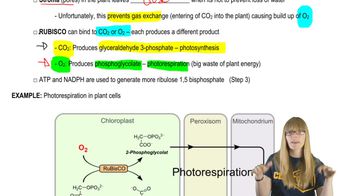
 07:37
07:37