Skip to main content
Cell Biology
나의 코스
배우기
시험 준비
AI 튜터
학습 가이드
플래시카드
탐험해 보세요
앱을 사용해 보세요
나의 코스
배우기
시험 준비
AI 튜터
학습 가이드
플래시카드
탐험해 보세요
앱을 사용해 보세요
뒤로
Membrane Proteins definitions
카드를 뒤집기 위해 탭할 수 있습니다.
Transmembrane Protein
카드를 뒤집기 위해 탭할 수 있습니다.
👆
Transmembrane Protein
Spans the entire lipid bilayer, often forming alpha helices or beta barrels, and can function asymmetrically on each side of the membrane.
진행 상황 추적
컨트롤 버튼이 '내비게이션' 모드로 변경되었습니다.
1/15
관련 플래시카드
관련 실천
추천 영상
Membrane Proteins quiz #1
Membrane Proteins
13 용어
Membrane Proteins
8. Membrane Structure
7 문제점
주제
The Lipid Bilayer
8. Membrane Structure
7 문제점
주제
8. Membrane Structure
2 주제
6 문제점
장
VideoThumbView.guidedCourse
02:24
Alpha Helices and Beta Barrels
703
views
14
rank
VideoThumbView.guidedCourse
04:23
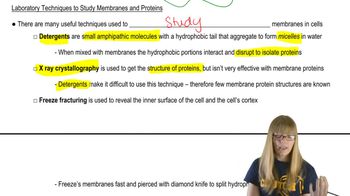
Laboratory Techniques
605
views
5
rank
VideoThumbView.guidedCourse
06:20
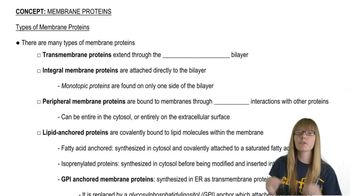
Types of Membrane Proteins
1045
views
13
rank
이 집합의 용어 (15)
하이드의 정의
Transmembrane Protein
Spans the entire lipid bilayer, often forming alpha helices or beta barrels, and can function asymmetrically on each side of the membrane.
Integral Membrane Protein
Directly attached to the lipid bilayer, may extend through or associate with only one side, and interacts with membrane lipids.
Peripheral Membrane Protein
Associates with the membrane via interactions with other proteins, not directly with lipids, and is confined to one side of the bilayer.
Lipid-Anchored Protein
Covalently bound to membrane lipids, providing strong attachment; includes types like GPI-anchored and fatty acid-anchored proteins.
Alpha Helix
Common structure in membrane-spanning regions, with hydrophobic side chains interacting with lipid tails, masking hydrophilic portions.
Beta Barrel
Cylindrical structure formed by beta sheets, often creating channels for large molecules to cross the membrane.
Glycoprotein
Protein with attached carbohydrate chains, contributing to cell protection and extracellular interactions.
Glycolipid
Lipid molecule with a carbohydrate group, found on the membrane surface, involved in cell recognition.
Glycocalyx
Protective, carbohydrate-rich layer on the cell surface, formed by glycoproteins and glycolipids.
Cell Cortex
Network beneath the plasma membrane, composed of proteins and cytoskeleton, supporting cell shape and limiting protein movement.
Lateral Diffusion
Movement of membrane proteins or lipids within the same layer of the bilayer, contributing to membrane fluidity.
Rotational Diffusion
Spinning of membrane proteins or lipids around their axis within the bilayer, affecting membrane dynamics.
Freeze Fracturing
Technique that splits frozen membranes to reveal embedded proteins and inner membrane surfaces for structural study.
FRAP
Method using fluorescence recovery to measure mobility and fluidity of membrane proteins or lipids after photobleaching.
Detergent
Small molecule with hydrophobic and hydrophilic regions, used to disrupt membranes and isolate proteins in laboratory studies.
 뒤로뒤로
뒤로뒤로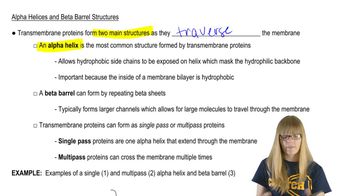
 02:24
02:24