Skip to main content
Cell Biology
나의 코스
배우기
시험 준비
AI 튜터
학습 가이드
플래시카드
탐험해 보세요
앱을 사용해 보세요
나의 코스
배우기
시험 준비
AI 튜터
학습 가이드
플래시카드
탐험해 보세요
앱을 사용해 보세요
뒤로
Overview of Cellular Respiration definitions
카드를 뒤집기 위해 탭할 수 있습니다.
Cellular Respiration
카드를 뒤집기 위해 탭할 수 있습니다.
👆
Cellular Respiration
Series of reactions breaking down molecules for energy, involving multiple electron transfers and interconnected metabolic pathways.
진행 상황 추적
컨트롤 버튼이 '내비게이션' 모드로 변경되었습니다.
1/15
관련 플래시카드
관련 실천
추천 영상
Overview of Cellular Respiration quiz #1
Overview of Cellular Respiration
10 용어
Overview of Cellular Respiration
11. Aerobic Respiration
7 문제점
주제
Mitochondria
11. Aerobic Respiration
7 문제점
주제
11. Aerobic Respiration
5 주제
15 문제점
장
VideoThumbView.guidedCourse
04:42
Cellular Respiration Overview
949
views
10
rank
2
comments
이 집합의 용어 (15)
하이드의 정의
Cellular Respiration
Series of reactions breaking down molecules for energy, involving multiple electron transfers and interconnected metabolic pathways.
Glycolysis
Initial metabolic pathway that splits glucose into pyruvate, generating small amounts of ATP and electron carriers.
Fermentation
Anaerobic process that oxidizes molecules, allowing energy extraction when oxygen is scarce, producing intermediates like acetyl CoA.
Pyruvate
Three-carbon molecule produced from glucose breakdown, serving as a key intermediate before entering further metabolic cycles.
Acetyl CoA
Molecule formed by oxidation of pyruvate, acting as the entry substrate for the Krebs cycle in energy metabolism.
Krebs Cycle
Cyclic series of reactions in mitochondria that processes acetyl groups, generating electron carriers, ATP, and carbon dioxide.
NADH
High-energy electron carrier produced during metabolic pathways, crucial for transferring electrons to the electron transport chain.
FADH2
Reduced electron carrier generated in the Krebs cycle, delivering electrons to the electron transport chain for ATP production.
Electron Transport Chain
Membrane-associated series of protein complexes that transfer electrons, pumping protons to create an electrochemical gradient.
ATP Synthesis
Process where energy from a proton gradient is harnessed to convert ADP and inorganic phosphate into cellular energy currency.
Oxidative Phosphorylation
Final stage of aerobic respiration coupling electron transfer and proton movement to drive ATP generation via chemiosmotic mechanisms.
Chemiosmotic Coupling
Mechanism linking the movement of protons across a membrane to the synthesis of ATP, utilizing an electrochemical gradient.
Proton Gradient
Difference in hydrogen ion concentration and charge across a membrane, storing potential energy for cellular processes.
Proton Motive Force
Electrochemical gradient of hydrogen ions across a membrane, providing the energy required for ATP synthesis.
Carbon Dioxide
Waste product released during the Krebs cycle as organic molecules are oxidized for energy extraction.
 뒤로뒤로
뒤로뒤로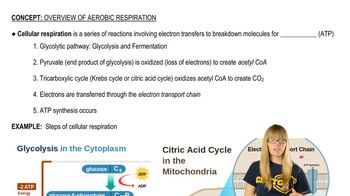
 04:42
04:42