Skip to main content
Cell Biology
나의 코스
배우기
시험 준비
AI 튜터
학습 가이드
플래시카드
탐험해 보세요
앱을 사용해 보세요
나의 코스
배우기
시험 준비
AI 튜터
학습 가이드
플래시카드
탐험해 보세요
앱을 사용해 보세요
뒤로
Principles of Transmembrane Transport definitions
카드를 뒤집기 위해 탭할 수 있습니다.
Semipermeability
카드를 뒤집기 위해 탭할 수 있습니다.
👆
Semipermeability
Property allowing selective passage of certain molecules while restricting others, enabling regulation of cellular exchange with the environment.
진행 상황 추적
컨트롤 버튼이 '내비게이션' 모드로 변경되었습니다.
1/14
관련 플래시카드
관련 실천
추천 영상
Principles of Transmembrane Transport quiz #1
Principles of Transmembrane Transport
40 용어
Principles of Transmembrane Transport quiz #2
Principles of Transmembrane Transport
34 용어
Principles of Transmembrane Transport
9. Transport Across Membranes
7 문제점
주제
Passive Transport: Diffusion and Osmosis
9. Transport Across Membranes
7 문제점
주제
9. Transport Across Membranes
5 주제
15 문제점
장
VideoThumbView.guidedCourse
03:37
Membranes and Gradients
1228
views
26
rank
3
comments
VideoThumbView.guidedCourse
03:11
Passive and Active Transport
1090
views
23
rank
1
comments
이 집합의 용어 (14)
하이드의 정의
Semipermeability
Property allowing selective passage of certain molecules while restricting others, enabling regulation of cellular exchange with the environment.
Concentration Gradient
Difference in molecule concentration across a membrane, creating a driving force for movement from high to low concentration.
Electrical Potential
Charge difference across a membrane, resulting from unequal distribution of ions on either side.
Electrochemical Potential
Combined effect of concentration gradient and electrical potential, determining the overall driving force for ion movement.
Membrane Potential
Net difference between concentration gradient and electrical potential, reflecting the overall charge difference across the membrane.
Passive Transport
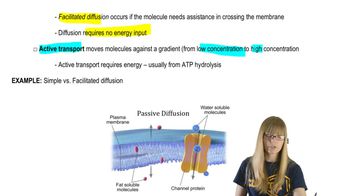
Movement of molecules down a gradient without energy input, occurring via simple or facilitated diffusion.
Simple Diffusion
Unassisted movement of molecules directly through the membrane, requiring no proteins or energy.
Facilitated Diffusion
Transport of molecules across the membrane with the help of proteins, but without energy expenditure.
Active Transport
Energy-dependent movement of molecules against their gradient, typically powered by ATP.
Channel Protein
Membrane protein forming a selective portal, allowing passage based on size or charge.
Transporter
Highly selective membrane protein permitting only specific molecules to bind and cross.
ATP-Powered Pump
Membrane protein using ATP energy to move substances across the membrane against their gradient.
Extracellular Environment
Area outside the cell, differing in composition from the cell's interior and influencing transport processes.
Intracellular Environment
Internal cellular space with distinct concentrations and charges compared to the outside, crucial for maintaining gradients.
 뒤로뒤로
뒤로뒤로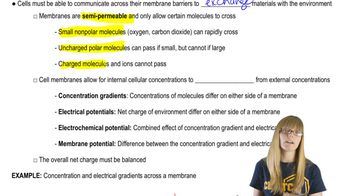
 03:37
03:37