Skip to main content
Cell Biology
나의 코스
배우기
시험 준비
AI 튜터
학습 가이드
플래시카드
탐험해 보세요
앱을 사용해 보세요
나의 코스
배우기
시험 준비
AI 튜터
학습 가이드
플래시카드
탐험해 보세요
앱을 사용해 보세요
뒤로
Structure and Function of DNA definitions
카드를 뒤집기 위해 탭할 수 있습니다.
Nucleotide
카드를 뒤집기 위해 탭할 수 있습니다.
👆
Nucleotide
Building block containing a sugar, phosphate group, and one of four nitrogenous bases; forms the basic unit of genetic material.
진행 상황 추적
컨트롤 버튼이 '내비게이션' 모드로 변경되었습니다.
1/15
관련 플래시카드
관련 실천
추천 영상
Structure and Function of DNA quiz #1
Structure and Function of DNA
10 용어
Structure and Function of DNA
4. DNA, Chromosomes, and Genomes
7 문제점
주제
Helical Formations of DNA
4. DNA, Chromosomes, and Genomes
7 문제점
주제
4. DNA, Chromosomes, and Genomes - Part 1 of 2
5 주제
14 문제점
장
4. DNA, Chromosomes, and Genomes - Part 2 of 2
5 주제
13 문제점
장
VideoThumbView.guidedCourse
08:23
Nucleotides and DNA
846
views
11
rank
이 집합의 용어 (15)
하이드의 정의
Nucleotide
Building block containing a sugar, phosphate group, and one of four nitrogenous bases; forms the basic unit of genetic material.
Adenine
Purine base with two carbon rings; pairs with thymine via two hydrogen bonds in genetic material.
Cytosine
Pyrimidine base with one carbon ring; forms three hydrogen bonds with guanine in double-stranded genetic material.
Guanine
Purine base with two carbon rings; establishes three hydrogen bonds with cytosine in the double helix.
Thymine
Pyrimidine base with one carbon ring; connects to adenine through two hydrogen bonds in genetic strands.
Purine
Nitrogenous base category with two carbon rings; includes adenine and guanine.
Pyrimidine
Nitrogenous base category with a single carbon ring; includes cytosine and thymine.
Base Pair
Two nitrogenous bases joined by hydrogen bonds, forming the rungs of the double helix.
Hydrogen Bond
Weak interaction stabilizing base pairs; two connect adenine-thymine, three connect guanine-cytosine.
Sugar-Phosphate Backbone
Structural framework of genetic strands, formed by alternating sugars and phosphate groups.
Directionality
Orientation of a genetic strand, defined by 5' phosphate and 3' hydroxyl ends, crucial for strand pairing.
Double Helix
Energetically favorable structure with two antiparallel strands and complementary base pairing.
Antiparallel
Arrangement where two strands run in opposite directions, enabling proper base pairing.
Major Groove
Wider region in the double helix, providing access for protein interactions.
B-DNA
Most common right-handed double helix form, featuring 10 base pairs per helical turn.
 뒤로뒤로
뒤로뒤로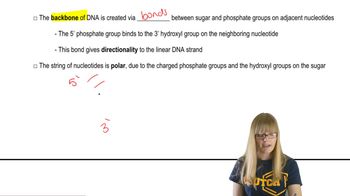
 08:23
08:23