Skip to main content
Cell Biology
나의 코스
배우기
시험 준비
AI 튜터
학습 가이드
플래시카드
탐험해 보세요
앱을 사용해 보세요
나의 코스
배우기
시험 준비
AI 튜터
학습 가이드
플래시카드
탐험해 보세요
앱을 사용해 보세요
뒤로
Cell Biology: Bioenergetics and Enzymes
카드를 뒤집기 위해 탭할 수 있습니다.
What types of work do cells perform that require energy?
카드를 뒤집기 위해 탭할 수 있습니다.
👆
What types of work do cells perform that require energy?
Cells perform mechanical work, transport work, and chemical work, all requiring energy input.
진행 상황 추적
컨트롤 버튼이 '내비게이션' 모드로 변경되었습니다.
1/20
추천 영상
VideoThumbView.guidedCourse
04:45
Energy Consumption
712
views
12
rank
VideoThumbView.guidedCourse
14:44
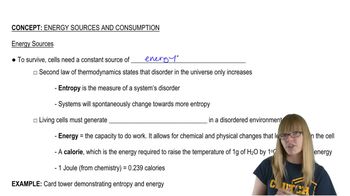
Energy Sources
1027
views
20
rank
2
comments
이 집합의 용어 (20)
하이드의 정의
What types of work do cells perform that require energy?
Cells perform mechanical work, transport work, and chemical work, all requiring energy input.
What is bioenergetics?
Bioenergetics is the application of thermodynamic principles to biological systems, focusing on energy conservation and transformation.
What does it mean that cells are an open system?
Cells exchange energy and matter with their surroundings, allowing them to maintain order and perform work.
What is the difference between a calorie and a Calorie on food labels?
A calorie (small c) is the energy to raise 1g of water by 1°C; a Calorie (capital C) equals 1000 calories or 1 kilocalorie.
What determines the direction of chemical reactions in cells?
The entropy of the universe must increase (2nd law of thermodynamics) and the free energy of the system must decrease.
What does a negative free energy change (ΔG) indicate about a reaction?
A negative ΔG means the reaction is exergonic and proceeds spontaneously in the forward direction.
What is the difference between ΔG' and ΔG0'?
ΔG0' is the standard free energy change under standard conditions; ΔG' is the actual free energy change under cellular conditions.
Define exergonic and endergonic reactions.
Exergonic reactions release energy (ΔG < 0); endergonic reactions require energy input (ΔG > 0).
What does 'steady state' mean in cellular reactions?
Steady state means reactant and product concentrations remain constant over time despite ongoing reactions.
How can reactions with positive ΔG' values proceed in cells?
By altering reactant/product ratios or coupling the reaction to a highly exergonic reaction.
Define enzyme, substrate, and active site.
An enzyme is a protein catalyst; substrate is the molecule acted upon; active site is the enzyme region where substrate binds.
What is an allosteric site on an enzyme?
An allosteric site is a regulatory site where molecules bind to modulate enzyme activity.
What is turnover number (kcat)?
kcat is the number of substrate molecules converted to product per enzyme molecule per second.
Define KM and Vmax in enzyme kinetics.
KM is the substrate concentration at half Vmax; Vmax is the maximum reaction rate achieved by the enzyme.
How do enzymes affect activation energy (EA) and reaction rates?
Enzymes lower EA, increasing reaction rates without changing ΔG.
What factors affect enzyme activity?
pH, temperature, ion concentration, and presence of inhibitors affect enzyme structure and activity.
What is the difference between competitive and noncompetitive reversible inhibitors?
Competitive inhibitors bind the active site; noncompetitive inhibitors bind elsewhere, altering enzyme function.
How is enzyme activity regulated in cells after synthesis?
Via allosteric regulation, chemical modification (e.g., phosphorylation), proteolysis, and sequestration.
Name four major classes of enzymes.
Oxidoreductases, transferases, isomerases, and hydrolases.
Why are enzymes important for cellular reactions?
They allow reactions to proceed at useful rates by lowering activation energy and stabilizing the metastable state.
 뒤로뒤로
뒤로뒤로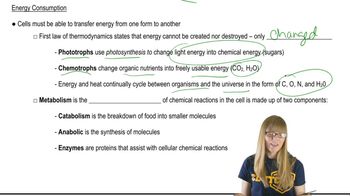
 04:45
04:45