In Exercises 1–68, factor completely, or state that the polynomial is prime.
(x + 5)(x − 3) + (x + 5)(x − 7)
검증된 단계별 안내
1
Factor out the common term \((x + 5)\) from both parts of the expression.
Rewrite the expression as \((x + 5)((x - 3) + (x - 7))\).
Simplify the expression inside the parentheses: \((x - 3) + (x - 7)\).
Combine like terms inside the parentheses: \(2x - 10\).
The factored form of the expression is \((x + 5)(2x - 10)\).
비슷한 문제에 대한 검증된 영상 답변:
이 영상 해법은 위 문제에 도움이 된다고 튜터들이 추천한 것입니다.
영상 길이:
4m
영상 재생:
0 댓글
주요 개념
질문에 올바르게 답하기 위해 반드시 이해해야 하는 핵심 개념들은 다음과 같습니다.
Factoring Polynomials
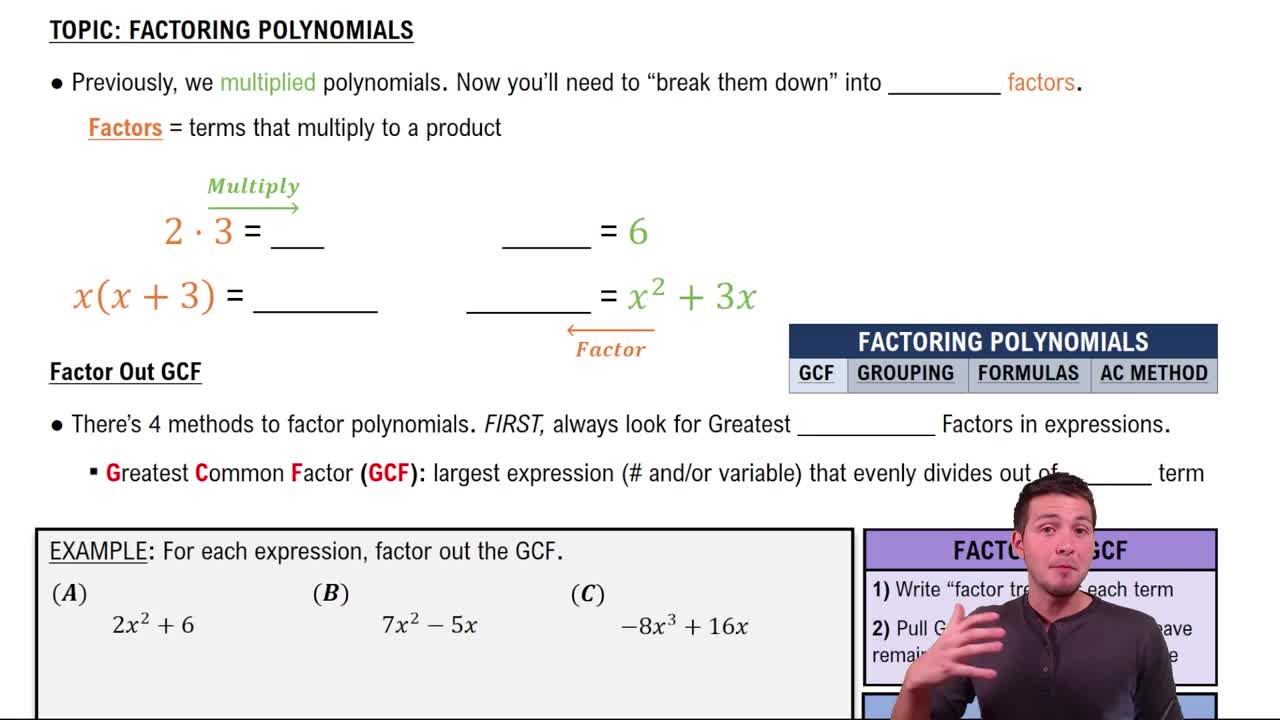
Factoring polynomials involves expressing a polynomial as a product of its simpler components, or factors. This process is essential for simplifying expressions and solving equations. In the given question, recognizing common factors in the polynomial will help in breaking it down into simpler forms.
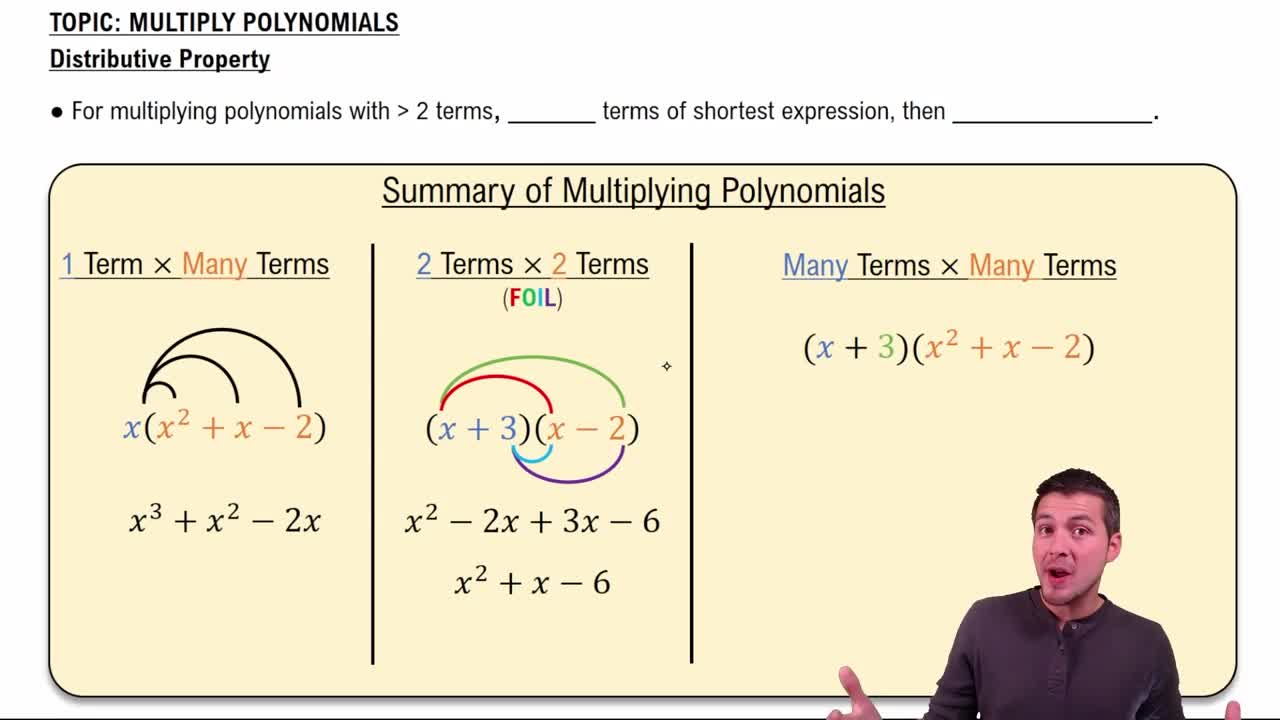
The distributive property states that a(b + c) = ab + ac, allowing us to multiply a single term by two or more terms inside parentheses. This property is crucial for expanding expressions and simplifying polynomials, as seen in the initial step of the problem where we need to combine like terms after applying this property.
Multiply Polynomials Using the Distributive Property
Combining Like Terms
Combining like terms is the process of simplifying an expression by adding or subtracting terms that have the same variable raised to the same power. This step is vital in polynomial manipulation, as it helps in reducing the expression to a more manageable form before factoring or determining if the polynomial is prime.

 4:41분
4:41분 검증된 단계별 안내
 07:30
07:30