In Exercises 23–48, factor completely, or state that the polynomial is prime.
x² + 25y²
검증된 단계별 안내
1
Identify the given polynomial: \(x^2 + 25y^2\).
Recognize that this is a sum of squares, \(a^2 + b^2\), where \(a = x\) and \(b = 5y\).
Recall that a sum of squares does not factor over the real numbers into linear factors.
Conclude that \(x^2 + 25y^2\) is a prime polynomial over the real numbers.
If complex numbers are considered, use the identity \(a^2 + b^2 = (a + bi)(a - bi)\) to factor it as \((x + 5yi)(x - 5yi)\).
비슷한 문제에 대한 검증된 영상 답변:
이 영상 해법은 위 문제에 도움이 된다고 튜터들이 추천한 것입니다.
영상 길이:
2m
영상 재생:
0 댓글
주요 개념
질문에 올바르게 답하기 위해 반드시 이해해야 하는 핵심 개념들은 다음과 같습니다.
Factoring Polynomials
Factoring polynomials involves breaking down a polynomial expression into simpler components, or factors, that when multiplied together yield the original polynomial. This process is essential for simplifying expressions, solving equations, and analyzing polynomial behavior. Common techniques include identifying common factors, using the difference of squares, and applying special factoring formulas.
The expression x² + 25y² represents a sum of squares, which is a specific type of polynomial that cannot be factored over the real numbers. Unlike the difference of squares, which can be factored into two binomials, the sum of squares does not have real factors and is considered prime in the context of real number factorization. Understanding this distinction is crucial for determining whether a polynomial can be factored.
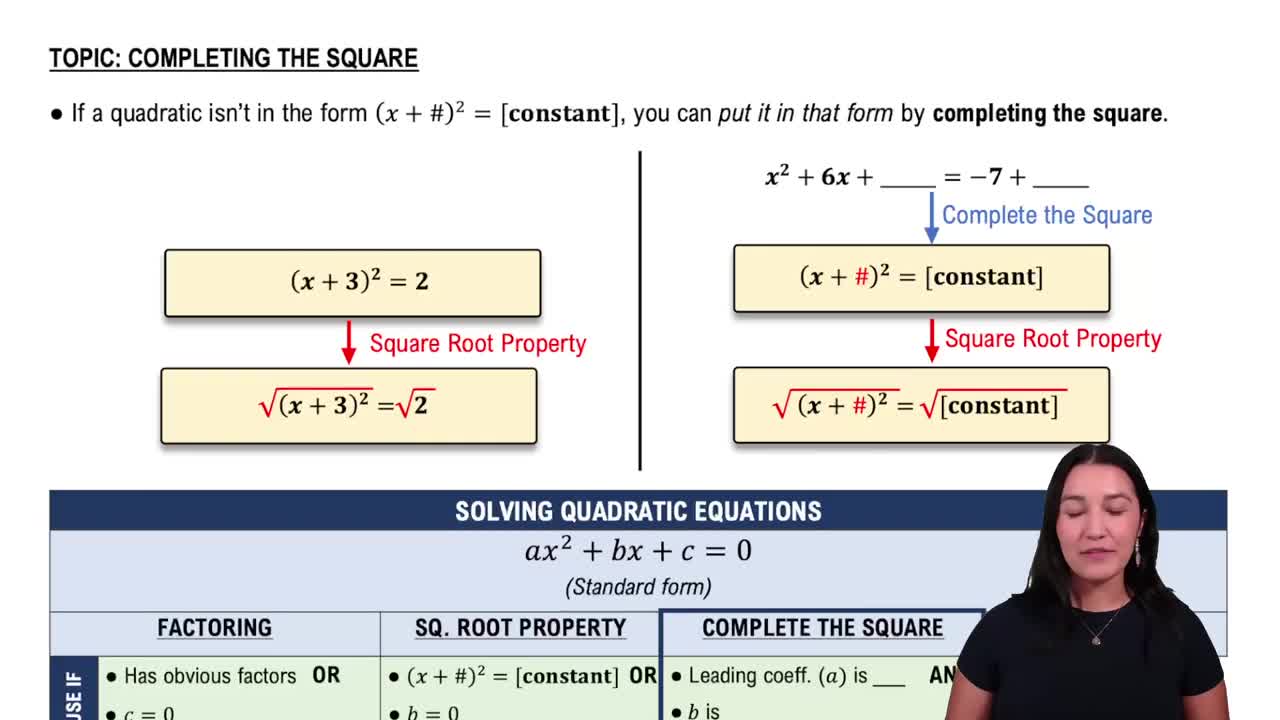
Solving Quadratic Equations by Completing the Square
Prime Polynomials
A prime polynomial is one that cannot be factored into the product of two non-constant polynomials with real coefficients. Recognizing prime polynomials is important in algebra as it helps in understanding the limits of factorization and the nature of polynomial roots. In the case of x² + 25y², identifying it as prime indicates that it does not have simpler polynomial factors.

 2:37분
2:37분 검증된 단계별 안내

 07:30
07:30