In Exercises 1–22, factor each difference of two squares. Assume that any variable exponents represent whole numbers.
x² - 4
검증된 단계별 안내
1
Identify the expression as a difference of squares: \(x^2 - 4\).
Recall the formula for factoring a difference of squares: \(a^2 - b^2 = (a - b)(a + b)\).
Recognize that \(x^2\) is a perfect square with \(a = x\) and \(4\) is a perfect square with \(b = 2\).
Apply the difference of squares formula: substitute \(a = x\) and \(b = 2\) into \((a - b)(a + b)\).
Write the factored form: \((x - 2)(x + 2)\).
비슷한 문제에 대한 검증된 영상 답변:
이 영상 해법은 위 문제에 도움이 된다고 튜터들이 추천한 것입니다.
영상 길이:
2m
영상 재생:
0 댓글
주요 개념
질문에 올바르게 답하기 위해 반드시 이해해야 하는 핵심 개념들은 다음과 같습니다.
Difference of Squares
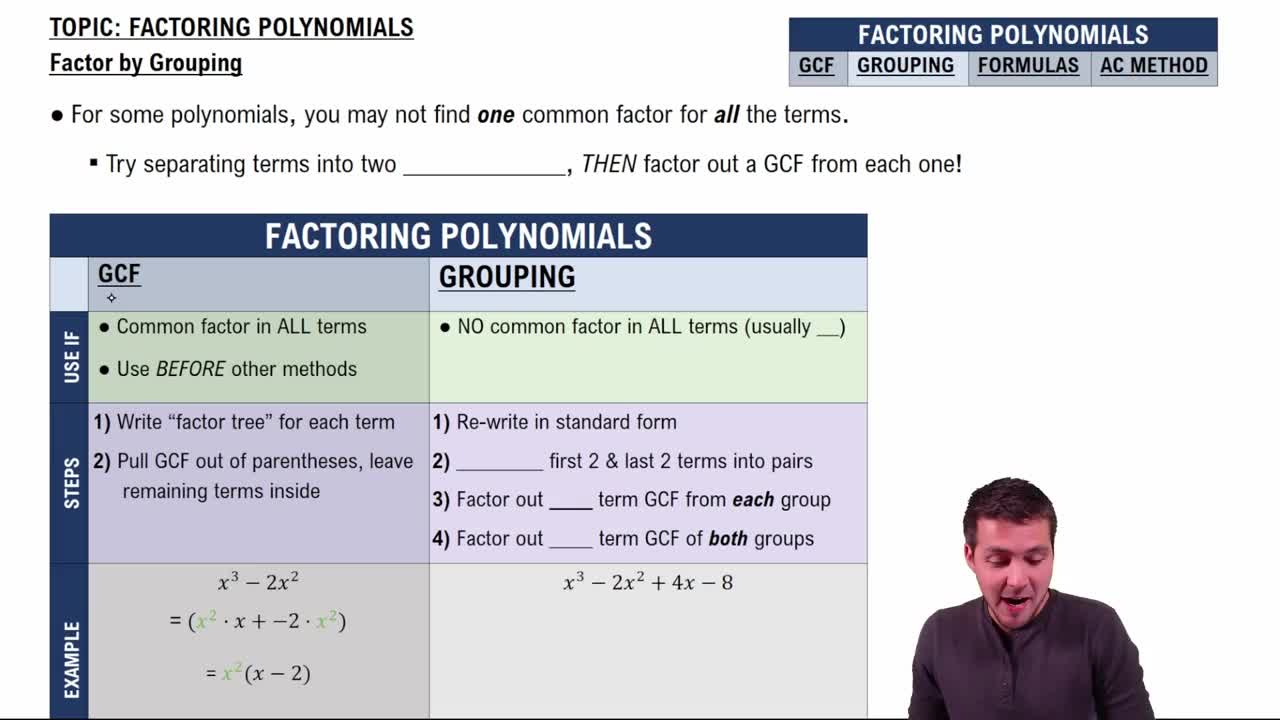
The difference of squares is a specific algebraic expression that takes the form a² - b², where a and b are any algebraic expressions. This expression can be factored into (a - b)(a + b). Understanding this concept is crucial for recognizing and applying the factoring technique to simplify expressions like x² - 4.
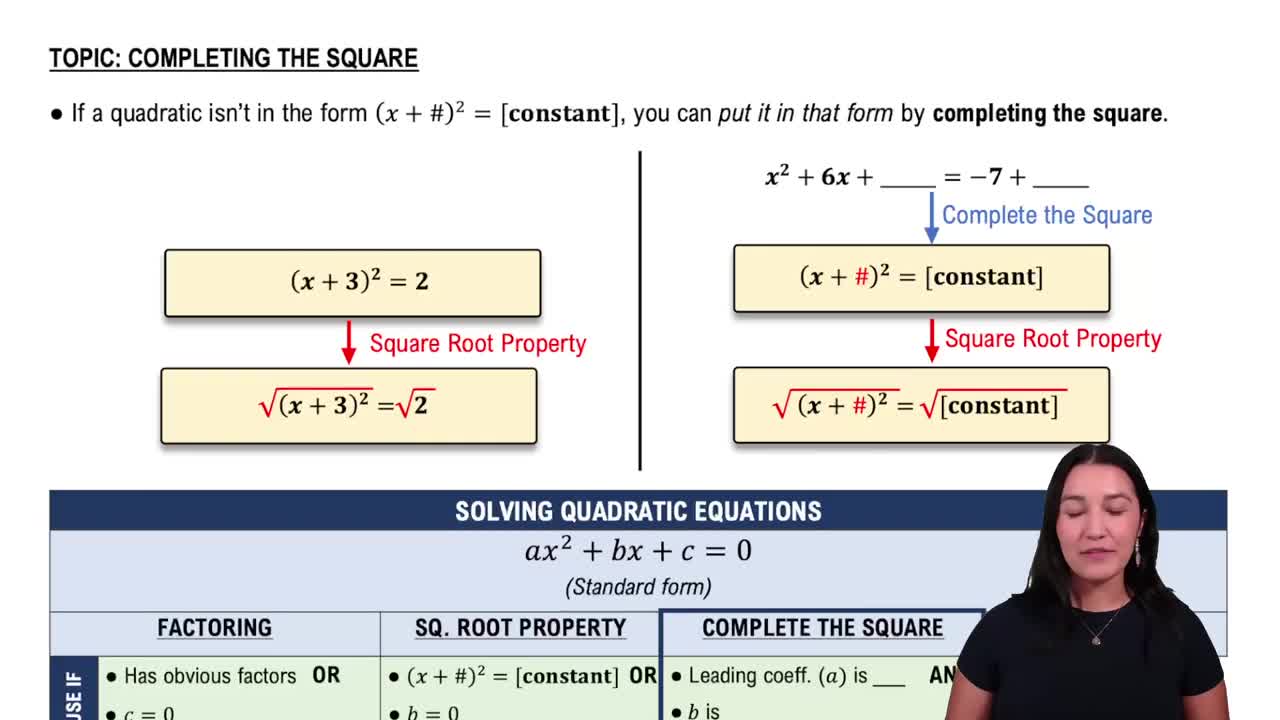
Solving Quadratic Equations by Completing the Square
Factoring
Factoring is the process of breaking down an expression into simpler components, or factors, that when multiplied together yield the original expression. In the case of the difference of squares, recognizing the structure allows for efficient simplification, which is a fundamental skill in algebra that aids in solving equations and simplifying expressions.
Exponents represent the number of times a base is multiplied by itself. In the expression x² - 4, the exponent indicates that x is squared. Understanding exponents is essential for manipulating algebraic expressions, as they dictate the behavior of the variables involved, especially when factoring or simplifying expressions.

 2:46분
2:46분 검증된 단계별 안내
 06:24
06:24