In Exercises 1–34, solve each rational equation. If an equation has no solution, so state.
1/x + 2 = 3/x
검증된 단계별 안내
1
Identify the least common denominator (LCD) of the rational expressions. In this case, the LCD is \( x \).
Multiply every term in the equation by the LCD \( x \) to eliminate the fractions: \( x \cdot \frac{1}{x} + x \cdot 2 = x \cdot \frac{3}{x} \).
Simplify each term: \( 1 + 2x = 3 \).
Rearrange the equation to isolate the variable \( x \): \( 2x = 3 - 1 \).
Solve for \( x \) by dividing both sides by 2: \( x = \frac{2}{2} \).
비슷한 문제에 대한 검증된 영상 답변:
이 영상 해법은 위 문제에 도움이 된다고 튜터들이 추천한 것입니다.
영상 길이:
3m
영상 재생:
0 댓글
주요 개념
질문에 올바르게 답하기 위해 반드시 이해해야 하는 핵심 개념들은 다음과 같습니다.
Rational Equations
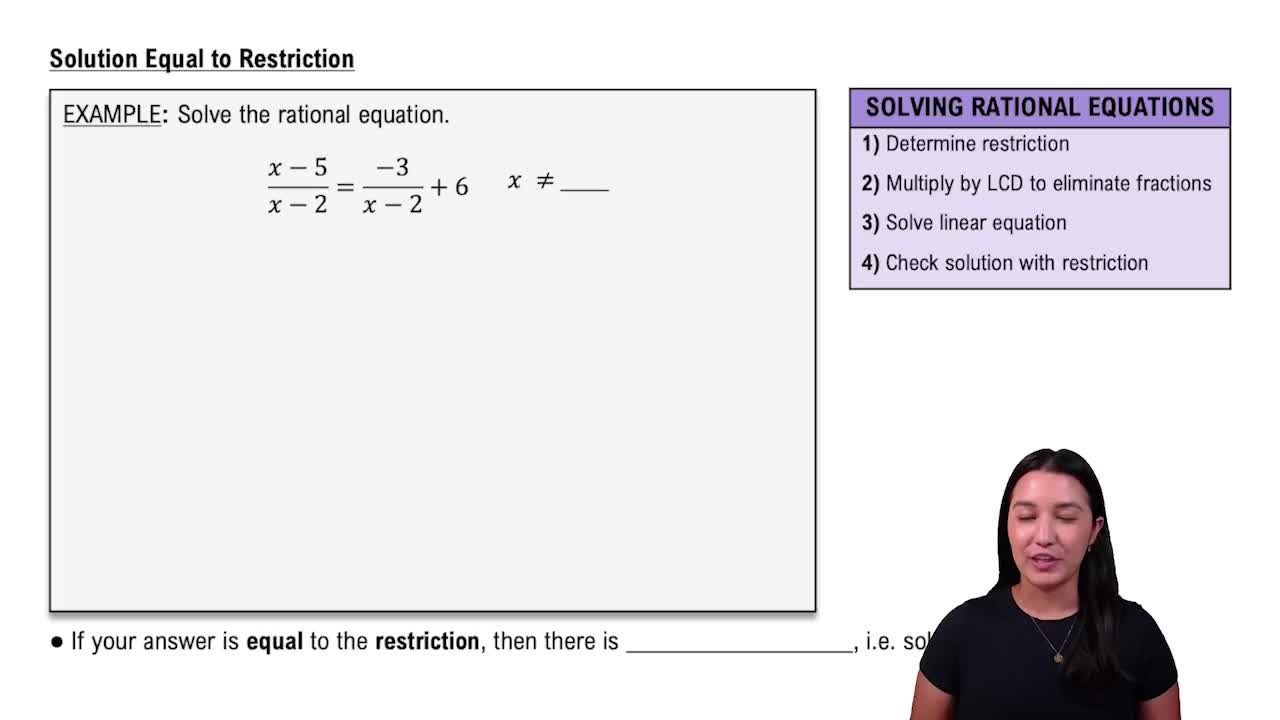
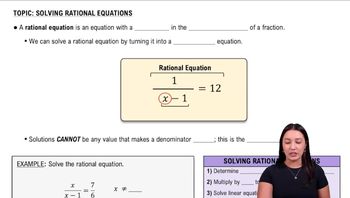
Rational equations are equations that involve fractions with polynomials in the numerator and denominator. To solve these equations, one typically seeks a common denominator to eliminate the fractions, allowing for easier manipulation and simplification. Understanding how to work with rational expressions is crucial for solving these types of equations.
Finding a common denominator is a key step in solving rational equations. It involves identifying a denominator that all fractions in the equation can share, which allows for the elimination of the fractions. This process simplifies the equation, making it easier to isolate the variable and solve for its value.
When solving rational equations, it is important to check for extraneous solutions, which are values that may satisfy the manipulated equation but do not satisfy the original equation. This often occurs when the process of eliminating fractions introduces solutions that make the original denominators zero, leading to undefined expressions. Verifying solutions ensures that the final answer is valid.

 3:14분
3:14분 검증된 단계별 안내
 05:56
05:56