In Exercises 23–34, factor out the negative of the greatest common factor.
−4x³ + 32x² − 20x
검증된 단계별 안내
1
Identify the greatest common factor (GCF) of the coefficients: -4, 32, and -20.
The GCF of 4, 32, and 20 is 4. Since we need to factor out the negative of the GCF, we use -4.
Factor out -4 from each term: -4(x^3 - 8x^2 + 5x).
Rewrite the expression as -4(x^3 - 8x^2 + 5x).
Check your work by distributing -4 back into the expression to ensure it matches the original polynomial.
비슷한 문제에 대한 검증된 영상 답변:
이 영상 해법은 위 문제에 도움이 된다고 튜터들이 추천한 것입니다.
영상 길이:
2m
영상 재생:
0 댓글
주요 개념
질문에 올바르게 답하기 위해 반드시 이해해야 하는 핵심 개념들은 다음과 같습니다.
Greatest Common Factor (GCF)
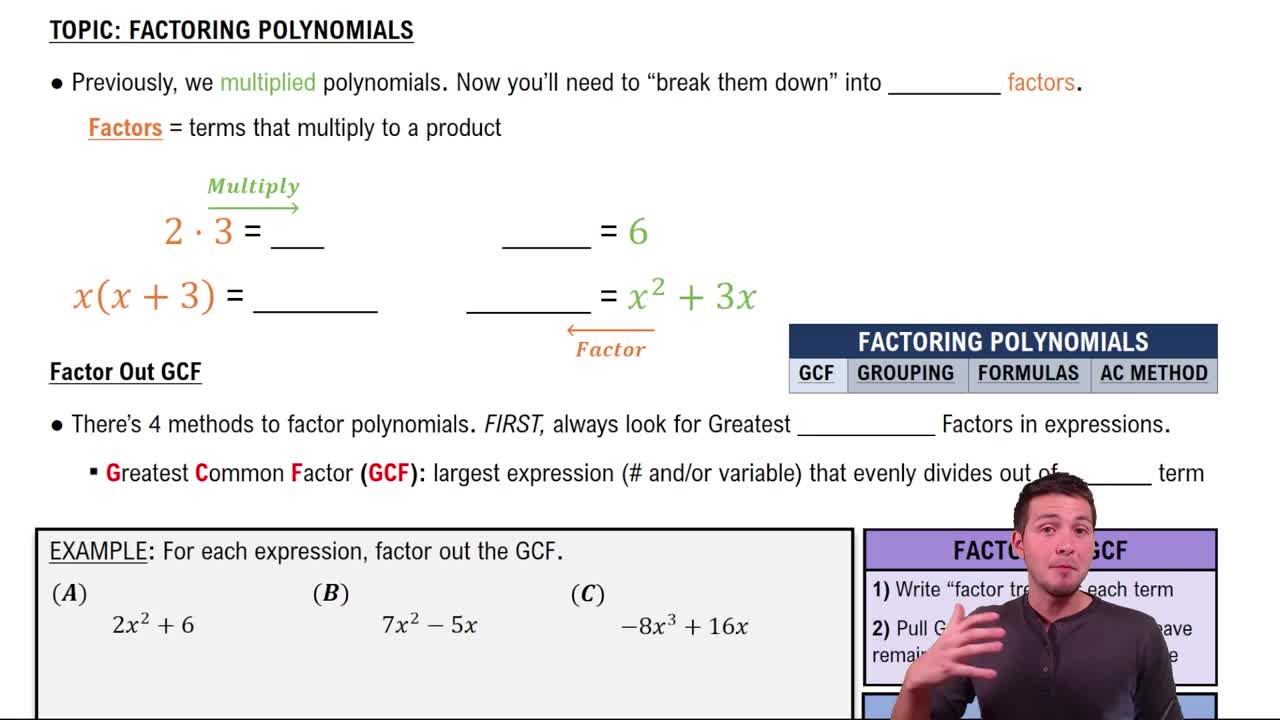
The Greatest Common Factor (GCF) is the largest integer or algebraic expression that divides each term of a polynomial without leaving a remainder. To find the GCF, identify the common factors in the coefficients and the variables of each term. For example, in the expression -4x³ + 32x² - 20x, the GCF is 4x, as it is the highest factor that can be factored out from all terms.
Factoring polynomials involves rewriting a polynomial as a product of its factors. This process simplifies expressions and can make solving equations easier. In the context of the given polynomial, factoring out the GCF helps to express the polynomial in a simpler form, which can be useful for further analysis or solving.
Factoring out a negative sign means extracting a negative value from the polynomial, which can change the signs of the terms. This is particularly useful when the leading coefficient is negative, as it can help to standardize the expression. In the given polynomial, factoring out the negative of the GCF will result in a polynomial with positive leading coefficients, making it easier to work with.

 2:37분
2:37분 검증된 단계별 안내
 5:57
5:57