Skip to main content
College Algebra
나의 코스
배우기
시험 준비
AI 튜터
학습 가이드
교과서적 해결책
플래시카드
탐험해 보세요
앱을 사용해 보세요
나의 코스
배우기
시험 준비
AI 튜터
학습 가이드
교과서적 해결책
플래시카드
탐험해 보세요
앱을 사용해 보세요
뒤로
Multiplying Polynomials quiz
1 학생이 이 점이 도움이 되었다고 느꼈습니다
카드를 뒤집기 위해 탭할 수 있습니다.
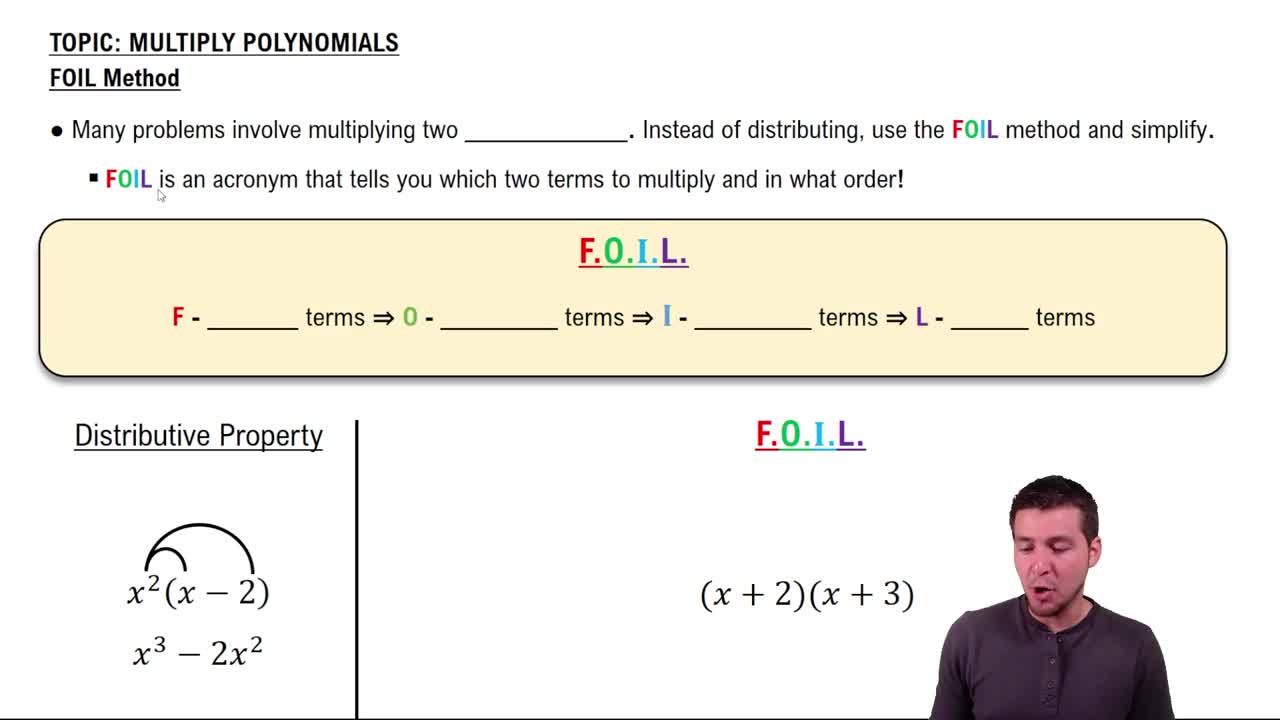
What does the FOIL acronym stand for when multiplying two binomials?
카드를 뒤집기 위해 탭할 수 있습니다.
👆
What does the FOIL acronym stand for when multiplying two binomials?
FOIL stands for First, Outer, Inner, Last, which are the pairs of terms you multiply together in order.
진행 상황 추적
컨트롤 버튼이 '내비게이션' 모드로 변경되었습니다.
1/15
관련 플래시카드
관련 실천
추천 영상
Multiplying Polynomials definitions
Multiplying Polynomials
15 용어
Multiplying Polynomials
0. Review of Algebra
3 문제점
주제
Callie
Factoring Polynomials
0. Review of Algebra
7 문제점
주제
Callie
0. Review of Algebra - Part 1 of 2
5 주제
10 문제점
장
Callie
0. Review of Algebra - Part 2 of 2
3 주제
10 문제점
장
Callie
03:41
Special Products - Cube Formulas
2482
views
45
rank
1
comments
04:14
Special Products - Square Formulas
2653
views
49
rank
03:07
FOIL
4143
views
121
rank
이 집합의 용어 (15)
하이드의 정의
What does the FOIL acronym stand for when multiplying two binomials?
FOIL stands for First, Outer, Inner, Last, which are the pairs of terms you multiply together in order.
When can you use the FOIL method for multiplying polynomials?
You can use FOIL only when multiplying two binomials (expressions with exactly two terms each).
What is the result of multiplying (x + 2)(x + 3) using FOIL?
The result is x^2 + 5x + 6 after combining like terms.
Why can't you use FOIL to multiply a binomial by a trinomial?
FOIL only works for two-term by two-term multiplication; for more terms, you must use the distributive property.
How do you multiply a binomial by a trinomial?
Break the binomial into two distributive problems, multiply each term by the entire trinomial, and then combine like terms.
What is a quick way to check if you multiplied polynomials correctly before simplifying?
Multiply the number of terms in each polynomial; the product is the number of terms you should have before combining like terms.
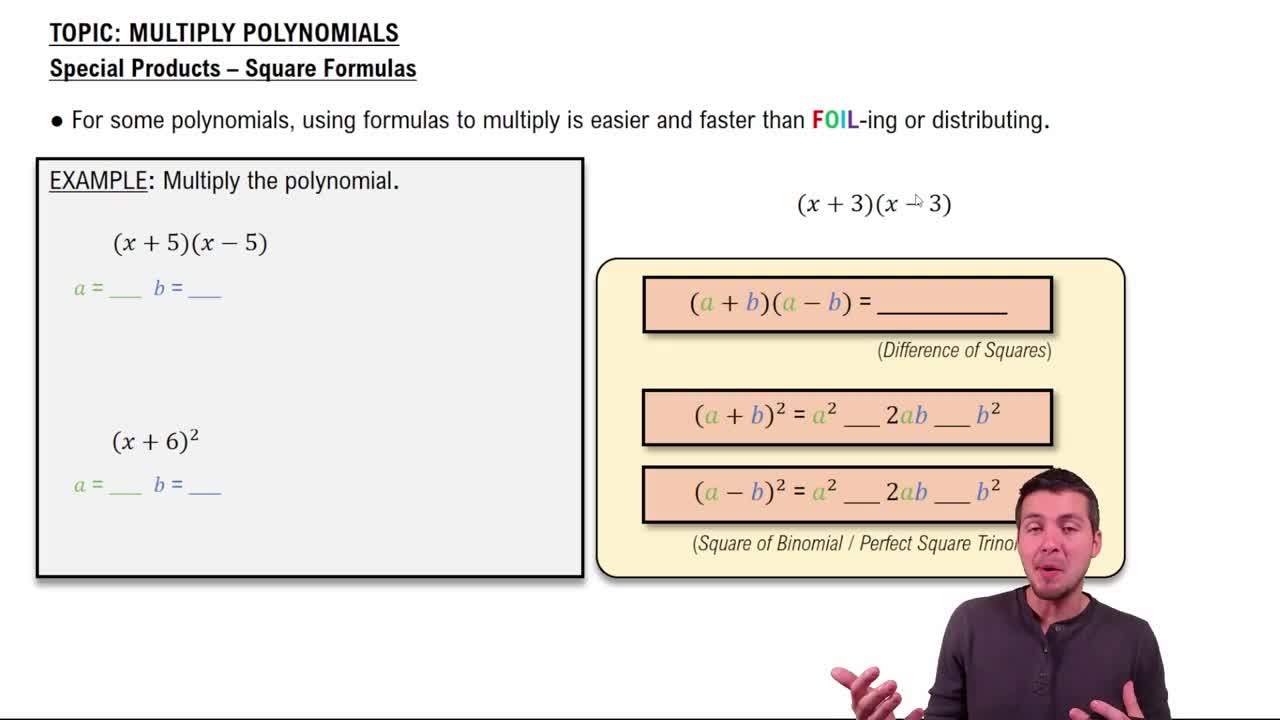
What is the special product formula for the difference of squares?
The formula is (A + B)(A - B) = A^2 - B^2.
What pattern do you notice in the middle terms when multiplying (A + B)(A - B)?
The middle terms always cancel out, leaving only A^2 - B^2.
What is the formula for the square of a binomial (A + B)^2?
The formula is (A + B)^2 = A^2 + 2AB + B^2.
How do you expand (x + 6)^2 using the special product formula?
It expands to x^2 + 12x + 36.
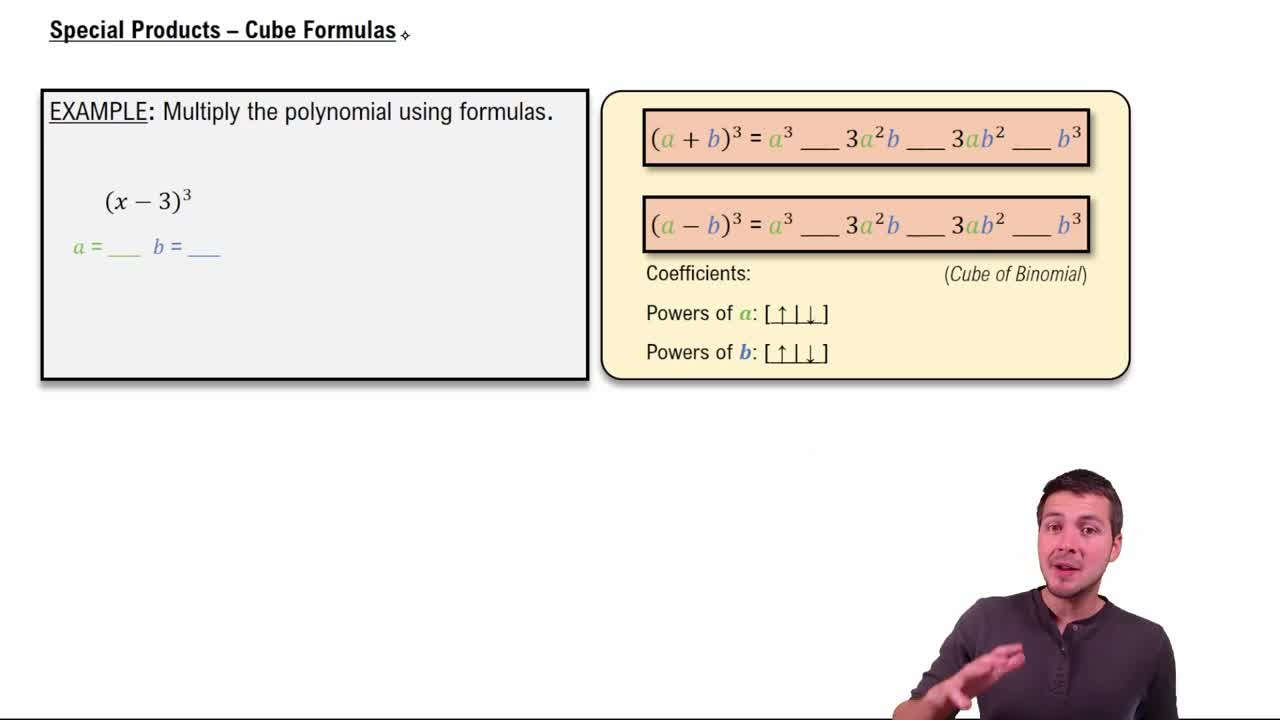
What is the formula for the cube of a binomial (A - B)^3?
The formula is (A - B)^3 = A^3 - 3A^2B + 3AB^2 - B^3.
How do the signs alternate in the expansion of (A - B)^3?
The signs alternate as negative, positive, negative: -, +, -.
What are the coefficients in the expansion of a binomial cube (A ± B)^3?
The coefficients are always 1, 3, 3, and 1.
How do the powers of A and B change in the expansion of (A + B)^3?
The powers of A decrease from 3 to 0, while the powers of B increase from 0 to 3.
Why is recognizing patterns in polynomial multiplication useful?
Recognizing patterns allows you to use shortcuts and special product formulas, making calculations faster and less complex.
 뒤로뒤로
뒤로뒤로
 03:41
03:41