Skip to main content
College Algebra
나의 코스
배우기
시험 준비
AI 튜터
학습 가이드
교과서적 해결책
플래시카드
탐험해 보세요
앱을 사용해 보세요
나의 코스
배우기
시험 준비
AI 튜터
학습 가이드
교과서적 해결책
플래시카드
탐험해 보세요
앱을 사용해 보세요
뒤로
Probability definitions
카드를 뒤집기 위해 탭할 수 있습니다.
Theoretical Probability
카드를 뒤집기 위해 탭할 수 있습니다.
👆
Theoretical Probability
Calculated using possible outcomes before any experiment, found by dividing favorable outcomes by total possible outcomes.
진행 상황 추적
컨트롤 버튼이 '내비게이션' 모드로 변경되었습니다.
1/15
관련 플래시카드
관련 실천
추천 영상
Probability quiz
Probability
15 용어
Probability
10. Combinatorics & Probability
3 문제점
주제
Callie
Combinatorics
10. Combinatorics & Probability
4 문제점
주제
Callie
10. Combinatorics & Probability
3 주제
5 문제점
장
Justin
2:57
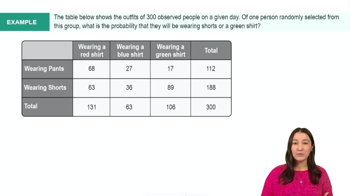
Probability of Non-Mutually Exclusive Events Example
999
views
2
rank
5:54
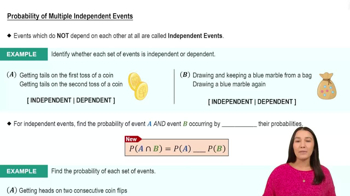
Probability of Multiple Independent Events
669
views
5:14
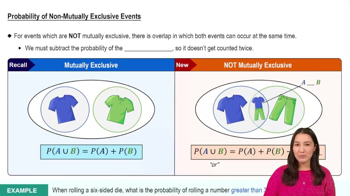
Probability of Non-Mutually Exclusive Events
799
views
2
rank
이 집합의 용어 (15)
하이드의 정의
Theoretical Probability
Calculated using possible outcomes before any experiment, found by dividing favorable outcomes by total possible outcomes.
Empirical Probability
Calculated from actual experimental data, found by dividing the number of times an event occurs by the total number of trials.
Sample Space
Set of all possible outcomes for a random experiment, often represented using curly brackets in set notation.
Event
Any outcome or group of outcomes from a random experiment, regardless of size or significance.
Complement
All outcomes in the sample space where a specific event does not occur; its probability is 1 minus the event's probability.
Mutually Exclusive Events
Events that cannot occur at the same time; their probabilities are added to find the chance of either occurring.
Non-Mutually Exclusive Events
Events that can occur simultaneously; their combined probability requires subtracting the overlap.
Independent Events
Events where the outcome of one does not affect the outcome of the other; their joint probability is the product of their probabilities.
Dependent Events
Events where the outcome of one affects the probability of the other occurring.
Set Notation
Mathematical symbols and brackets used to represent collections of outcomes, such as events or sample spaces.
Or Probability
Probability that at least one of multiple events occurs; calculated differently for mutually exclusive and non-mutually exclusive events.
And Probability
Probability that multiple events all occur; for independent events, found by multiplying their individual probabilities.
Overlap Region
Portion in a Venn diagram where two events share outcomes, relevant for non-mutually exclusive events.
Trial
A single occurrence or observation in an experiment, used to gather data for empirical probability.
Favorable Outcome
An outcome that satisfies the condition of the event being considered in a probability calculation.
 뒤로뒤로
뒤로뒤로

 2:57
2:57