Skip to main content
College Algebra
나의 코스
배우기
시험 준비
AI 튜터
학습 가이드
교과서적 해결책
플래시카드
탐험해 보세요
앱을 사용해 보세요
나의 코스
배우기
시험 준비
AI 튜터
학습 가이드
교과서적 해결책
플래시카드
탐험해 보세요
앱을 사용해 보세요
뒤로
Rational Equations quiz
2 학생들은 이 점이 도움이 되었다고 느꼈습니다
카드를 뒤집기 위해 탭할 수 있습니다.
What is a rational equation?
카드를 뒤집기 위해 탭할 수 있습니다.
👆
What is a rational equation?
A rational equation is an equation that contains a variable in the denominator of a fraction.
진행 상황 추적
컨트롤 버튼이 '내비게이션' 모드로 변경되었습니다.
1/15
관련 플래시카드
관련 실천
추천 영상
Rational Equations definitions
Rational Equations
15 용어
Rational Equations
1. Equations & Inequalities
7 문제점
주제
Callie
The Imaginary Unit
1. Equations & Inequalities
7 문제점
주제
Callie
1. Equations & Inequalities - Part 1 of 3
4 주제
11 문제점
장
Callie
1. Equations & Inequalities - Part 2 of 3
4 주제
10 문제점
장
Callie
1. Equations & Inequalities - Part 3 of 3
4 주제
10 문제점
장
Callie
05:56
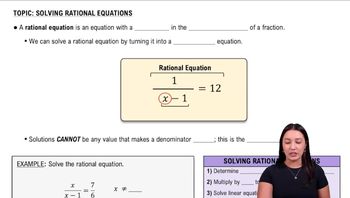
Introduction to Rational Equations
5647
views
133
rank
3
comments
05:21
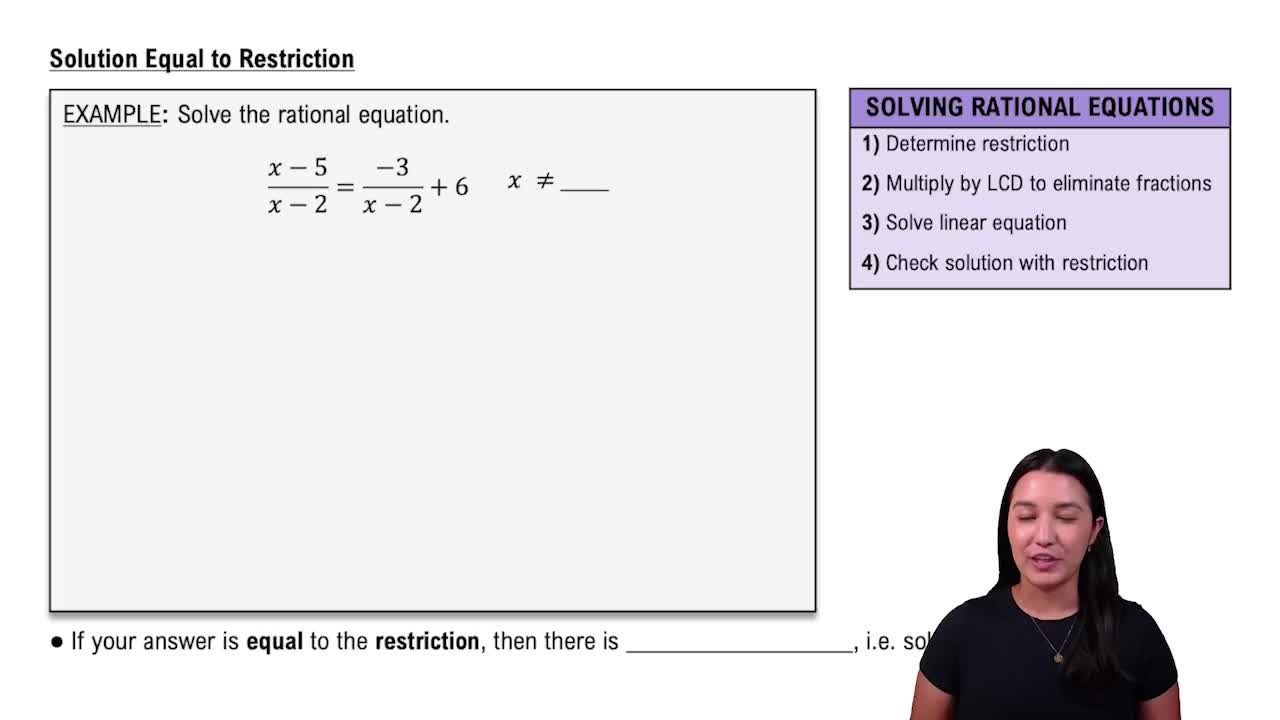
Restrictions on Rational Equations
3528
views
65
rank
이 집합의 용어 (15)
하이드의 정의
What is a rational equation?
A rational equation is an equation that contains a variable in the denominator of a fraction.
Why can't the denominator in a rational equation be zero?
Because division by zero is undefined, so any value of x that makes the denominator zero is not allowed.
What is a restriction in the context of rational equations?
A restriction is a value of x that would make the denominator zero, and thus is not allowed as a solution.
What is the first step in solving a rational equation?
The first step is to determine the restriction by setting the denominator equal to zero and solving for x.
How do you eliminate fractions in a rational equation?
Multiply every term in the equation by the least common denominator (LCD) to clear the fractions.
What do you do after multiplying by the LCD in a rational equation?
After multiplying by the LCD, simplify the equation to a linear form and solve for x.
Why must you check your solution against the restriction after solving a rational equation?
You must check to ensure your solution does not equal the restriction, as that would make the denominator zero.
What happens if your solution equals the restriction in a rational equation?
If your solution equals the restriction, there is no valid solution and the solution set is empty.
How do you find the least common denominator (LCD) when denominators have no common factors?
The LCD is simply the product of the different denominators.
What is the purpose of distributing the LCD to every term in the equation?
Distributing the LCD to every term ensures all denominators are eliminated from the equation.
After clearing denominators, what type of equation do you usually get?
You usually get a linear equation, which can be solved using familiar algebraic methods.
What should you do if your solution does not match the restriction?
If your solution does not match the restriction, it is a valid solution to the rational equation.
What does it mean if the solution set is empty for a rational equation?
It means there is no value of x that satisfies the equation without making the denominator zero.
Why is it important to include all terms when multiplying by the LCD?
It's important because missing a term could result in an incorrect equation and solution.
What is another way to say there is no solution to a rational equation?
You can say the solution set is the empty set, meaning no value of x works.
 뒤로뒤로
뒤로뒤로
 05:56
05:56