Skip to main content
College Algebra
나의 코스
배우기
시험 준비
AI 튜터
학습 가이드
교과서적 해결책
플래시카드
탐험해 보세요
앱을 사용해 보세요
나의 코스
배우기
시험 준비
AI 튜터
학습 가이드
교과서적 해결책
플래시카드
탐험해 보세요
앱을 사용해 보세요
뒤로
Rational Exponents quiz
카드를 뒤집기 위해 탭할 수 있습니다.
How can the square root of a number be expressed using exponents?
카드를 뒤집기 위해 탭할 수 있습니다.
👆
How can the square root of a number be expressed using exponents?
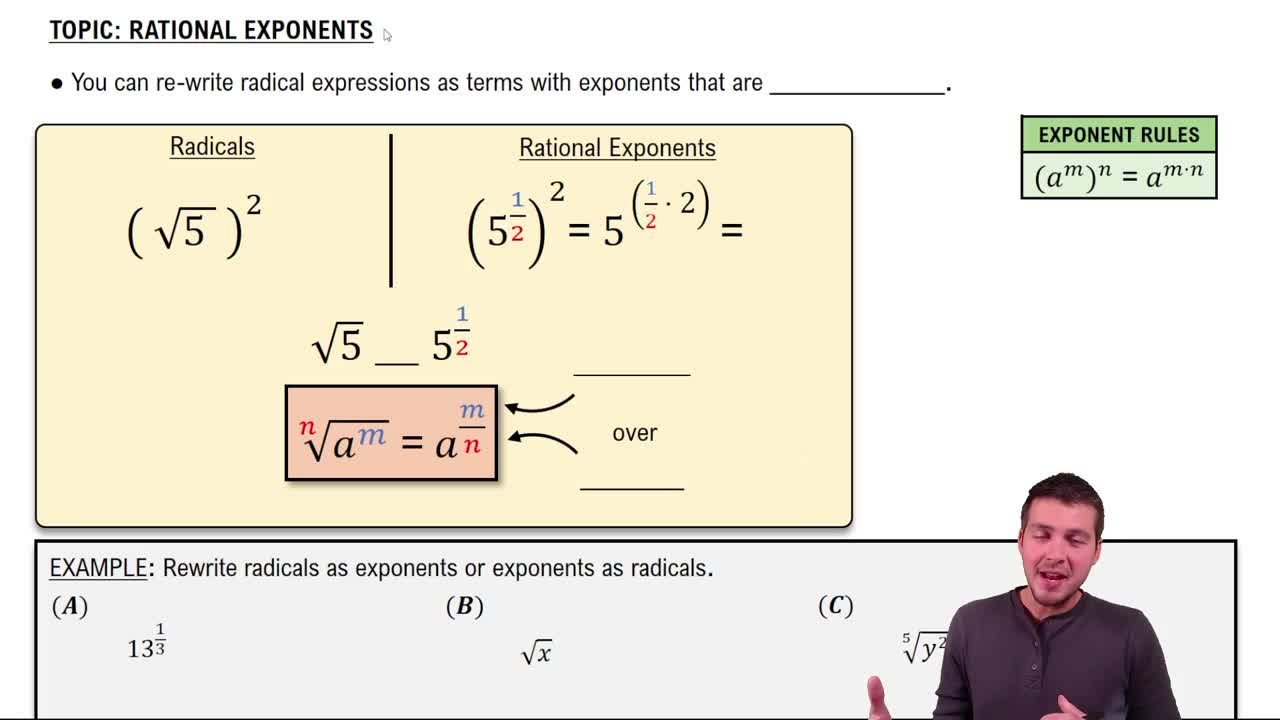
The square root of a number can be written as the number raised to the power of one-half.
진행 상황 추적
컨트롤 버튼이 '내비게이션' 모드로 변경되었습니다.
1/15
관련 플래시카드
관련 실천
추천 영상
Rational Exponents definitions
Rational Exponents
15 용어
Rational Exponents
0. Review of Algebra
4 문제점
주제
Callie
0. Review of Algebra - Part 1 of 2
5 주제
10 문제점
장
Callie
0. Review of Algebra - Part 2 of 2
3 주제
10 문제점
장
Callie
04:06
Rational Exponents
2921
views
123
rank
1
comments
이 집합의 용어 (15)
하이드의 정의
How can the square root of a number be expressed using exponents?
The square root of a number can be written as the number raised to the power of one-half.
What is a rational exponent?
A rational exponent is an exponent that is a fraction, representing both a power and a root.
How do you convert the cube root of 13 to an exponent?
The cube root of 13 is written as 13 to the one-third power, or 13^(1/3).
What does the denominator of a fractional exponent represent?
The denominator represents the index or root of the radical.
What does the numerator of a fractional exponent represent?
The numerator represents the power of the term inside the radical.
How would you write the square root of x as an exponent?
The square root of x is written as x^(1/2).
How do you convert y squared under a fifth root to a rational exponent?
It becomes y^(2/5), with 2 as the numerator and 5 as the denominator.
What is the relationship between squaring a number and taking its square root?
Squaring and taking the square root are inverse operations.
How do you convert 5^(1/2) to a radical expression?
5^(1/2) is equivalent to the square root of 5.
What happens when you square 5^(1/2)?
You get 5, because (5^(1/2))^2 = 5^(1/2*2) = 5^1.
How do you convert a radical with an invisible index to a rational exponent?
The invisible index is 2 for square roots, so the exponent is 1/2.
How do you convert 13^(1/3) to a radical?
13^(1/3) is the cube root of 13.
How do you convert a radical expression with a variable to a rational exponent?
The variable under the root becomes the base, and the exponent is 1 divided by the index.
What is the general rule for converting radicals to rational exponents?
The power inside the radical becomes the numerator, and the index becomes the denominator.
Why are rational exponents also called fractional exponents?
Because they are written as fractions, representing both a power and a root.
 뒤로뒤로
뒤로뒤로
 04:06
04:06