Skip to main content
College Algebra
나의 코스
배우기
시험 준비
AI 튜터
학습 가이드
교과서적 해결책
플래시카드
탐험해 보세요
앱을 사용해 보세요
나의 코스
배우기
시험 준비
AI 튜터
학습 가이드
교과서적 해결책
플래시카드
탐험해 보세요
앱을 사용해 보세요
뒤로
Rationalize Denominator quiz
카드를 뒤집기 위해 탭할 수 있습니다.
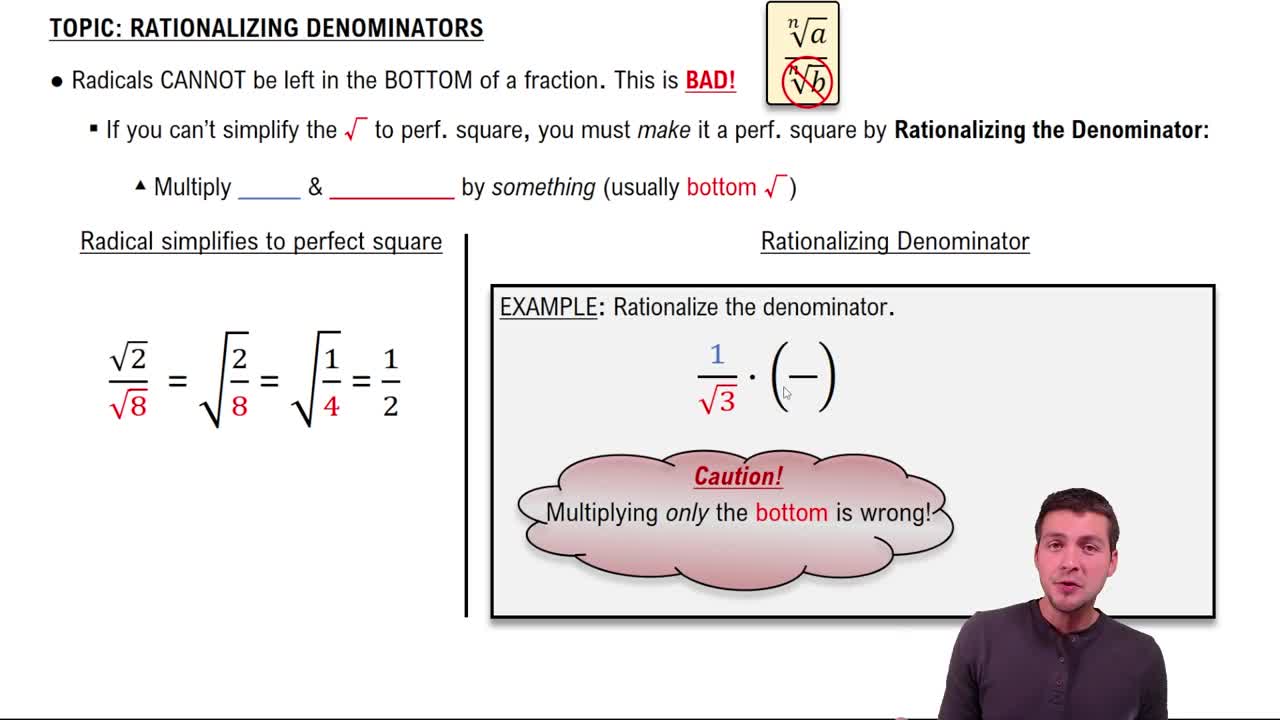
What does it mean to rationalize the denominator?
카드를 뒤집기 위해 탭할 수 있습니다.
👆
What does it mean to rationalize the denominator?
Rationalizing the denominator means eliminating any radicals from the bottom of a fraction.
진행 상황 추적
컨트롤 버튼이 '내비게이션' 모드로 변경되었습니다.
1/15
관련 플래시카드
관련 실천
추천 영상
Rationalize Denominator definitions
Rationalize Denominator
15 용어
Rational Exponents
0. Review of Algebra
4 문제점
주제
Callie
0. Review of Algebra - Part 1 of 2
5 주제
10 문제점
장
Callie
0. Review of Algebra - Part 2 of 2
3 주제
10 문제점
장
Callie
03:42
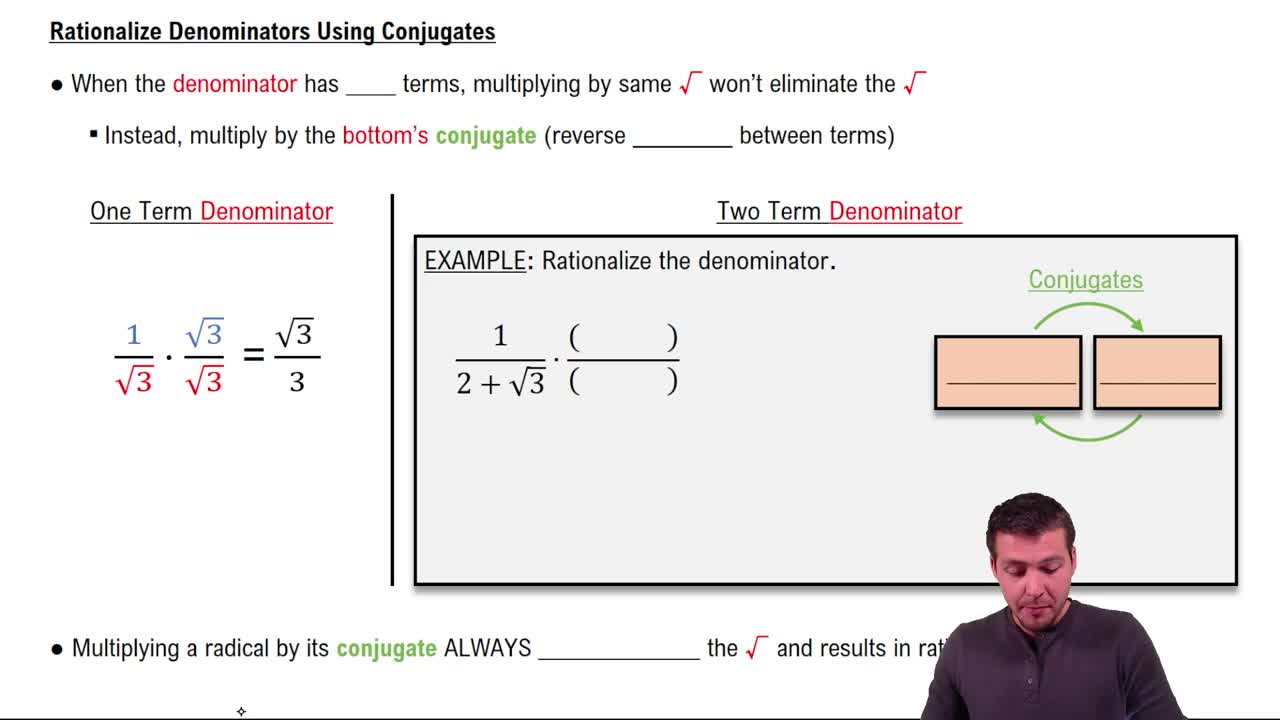
Rationalizing Denominators Using Conjugates
1568
views
13
rank
02:58
Rationalizing Denominators
2072
views
26
rank
이 집합의 용어 (15)
하이드의 정의
What does it mean to rationalize the denominator?
Rationalizing the denominator means eliminating any radicals from the bottom of a fraction.
Why can't you leave a radical in the denominator of a fraction?
It's a mathematical convention that radicals should not be left in the denominator; they must be removed to simplify the expression.
What do you multiply by to rationalize a denominator with a single radical term?
You multiply both the numerator and denominator by the radical itself.
What is the result of multiplying radical 3 by radical 3?
Multiplying radical 3 by radical 3 gives 3, which is a rational number.
If you have 1 over radical 3, what do you multiply by to rationalize the denominator?
You multiply both the numerator and denominator by radical 3.
What is the conjugate of 2 + radical 3?
The conjugate of 2 + radical 3 is 2 - radical 3.
Why do you use the conjugate to rationalize denominators with two terms?
Using the conjugate eliminates the radical by creating a difference of squares in the denominator.
What is the general formula for the conjugate of a + radical b?
The conjugate is a - radical b.
What happens when you multiply a binomial by its conjugate?
Multiplying a binomial by its conjugate results in a difference of squares, removing the radical.
What do you always have to do to both the numerator and denominator when rationalizing?
You must multiply both the numerator and denominator by the same value to keep the fraction equivalent.
What is the simplified form of 1 over radical 3 after rationalizing the denominator?
The simplified form is radical 3 over 3.
What is the simplified denominator when you multiply (2 + radical 3) by its conjugate (2 - radical 3)?
The denominator becomes 4 - 3, which simplifies to 1.
What is the result of rationalizing 1 over (2 + radical 3)?
The result is (2 - radical 3) over 1, or just 2 - radical 3.
When is it acceptable to have a radical in a fraction?
It is acceptable to have a radical in the numerator, but not in the denominator.
What are the two main methods for rationalizing denominators?
Multiply by the radical for single-term denominators, and by the conjugate for two-term denominators.
 뒤로뒤로
뒤로뒤로
 03:42
03:42