 뒤로
뒤로Basic Concepts of Algebraic Expressions in College Algebra
 03:50
03:50
이 집합의 용어 (10)
A numerical expression consists only of numbers and operations, such as addition or multiplication, without variables. Example: 2 × 3 + 5.
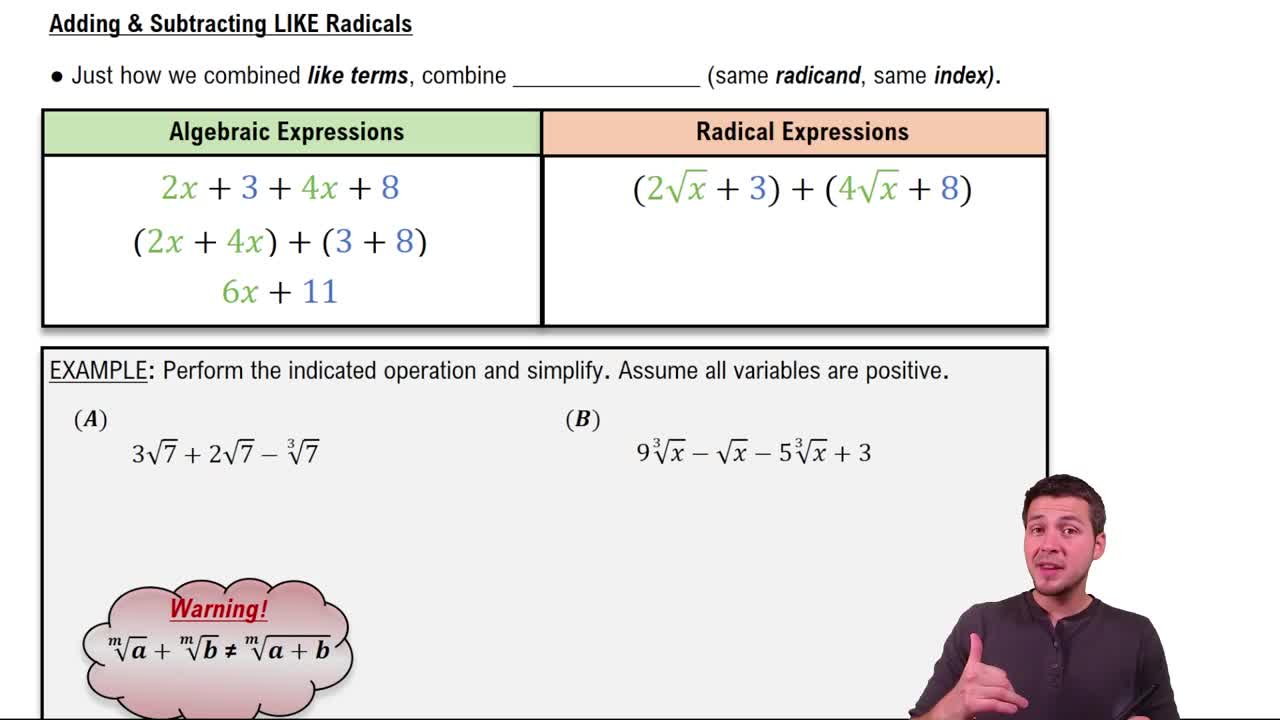
An algebraic expression includes variables (letters representing numbers) combined with numbers and operations. Example: 2x + 5.
A variable is a letter that represents a number which can change or vary within an expression.
A coefficient is a constant number that multiplies a variable, such as the 2 in 2x.
A constant is a standalone number that does not change, like the 5 in 2x + 5.
Coefficients typically appear before the variables in algebraic expressions.
Constants usually appear at the end of algebraic expressions.
Example: \(2 \times 3 + 5\)
Example: \(2x + 5\)
Algebraic expressions include variables and coefficients, while numerical expressions contain only numbers and operations.