Ch. 2 - Functions and Graphs
Blitzer - College Algebra 8th Edition
Blitzer8th EditionCollege AlgebraISBN: 9780136970514당신이 사용하는 게 아니라요?교과서 변경
3장, 문제 15

The functions in Exercises 11-28 are all one-to-one. For each function, a. Find an equation for f-1(x), the inverse function. b. Verify that your equation is correct by showing that f(ƒ-1 (x)) = = x and ƒ-1 (f(x)) = x. f(x) = 2x + 3

검증된 단계별 안내
1
Start with the given function: \(f(x) = 2x + 3\). To find the inverse function \(f^{-1}(x)\), first replace \(f(x)\) with \(y\): \(y = 2x + 3\).
Next, swap the roles of \(x\) and \(y\) to find the inverse: \(x = 2y + 3\). This means we are solving for \(y\) in terms of \(x\).
Isolate \(y\) by subtracting 3 from both sides: \(x - 3 = 2y\). Then, divide both sides by 2 to solve for \(y\): \(y = \frac{x - 3}{2}\).
Rewrite \(y\) as the inverse function notation: \(f^{-1}(x) = \frac{x - 3}{2}\). This is the formula for the inverse function.
To verify the inverse, compute \(f(f^{-1}(x))\) by substituting \(f^{-1}(x)\) into \(f(x)\) and simplify to check if it equals \(x\). Then compute \(f^{-1}(f(x))\) by substituting \(f(x)\) into \(f^{-1}(x)\) and simplify to check if it equals \(x\).

비슷한 문제에 대한 검증된 영상 답변:

이 영상 해법은 위 문제에 도움이 된다고 튜터들이 추천한 것입니다.
영상 길이:
2m
도움이 되었나요?

주요 개념

질문에 올바르게 답하기 위해 반드시 이해해야 하는 핵심 개념들은 다음과 같습니다.

One-to-One Functions

A one-to-one function assigns each input a unique output and vice versa, ensuring that the function has an inverse. This property is essential because only one-to-one functions can be inverted, meaning each output corresponds to exactly one input.
추천 영상:
4:07
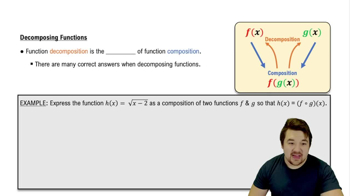
Decomposition of Functions

Finding the Inverse Function

To find the inverse of a function, swap the roles of x and y in the equation and solve for y. This process reverses the original function's operations, allowing you to express the inverse function f⁻¹(x) that 'undoes' f(x).
추천 영상:
4:30
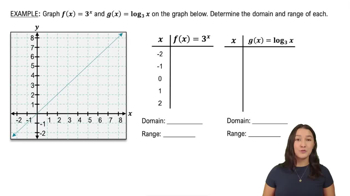
Graphing Logarithmic Functions

Verification of Inverse Functions

Verifying an inverse involves showing that composing the function and its inverse returns the original input: f(f⁻¹(x)) = x and f⁻¹(f(x)) = x. This confirms that the two functions are true inverses, effectively reversing each other's effects.
추천 영상:
4:30
Graphing Logarithmic Functions