Ch. 8 - Sequences, Induction, and Probability
Blitzer - College Algebra 8th Edition
Blitzer8th EditionCollege AlgebraISBN: 9780136970514당신이 사용하는 게 아니라요?교과서 변경
9장, 문제 72

Evaluate the expression. *permutation notation* the number of permutations 8 things taken 3 at a time (sub 8)P(sub 3)

검증된 단계별 안내
1
Understand the permutation formula: The number of permutations of n things taken r at a time is given by the formula: P(n,r)=n!(n-r)!, where n! is the factorial of n.
Identify the values of n and r from the problem: Here, n = 8 and r = 3. This means we are calculating the number of permutations of 8 things taken 3 at a time.
Substitute the values of n and r into the formula: P(8,3)=8!(8-3)!.
Simplify the denominator: Calculate 8-3=5, so the formula becomes: 8!5!.
Simplify the factorials: Expand the numerator and denominator. The numerator is 8×7×6×5!, and the denominator is 5!. Cancel out the common 5! terms, leaving 8×7×6.

비슷한 문제에 대한 검증된 영상 답변:

이 영상 해법은 위 문제에 도움이 된다고 튜터들이 추천한 것입니다.
영상 길이:
2m
도움이 되었나요?

주요 개념

질문에 올바르게 답하기 위해 반드시 이해해야 하는 핵심 개념들은 다음과 같습니다.

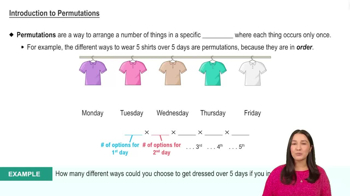
Permutations

Permutations refer to the different ways in which a set of items can be arranged or ordered. In mathematics, the number of permutations of 'n' items taken 'r' at a time is calculated using the formula P(n, r) = n! / (n - r)!, where 'n!' denotes the factorial of 'n'. This concept is crucial for understanding how to count arrangements when the order of selection matters.
추천 영상:
7:11
Introduction to Permutations

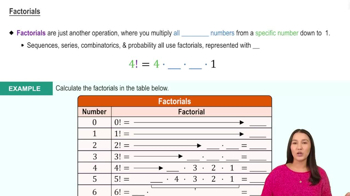
Factorial

The factorial of a non-negative integer 'n', denoted as 'n!', is the product of all positive integers up to 'n'. For example, 5! = 5 × 4 × 3 × 2 × 1 = 120. Factorials are fundamental in permutations and combinations, as they provide the necessary counts of arrangements and selections in various mathematical contexts.
추천 영상:
5:22
Factorials

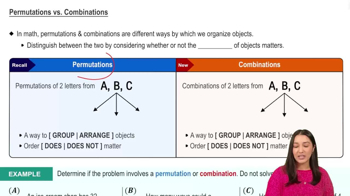
Combination vs. Permutation

While both permutations and combinations deal with selecting items from a set, the key difference lies in the importance of order. Permutations consider the arrangement of items as significant, while combinations do not. Understanding this distinction is essential when determining which formula to apply in problems involving selections of items.
추천 영상:
3:18
Permutations vs. Combinations