Ch. 1 - Equations and Inequalities
Lial - College Algebra 13th Edition
Lial13th EditionCollege AlgebraISBN: 9780136881063당신이 사용하는 게 아니라요?교과서 변경
2장, 문제 98

Answer each question. Find the values of a, b, and c for which the quadratic equation. ax2 + bx + c = 0 has the given numbers as solutions. (Hint: Use the zero-factor property in reverse.) i, -i

검증된 단계별 안내
1
Recall that if a quadratic equation has solutions (roots) \( r_1 \) and \( r_2 \), then it can be written as \( a(x - r_1)(x - r_2) = 0 \), where \( a \) is a nonzero constant.
Given the solutions \( i \) and \( -i \), write the factored form of the quadratic as \( a(x - i)(x + i) = 0 \).
Use the difference of squares formula to expand \( (x - i)(x + i) \): \( (x - i)(x + i) = x^2 - (i)^2 \).
Since \( i^2 = -1 \), substitute this into the expression to get \( x^2 - (-1) = x^2 + 1 \).
Therefore, the quadratic equation can be written as \( a(x^2 + 1) = 0 \). From this, identify \( a \), \( b \), and \( c \) by comparing to the standard form \( ax^2 + bx + c = 0 \).

비슷한 문제에 대한 검증된 영상 답변:

이 영상 해법은 위 문제에 도움이 된다고 튜터들이 추천한 것입니다.
영상 길이:
3m
도움이 되었나요?

주요 개념

질문에 올바르게 답하기 위해 반드시 이해해야 하는 핵심 개념들은 다음과 같습니다.

Quadratic Equations

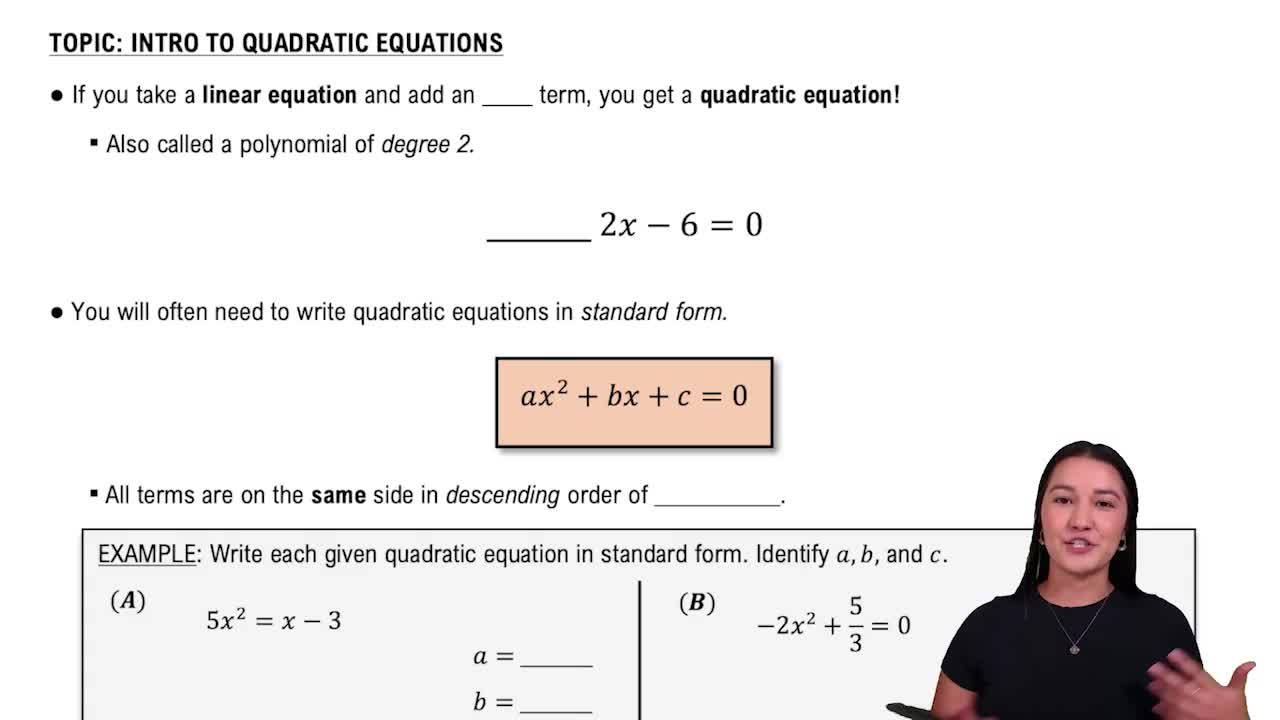
A quadratic equation is a second-degree polynomial equation of the form ax^2 + bx + c = 0, where a, b, and c are constants and a ≠ 0. The solutions (roots) of the equation are the values of x that satisfy it. Understanding the structure of quadratic equations is essential for finding coefficients given roots.
추천 영상:
05:35
Introduction to Quadratic Equations

Zero-Factor Property

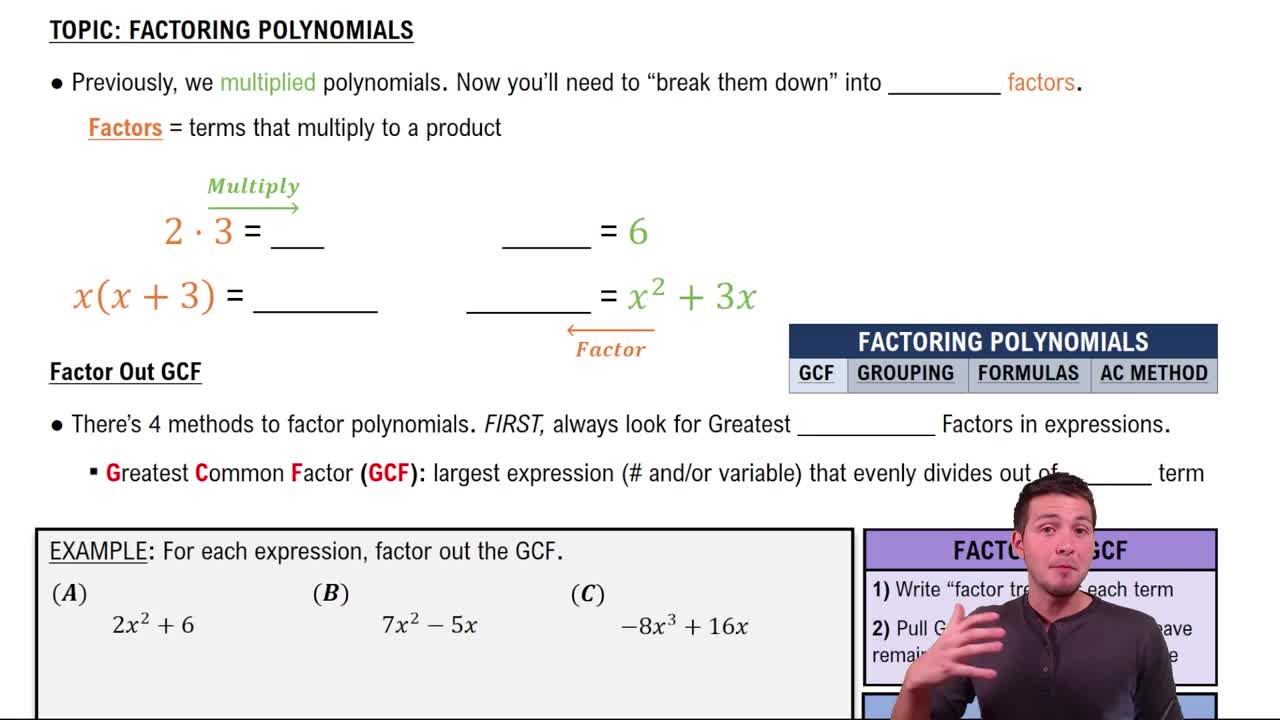
The zero-factor property states that if the product of two factors equals zero, then at least one of the factors must be zero. In reverse, if the solutions of a quadratic are known, the equation can be written as a product of factors set to zero, such as (x - r1)(x - r2) = 0, where r1 and r2 are roots.
추천 영상:
07:30
Introduction to Factoring Polynomials

Complex Conjugate Roots

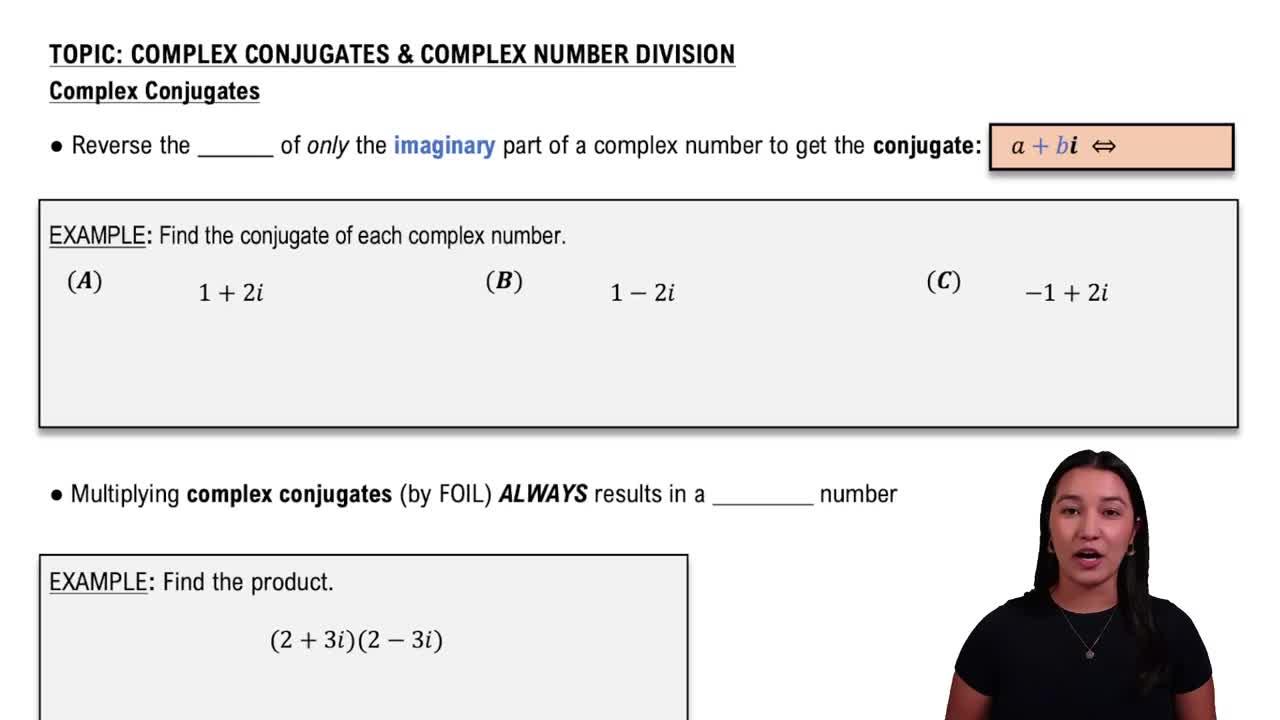
When a quadratic equation with real coefficients has complex roots, they occur in conjugate pairs like i and -i. This means the quadratic can be expressed as (x - i)(x + i) = 0, which expands to x^2 + 1 = 0. Recognizing this helps in determining the coefficients a, b, and c.
추천 영상:
05:33
Complex Conjugates