Ch. 1 - Equations and Inequalities
Lial - College Algebra 13th Edition
Lial13th EditionCollege AlgebraISBN: 9780136881063당신이 사용하는 게 아니라요?교과서 변경
2장, 문제 85

Evaluate the discriminant for each equation. Then use it to determine the number of distinct solutions, and tell whether they are rational, irrational, or nonreal complex numbers. (Do not solve the equation.) 3x2 + 5x + 2 = 0

검증된 단계별 안내
1
Identify the coefficients of the quadratic equation \(3x^2 + 5x + 2 = 0\). Here, \(a = 3\), \(b = 5\), and \(c = 2\).
Recall the formula for the discriminant of a quadratic equation \(ax^2 + bx + c = 0\), which is given by \(\Delta = b^2 - 4ac\).
Substitute the values of \(a\), \(b\), and \(c\) into the discriminant formula: \(\Delta = (5)^2 - 4 \times 3 \times 2\).
Calculate the value of the discriminant expression (but do not simplify to the final number as per instructions).
Use the value of the discriminant to determine the nature of the roots: if \(\Delta > 0\), there are two distinct real roots; if \(\Delta = 0\), there is one real root (a repeated root); if \(\Delta < 0\), the roots are nonreal complex numbers. Also, if \(\Delta\) is a perfect square, the roots are rational; otherwise, they are irrational.

비슷한 문제에 대한 검증된 영상 답변:

이 영상 해법은 위 문제에 도움이 된다고 튜터들이 추천한 것입니다.
영상 길이:
5m
도움이 되었나요?

주요 개념

질문에 올바르게 답하기 위해 반드시 이해해야 하는 핵심 개념들은 다음과 같습니다.

Discriminant of a Quadratic Equation

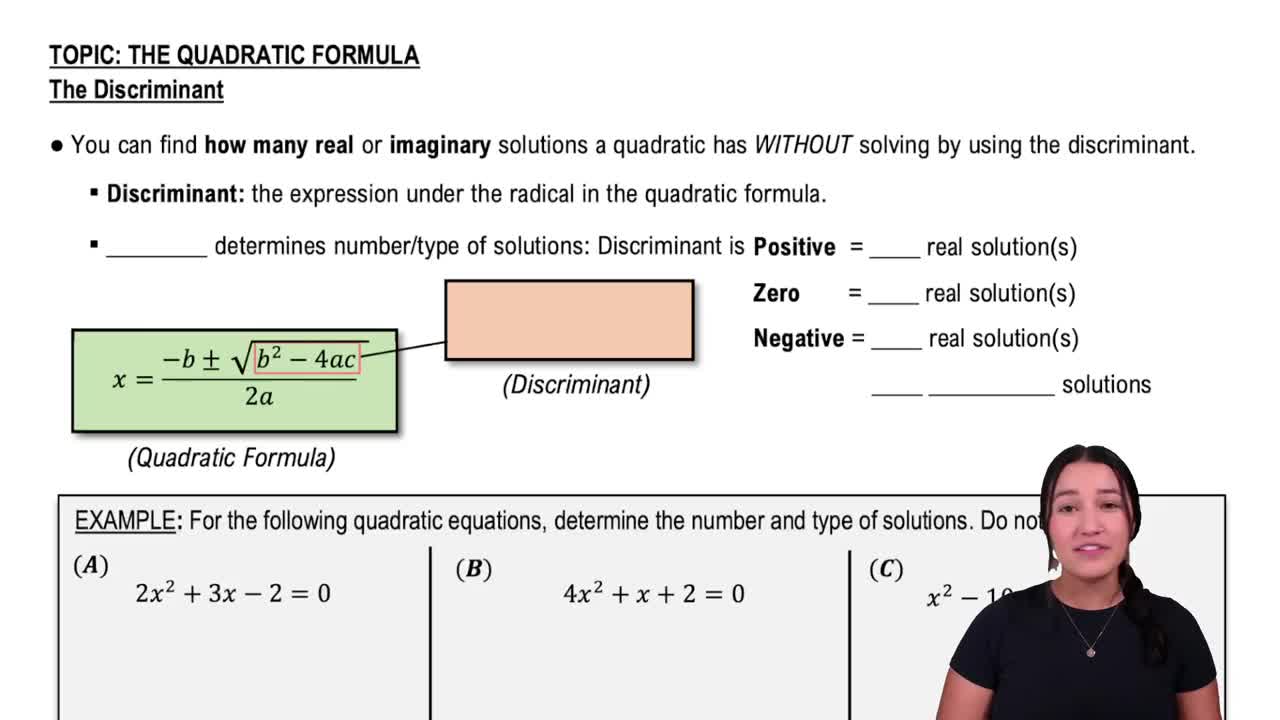
The discriminant is the part of the quadratic formula under the square root, given by b² - 4ac for an equation ax² + bx + c = 0. It determines the nature and number of solutions without solving the equation.
추천 영상:
04:11
The Discriminant

Number and Nature of Solutions Based on the Discriminant

If the discriminant is positive, there are two distinct real solutions; if zero, one real repeated solution; if negative, two nonreal complex solutions. This helps classify the roots quickly.
추천 영상:
4:47
The Number e

Rational vs. Irrational Solutions

When the discriminant is a perfect square, the solutions are rational numbers. If it is positive but not a perfect square, the solutions are irrational. This distinction helps understand the exact form of the roots.
추천 영상:
05:56
Introduction to Rational Equations