Evaluate the discriminant for each equation. Then use it to determine the number of distinct solutions, and tell whether they are rational, irrational, or nonreal complex numbers. (Do not solve the equation.) 4x2 = -6x + 3
Ch. 1 - Equations and Inequalities

2장, 문제 89
Evaluate the discriminant for each equation. Then use it to determine the number of distinct solutions, and tell whether they are rational, irrational, or nonreal complex numbers. (Do not solve the equation.) See Example 9.
검증된 단계별 안내1
Identify the coefficients of the quadratic equation in the form \(ax^2 + bx + c = 0\). Here, \(a = 9\), \(b = 11\), and \(c = 4\).
Recall the formula for the discriminant: \(\Delta = b^2 - 4ac\).
Substitute the values of \(a\), \(b\), and \(c\) into the discriminant formula: \(\Delta = (11)^2 - 4 \times 9 \times 4\).
Calculate the value of the discriminant (do not simplify fully as per instructions).
Use the value of the discriminant to determine the nature of the roots: if \(\Delta > 0\) and a perfect square, roots are rational and distinct; if \(\Delta > 0\) but not a perfect square, roots are irrational and distinct; if \(\Delta = 0\), roots are real and equal; if \(\Delta < 0\), roots are nonreal complex numbers.

비슷한 문제에 대한 검증된 영상 답변:
이 영상 해법은 위 문제에 도움이 된다고 튜터들이 추천한 것입니다.
영상 길이:
4m도움이 되었나요?
주요 개념
질문에 올바르게 답하기 위해 반드시 이해해야 하는 핵심 개념들은 다음과 같습니다.
Discriminant of a Quadratic Equation
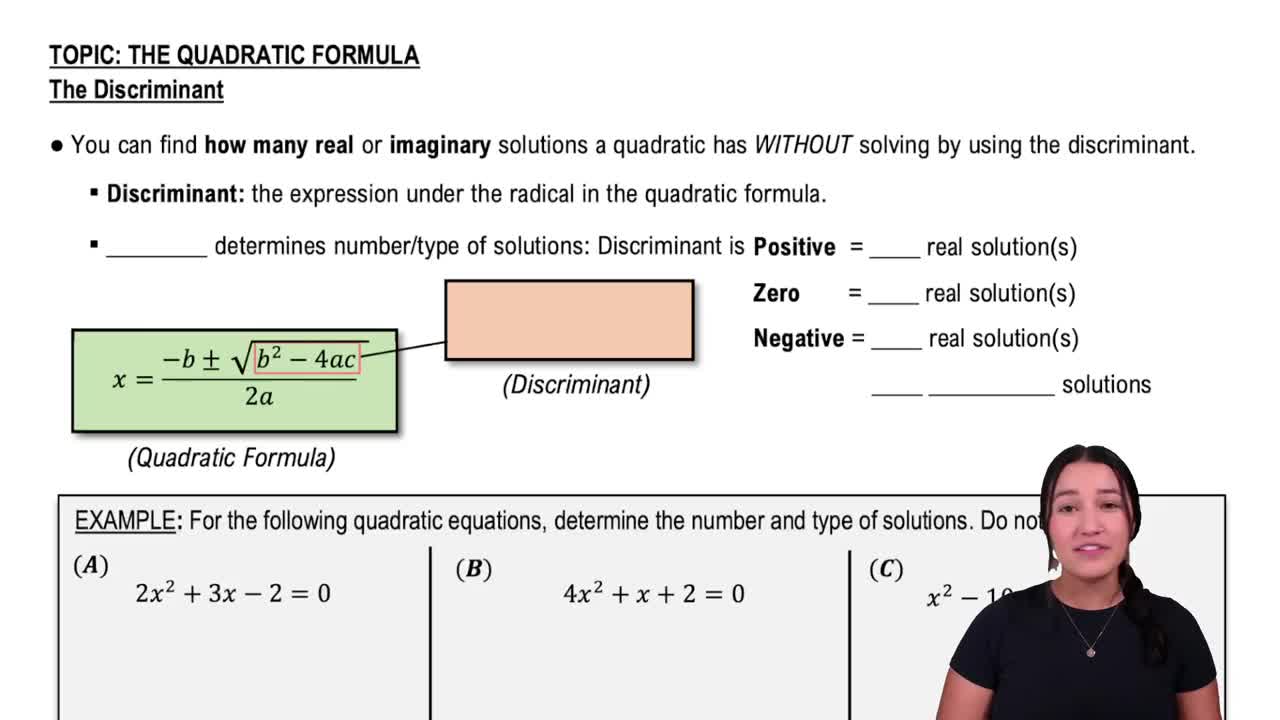
The discriminant is the part of the quadratic formula under the square root, given by b² - 4ac for an equation ax² + bx + c = 0. It determines the nature and number of solutions without solving the equation.
추천 영상:
The Discriminant
Number and Type of Solutions Based on the Discriminant
If the discriminant is positive, there are two distinct real solutions; if zero, one real repeated solution; if negative, two nonreal complex solutions. This helps classify the roots as real or complex.
추천 영상:
The Number e
Rational vs. Irrational Solutions
When the discriminant is a perfect square, the solutions are rational numbers; if it is positive but not a perfect square, the solutions are irrational. This distinction helps describe the exact nature of the roots.
추천 영상:
Introduction to Rational Equations
관련 실천
교과서 질문
1380
views
교과서 질문
Use the method described in Exercises 83–86, if applicable, and properties of absolute value to solve each equation or inequality. (Hint: Exercises 99 and 100 can be solved by inspection.) | 3x2 - 14x | = 5
640
views
교과서 질문
Use the method described in Exercises 83–86, if applicable, and properties of absolute value to solve each equation or inequality. (Hint: Exercises 99 and 100 can be solved by inspection.) | 3x2 + x | = 14
667
views
교과서 질문
Simplify each power of i. i25
973
views
교과서 질문
Determine whether each equation has a graph that is symmetric with respect to the x-axis, the y-axis, the origin, or none of these.
807
views
1
rank
교과서 질문
Solve each inequality. Give the solution set using interval notation.
822
views