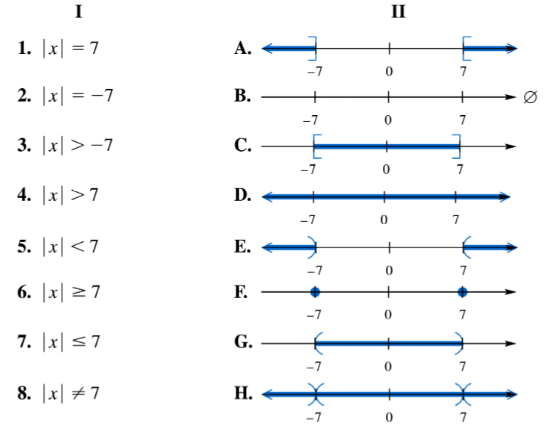
Match each equation or inequality in Column I with the graph of its solution set in Column II. | x | = 7
검증된 단계별 안내
1
Understand the equation given: \(|x| = 7\). This means the absolute value of \(x\) is equal to 7.
Recall that the absolute value \(|x|\) represents the distance of \(x\) from 0 on the number line, regardless of direction.
Set up two equations based on the definition of absolute value: \(x = 7\) and \(x = -7\).
Recognize that the solution set consists of two points on the number line: one at 7 and one at -7.
Match this solution set to the graph in Column II that shows exactly these two points, and no other values.
비슷한 문제에 대한 검증된 영상 답변:
이 영상 해법은 위 문제에 도움이 된다고 튜터들이 추천한 것입니다.
영상 길이:
2m
영상 재생:
0 댓글
도움이 되었나요?
주요 개념
질문에 올바르게 답하기 위해 반드시 이해해야 하는 핵심 개념들은 다음과 같습니다.
Absolute Value Definition
The absolute value of a number represents its distance from zero on the number line, always as a non-negative value. For example, |x| = 7 means x is 7 units away from zero, so x can be either 7 or -7.
To solve an equation like |x| = a, where a > 0, split it into two cases: x = a and x = -a. This reflects the two points on the number line that satisfy the distance condition.
The solution set of |x| = 7 consists of two points, x = 7 and x = -7. On a graph, these are represented as two distinct points on the number line, showing all values that satisfy the equation.


 검증된 단계별 안내
 08:07
08:07