Use the following facts. If x represents an integer, then x+1 represents the next consecutive integer. If x represents an even integer, then x+2 represents the next consecutive even integer. If x represents an odd integer, then x+2 represents the next consecutive odd integer. The difference of the squares of two positive consecutive odd integers is 32. Find the integers.
Ch. 1 - Equations and Inequalities

2장, 문제 17
Solve each equation. | (6x + 1)/ (x - 1) | = 3
검증된 단계별 안내1
Recognize that the equation involves an absolute value expression: \(\left| \frac{6x + 1}{x - 1} \right| = 3\). Recall that \(|A| = B\) means \(A = B\) or \(A = -B\).
Set up two separate equations to solve: \(\frac{6x + 1}{x - 1} = 3\) and \(\frac{6x + 1}{x - 1} = -3\).
Solve the first equation \(\frac{6x + 1}{x - 1} = 3\) by multiplying both sides by \((x - 1)\) to eliminate the denominator, giving \(6x + 1 = 3(x - 1)\).
Solve the second equation \(\frac{6x + 1}{x - 1} = -3\) similarly by multiplying both sides by \((x - 1)\), resulting in \(6x + 1 = -3(x - 1)\).
For each equation, expand the right side, collect like terms, and solve for \(x\). Finally, check for any restrictions such as \(x \neq 1\) because the denominator cannot be zero.

비슷한 문제에 대한 검증된 영상 답변:
이 영상 해법은 위 문제에 도움이 된다고 튜터들이 추천한 것입니다.
영상 길이:
2m도움이 되었나요?
주요 개념
질문에 올바르게 답하기 위해 반드시 이해해야 하는 핵심 개념들은 다음과 같습니다.
Absolute Value Equations
An absolute value equation involves expressions within absolute value bars, which represent the distance from zero on the number line. To solve, set up two separate equations: one where the expression equals the positive value, and one where it equals the negative value. This accounts for both possible cases of the absolute value.
추천 영상:
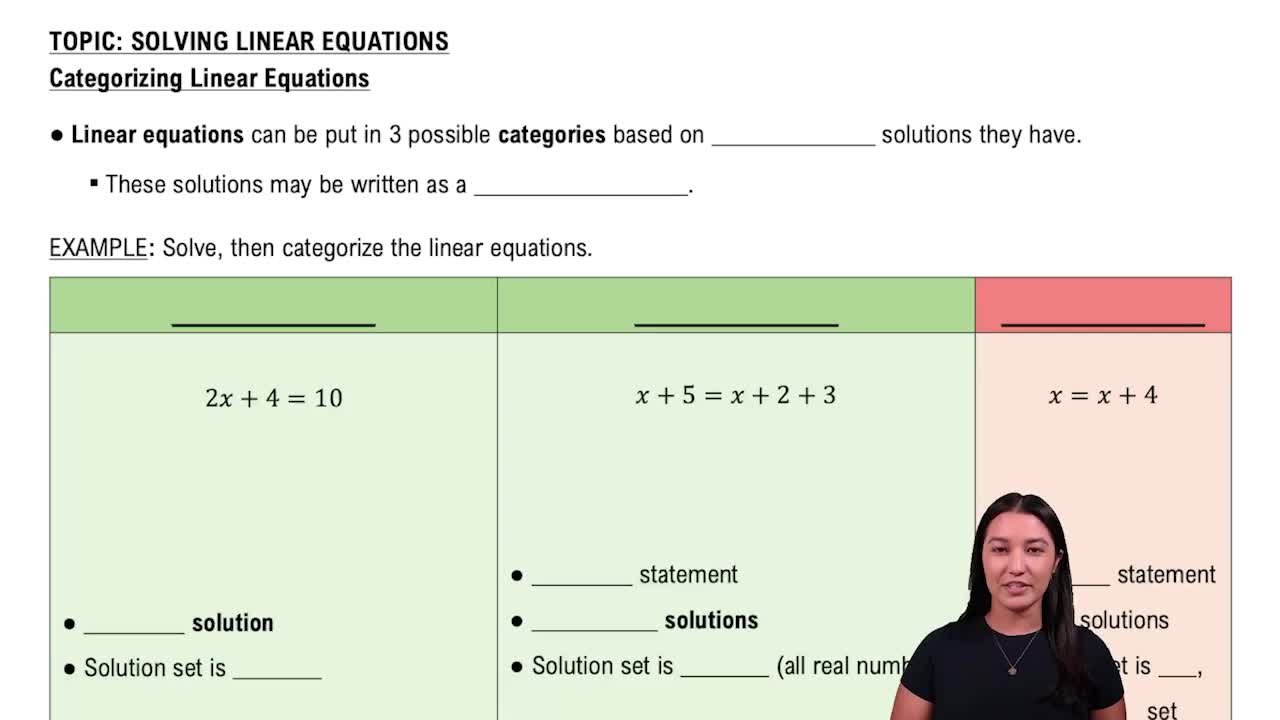
Categorizing Linear Equations
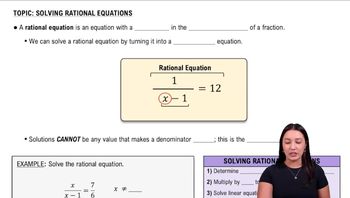
Solving Rational Equations
A rational equation contains variables in the denominator. To solve, first identify restrictions where the denominator is zero, then multiply both sides by the least common denominator to eliminate fractions. Afterward, solve the resulting equation while checking for extraneous solutions.
추천 영상:
Introduction to Rational Equations
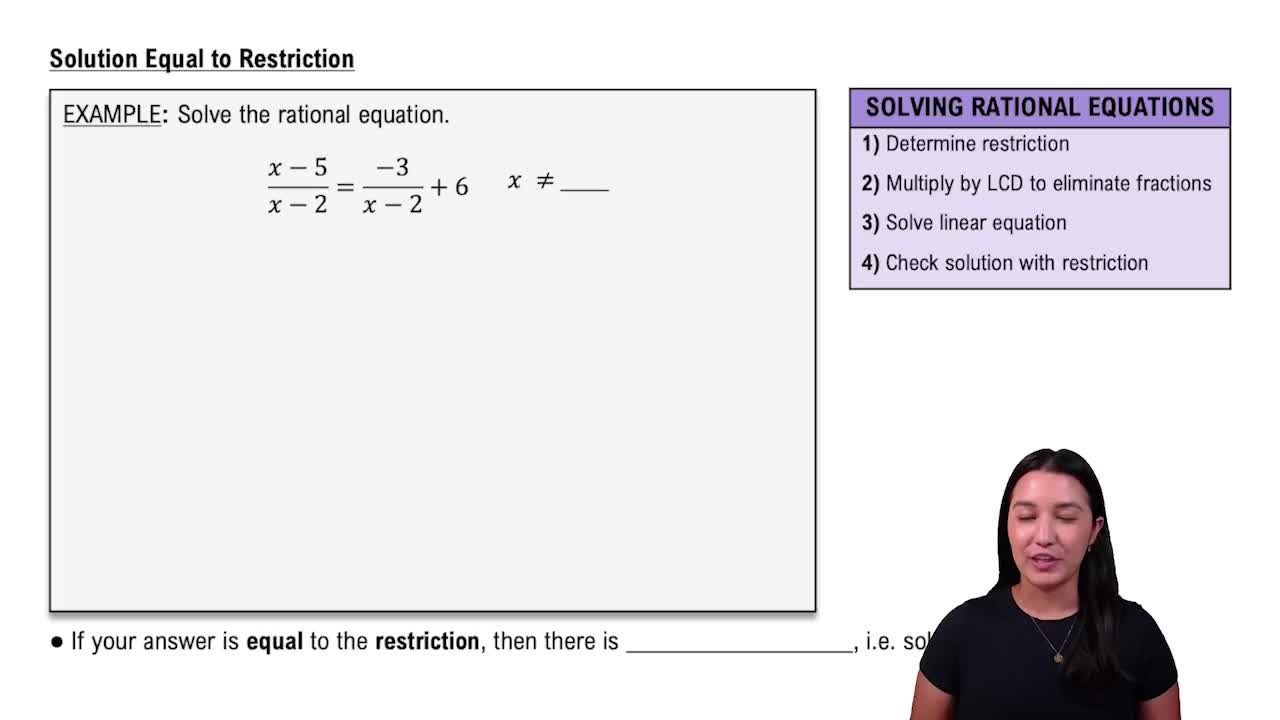
Checking for Extraneous Solutions
Extraneous solutions arise when solving equations involving absolute values or rational expressions, especially after multiplying both sides by expressions containing variables. Always substitute solutions back into the original equation to verify their validity and discard any that do not satisfy the original equation.
추천 영상:
Restrictions on Rational Equations
관련 실천
교과서 질문
841
views
교과서 질문
Solve each inequality. Give the solution set in interval notation. 3(x+5)+1≥5+3x
961
views
교과서 질문
Solve each equation.
546
views
교과서 질문
Solve each equation. See Example 1. (2x+5)/2 - 3x/(x-2) = x
567
views
교과서 질문
Solve each equation. (4x+3)/4 - 2x/(x+1) = x
572
views
교과서 질문
Use the following facts. If x represents an integer, then x+1 represents the next consecutive integer. If x represents an even integer, then x+2 represents the next consecutive even integer. If x represents an odd integer, then x+2 represents the next consecutive odd integer. The difference of the squares of two positive consecutive even integers is 84. Find the integers.
853
views
