Ch. 1 - Equations and Inequalities
Lial - College Algebra 13th Edition
Lial13th EditionCollege AlgebraISBN: 9780136881063당신이 사용하는 게 아니라요?교과서 변경
2장, 문제 61

Solve each equation or inequality. | 4.3x + 9.8| < 0

검증된 단계별 안내
1
Recognize that the problem involves an absolute value inequality: \(|4.3x + 9.8| < 0\).
Recall the definition of absolute value: \(|A|\) represents the distance of \(A\) from zero on the number line, and it is always greater than or equal to zero.
Understand that \(|4.3x + 9.8|\) is always \(\geq 0\) for any real number \(x\), so the inequality \(|4.3x + 9.8| < 0\) asks when the absolute value is less than zero.
Since absolute values cannot be negative, there are no real values of \(x\) that satisfy \(|4.3x + 9.8| < 0\).
Conclude that the solution set is empty, meaning no solution exists for this inequality.

비슷한 문제에 대한 검증된 영상 답변:

이 영상 해법은 위 문제에 도움이 된다고 튜터들이 추천한 것입니다.
영상 길이:
39s
도움이 되었나요?

주요 개념

질문에 올바르게 답하기 위해 반드시 이해해야 하는 핵심 개념들은 다음과 같습니다.

Absolute Value Inequalities

Absolute value inequalities involve expressions where the absolute value of a variable or expression is compared to a number. The absolute value represents the distance from zero, so it is always non-negative. Understanding how to interpret and solve inequalities involving absolute values is essential.
추천 영상:
06:07
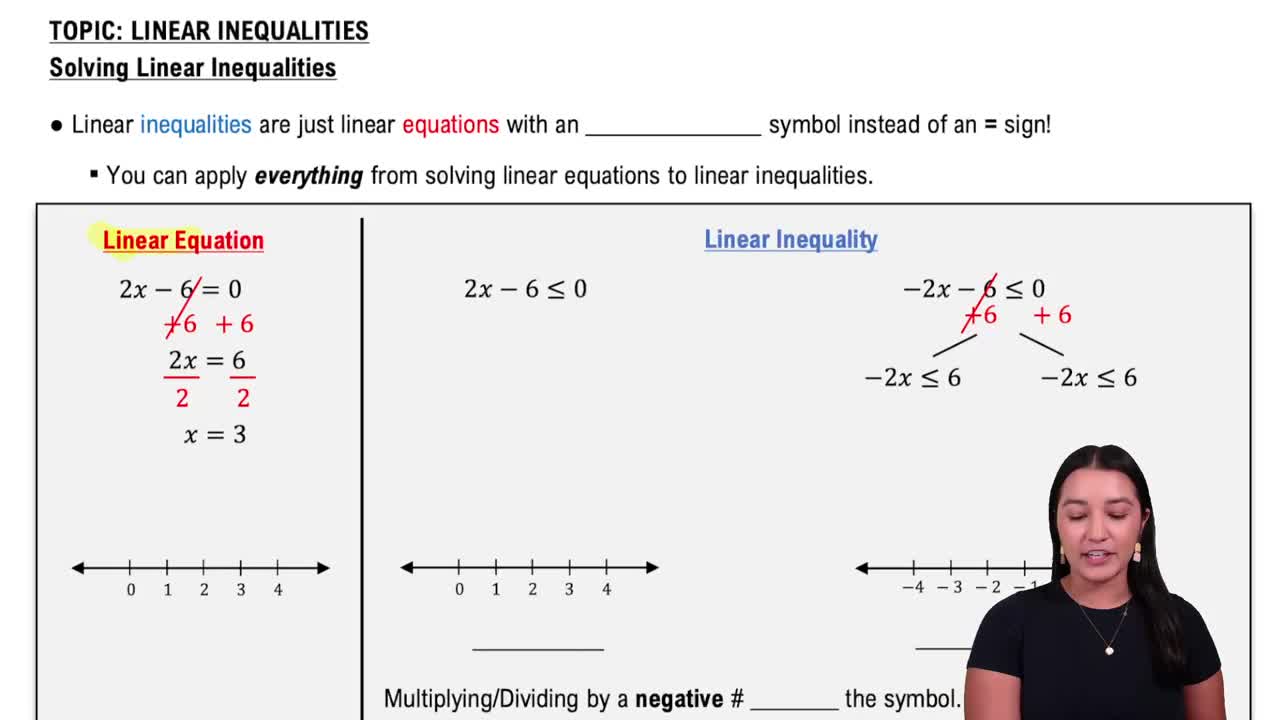
Linear Inequalities

Properties of Absolute Value

The absolute value of any real number is always greater than or equal to zero. This means expressions like |x| < 0 have no solution because absolute values cannot be negative. Recognizing this property helps quickly determine if an inequality has solutions.
추천 영상:
5:36
Change of Base Property

Solving Linear Inequalities

Solving linear inequalities involves isolating the variable and determining the range of values that satisfy the inequality. When combined with absolute values, it requires considering the definition of absolute value and testing possible cases or recognizing impossible conditions.
추천 영상:
06:07
Linear Inequalities