Ch. 1 - Equations and Inequalities
Lial - College Algebra 13th Edition
Lial13th EditionCollege AlgebraISBN: 9780136881063당신이 사용하는 게 아니라요?교과서 변경
2장, 문제 23

Solve each inequality. Give the solution set in interval notation. (1/3)x+(2/5)x-(1/2)(x+3)≤1/10

검증된 단계별 안내
1
First, write down the inequality clearly: \(\frac{1}{3}x + \frac{2}{5}x - \frac{1}{2}(x + 3) \leq \frac{1}{10}\).
Distribute the \(-\frac{1}{2}\) across the terms inside the parentheses: \(-\frac{1}{2} \times x\) and \(-\frac{1}{2} \times 3\) to get \(-\frac{1}{2}x - \frac{3}{2}\).
Combine like terms on the left side: add \(\frac{1}{3}x\), \(\frac{2}{5}x\), and \(-\frac{1}{2}x\) together by finding a common denominator and summing the coefficients.
After combining the \(x\) terms, rewrite the inequality as a linear inequality in the form \(Ax + B \leq C\), where \(A\), \(B\), and \(C\) are constants.
Isolate \(x\) by adding or subtracting constants on both sides and then dividing by the coefficient of \(x\). Remember to reverse the inequality sign if you multiply or divide by a negative number. Finally, express the solution set in interval notation.

비슷한 문제에 대한 검증된 영상 답변:

이 영상 해법은 위 문제에 도움이 된다고 튜터들이 추천한 것입니다.
영상 길이:
4m
도움이 되었나요?

주요 개념

질문에 올바르게 답하기 위해 반드시 이해해야 하는 핵심 개념들은 다음과 같습니다.

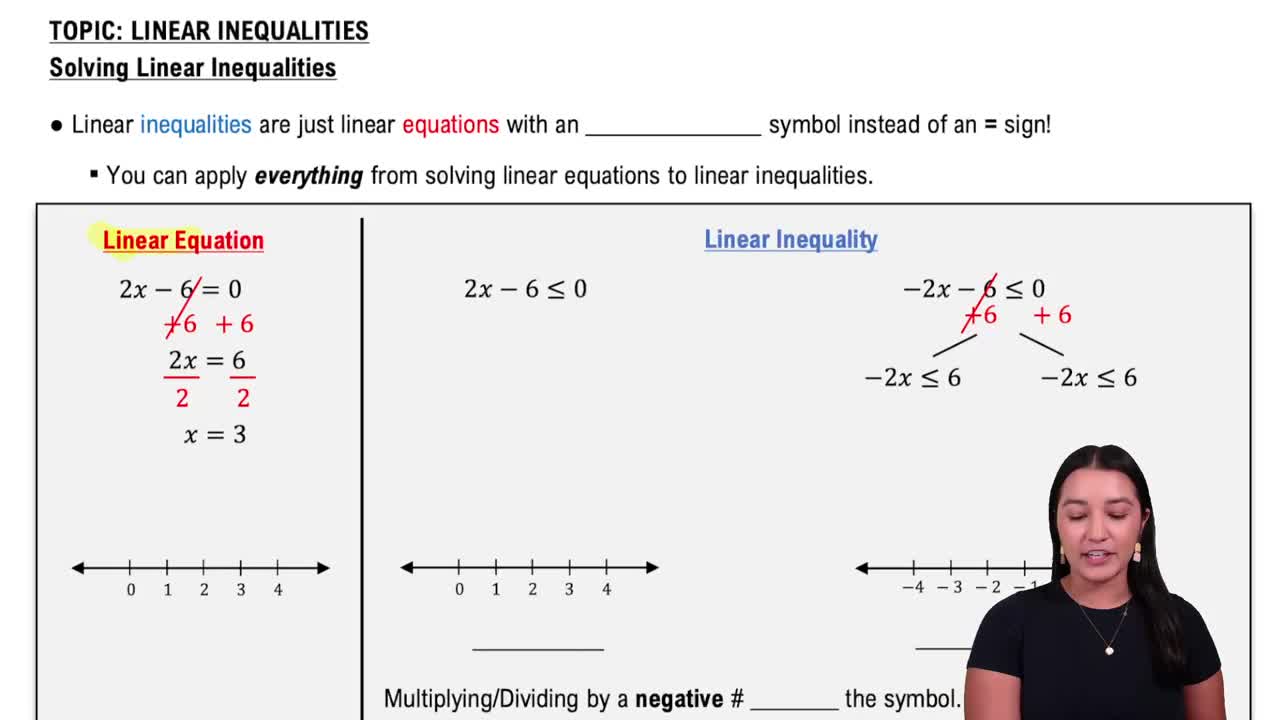
Solving Linear Inequalities

Linear inequalities involve expressions with variables raised to the first power and inequality signs. To solve them, isolate the variable on one side by performing algebraic operations like addition, subtraction, multiplication, or division, while carefully reversing the inequality sign when multiplying or dividing by a negative number.
추천 영상:
06:07
Linear Inequalities

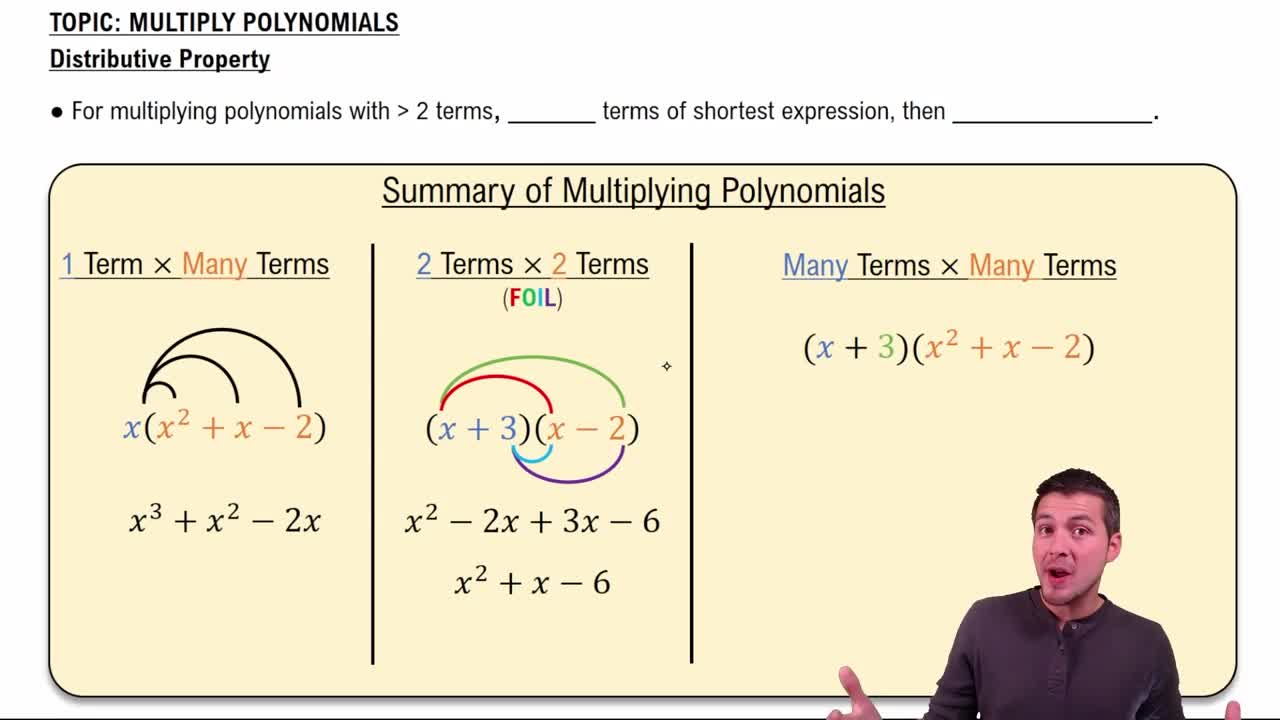
Combining Like Terms and Distributive Property

Combining like terms means adding or subtracting terms with the same variable and exponent. The distributive property allows you to multiply a single term across terms inside parentheses, e.g., a(b + c) = ab + ac. Both are essential for simplifying expressions before solving inequalities.
추천 영상:
가이드 코스
04:15
Multiply Polynomials Using the Distributive Property

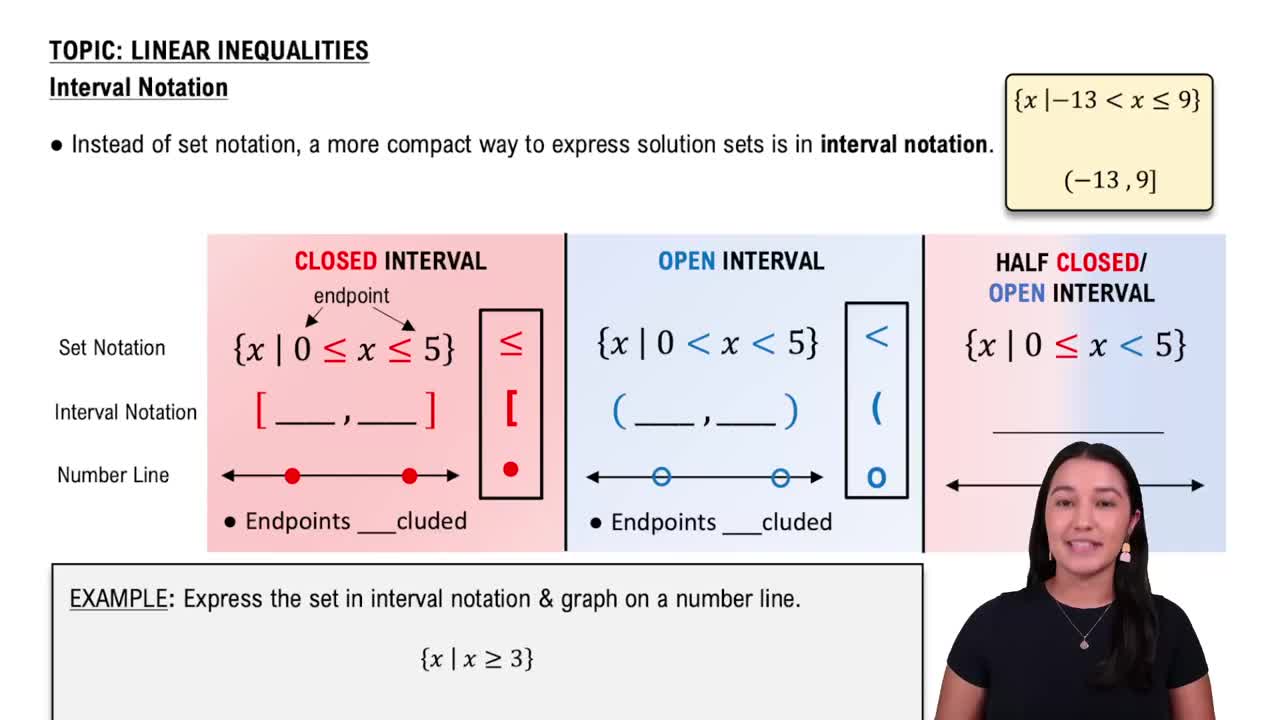
Interval Notation

Interval notation is a concise way to represent solution sets of inequalities using parentheses and brackets. Parentheses indicate that an endpoint is not included, while brackets mean it is included. For example, [a, b) includes a but excludes b, clearly showing the range of values satisfying the inequality.
추천 영상:
05:18
Interval Notation