Use the following facts. If x represents an integer, then x+1 represents the next consecutive integer. If x represents an even integer, then x+2 represents the next consecutive even integer. If x represents an odd integer, then x+2 represents the next consecutive odd integer. The difference of the squares of two positive consecutive odd integers is 32. Find the integers.
Ch. 1 - Equations and Inequalities

2장, 문제 18
Solve each inequality. Give the solution set in interval notation. 6x-(2x+3)≥4x-5
검증된 단계별 안내1
Start by simplifying both sides of the inequality. Distribute the negative sign on the left side: write \(6x - (2x + 3)\) as \(6x - 2x - 3\).
Combine like terms on the left side: \(6x - 2x\) simplifies to \$4x$, so the inequality becomes \(4x - 3 \geq 4x - 5\).
Next, isolate the variable terms on one side by subtracting \$4x$ from both sides: \(4x - 3 - 4x \geq 4x - 5 - 4x\).
Simplify both sides after subtraction: the left side becomes \(-3\) and the right side becomes \(-5\), so the inequality is \(-3 \geq -5\).
Analyze the inequality \(-3 \geq -5\). Since this is a true statement and does not involve \(x\), conclude what this means for the solution set in interval notation.

비슷한 문제에 대한 검증된 영상 답변:
이 영상 해법은 위 문제에 도움이 된다고 튜터들이 추천한 것입니다.
영상 길이:
3m도움이 되었나요?
주요 개념
질문에 올바르게 답하기 위해 반드시 이해해야 하는 핵심 개념들은 다음과 같습니다.
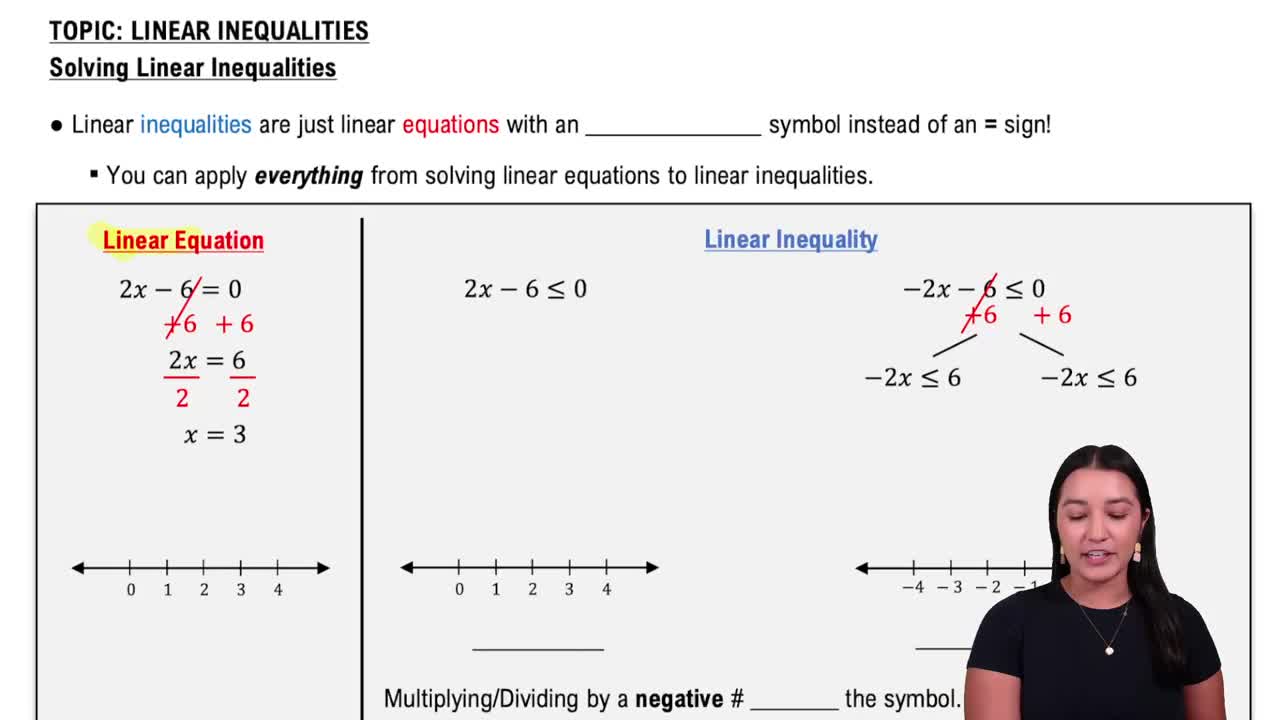
Solving Linear Inequalities
Solving linear inequalities involves isolating the variable on one side to find the range of values that satisfy the inequality. Similar to equations, operations like addition, subtraction, multiplication, and division are used, but special care is needed when multiplying or dividing by negative numbers, as this reverses the inequality sign.
추천 영상:
Linear Inequalities
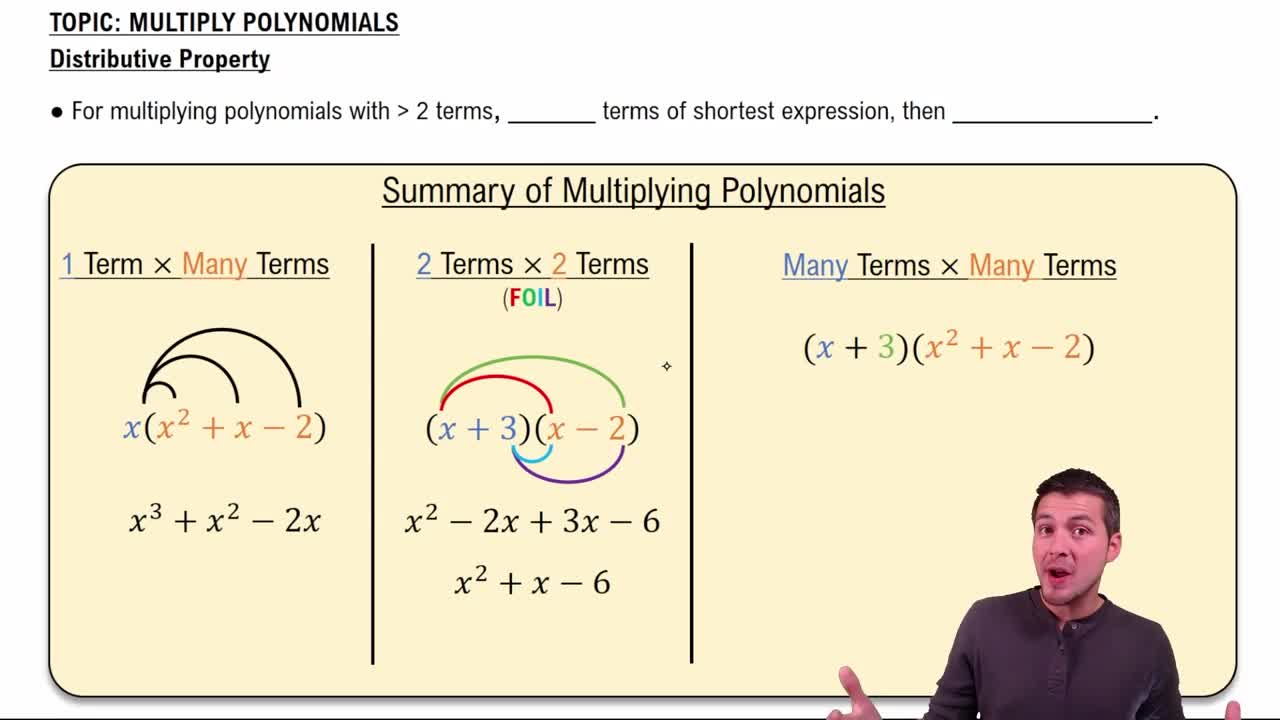
Distributive Property
The distributive property allows you to multiply a single term across terms inside parentheses, such as a(b + c) = ab + ac. Applying this property simplifies expressions and is essential for removing parentheses before solving inequalities or equations.
추천 영상:
가이드 코스
Multiply Polynomials Using the Distributive Property
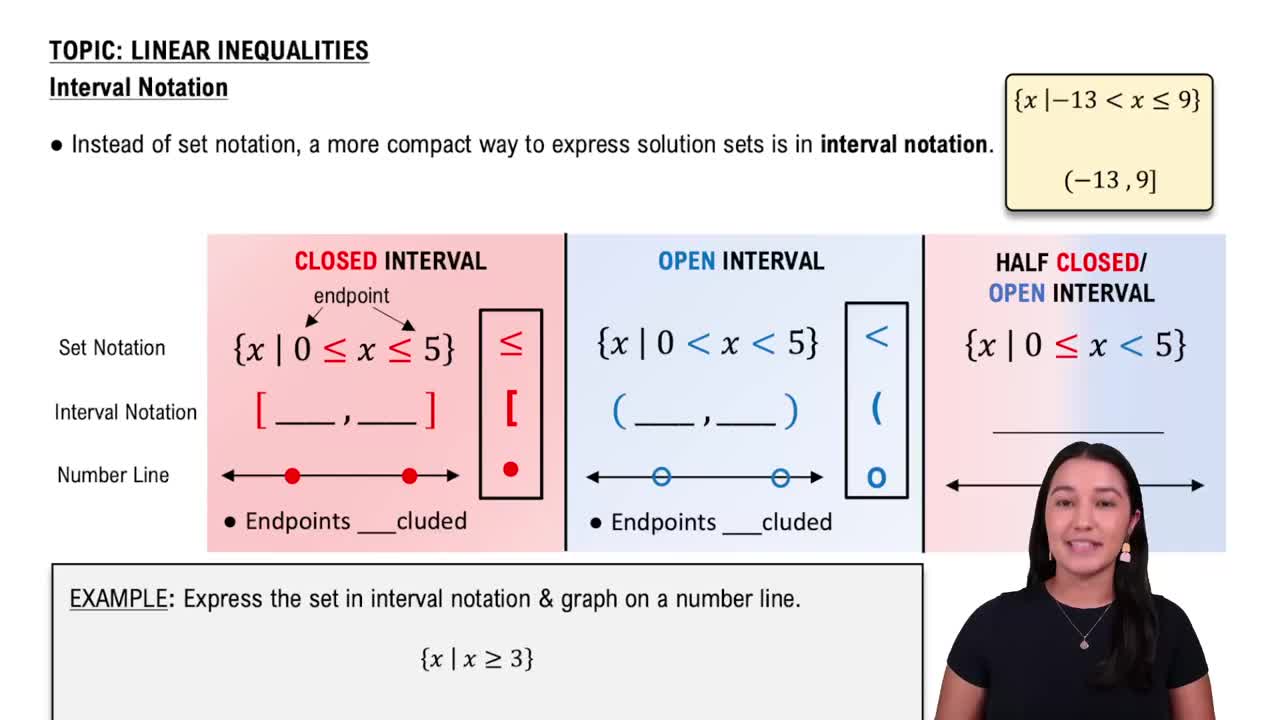
Interval Notation
Interval notation is a concise way to represent solution sets of inequalities using intervals. It uses parentheses for values not included (open intervals) and brackets for values included (closed intervals), clearly showing the range of possible solutions.
추천 영상:
Interval Notation
관련 실천
교과서 질문
841
views
교과서 질문
Identify each number as real, complex, pure imaginary, or nonreal com-plex. (More than one of these descriptions will apply.) √24
976
views
교과서 질문
Solve each equation.
546
views
교과서 질문
Solve each equation using the zero-factor property. -6x2 + 7x = -10
994
views
교과서 질문
Solve each inequality. Give the solution set in interval notation. 8x-3x+2<2(x+7)
1239
views
교과서 질문
Perform each operation. Write answers in standard form. (6-i) + (7-2i)
735
views
