Ch. 1 - Equations and Inequalities
Lial - College Algebra 13th Edition
Lial13th EditionCollege AlgebraISBN: 9780136881063당신이 사용하는 게 아니라요?교과서 변경
2장, 문제 11

Use Choices A–D to answer each question. A. 3x2 - 17x - 6 = 0 B. (2x + 5)2 = 7 C. x2 + x = 12 D. (3x - 1)(x - 7) = 0 Only one of the equations does not require Step 1 of the method for completing the square described in this section. Which one is it? Solve it.

검증된 단계별 안내
1
Step 1: Understand the method of completing the square. The first step usually involves making the coefficient of \(x^2\) equal to 1 by dividing the entire equation by that coefficient if it is not already 1.
Step 2: Examine each equation to see if the coefficient of \(x^2\) is 1. For equation A: \(3x^2 - 17x - 6 = 0\), the coefficient of \(x^2\) is 3, so Step 1 is required.
Step 3: For equation B: \((2x + 5)^2 = 7\), the equation is already a perfect square on the left side, so the coefficient of \(x^2\) is effectively 1 after expansion, and Step 1 is not needed.
Step 4: For equation C: \(x^2 + x = 12\), the coefficient of \(x^2\) is 1, so Step 1 is not needed here either.
Step 5: For equation D: \((3x - 1)(x - 7) = 0\), this is a factored form, not a quadratic in standard form, so completing the square is not the first method to use; instead, solve by setting each factor equal to zero.

비슷한 문제에 대한 검증된 영상 답변:

이 영상 해법은 위 문제에 도움이 된다고 튜터들이 추천한 것입니다.
영상 길이:
3m
도움이 되었나요?

주요 개념

질문에 올바르게 답하기 위해 반드시 이해해야 하는 핵심 개념들은 다음과 같습니다.

Completing the Square Method

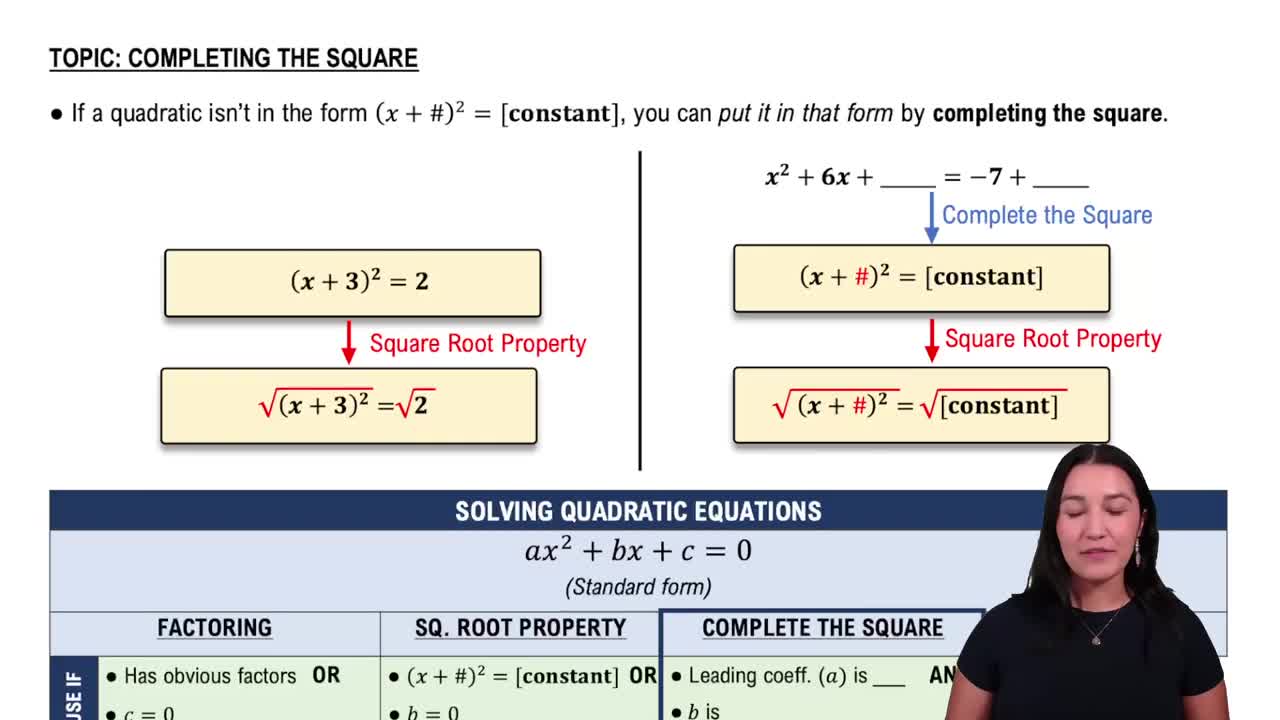
Completing the square is a technique used to solve quadratic equations by transforming them into a perfect square trinomial. This involves isolating the constant term, dividing the coefficient of x by 2, squaring it, and adding it to both sides. It simplifies solving quadratics that are not easily factorable.
추천 영상:
06:24
Solving Quadratic Equations by Completing the Square

Identifying When Completing the Square is Needed

Not all quadratic equations require completing the square. If the equation is already factored or can be solved by simple algebraic manipulation, the initial step of isolating the quadratic and linear terms (Step 1) may be unnecessary. Recognizing these cases saves time and effort.
추천 영상:
06:24
Solving Quadratic Equations by Completing the Square

Solving Quadratic Equations by Factoring

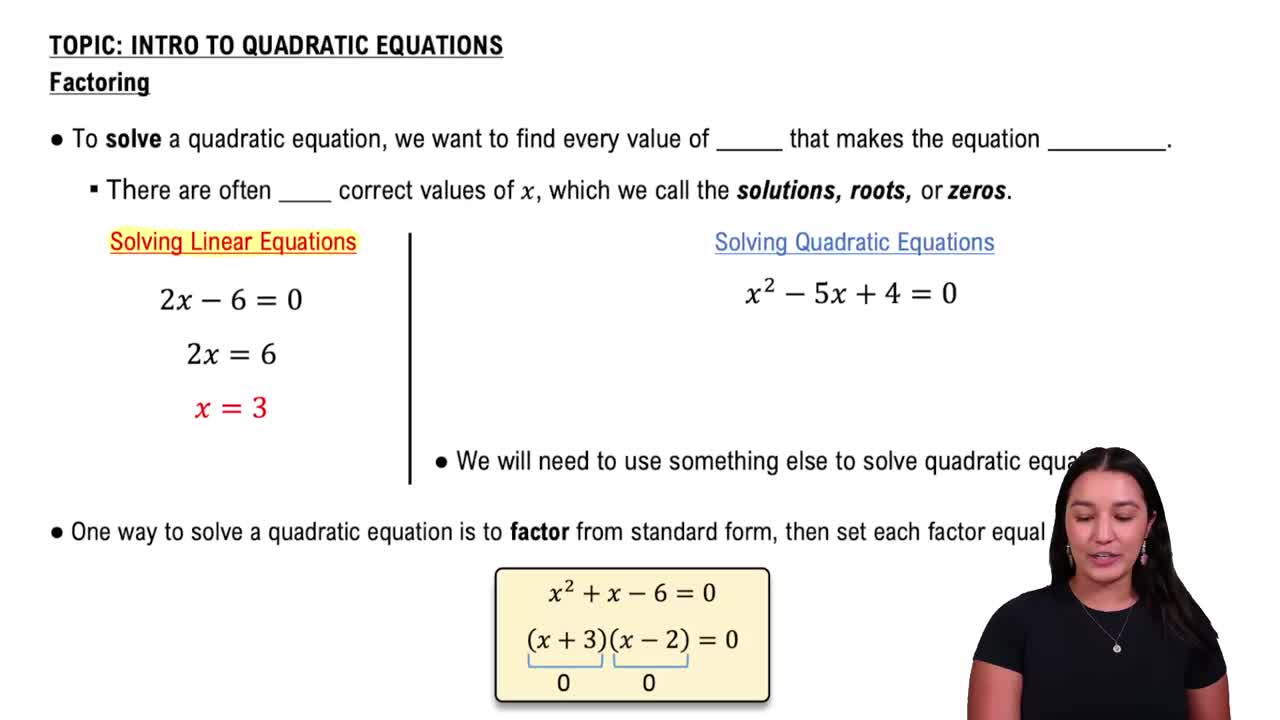
Factoring involves expressing a quadratic equation as a product of binomials set to zero. If the quadratic is already factored, like (3x - 1)(x - 7) = 0, you can directly find the roots by setting each factor equal to zero, bypassing the need for completing the square.
추천 영상:
06:08
Solving Quadratic Equations by Factoring